How do industrial control systems regulate water treatment?




A sudden change in river turbidity, a pump failure during peak demand, or an unexpected shift in pH can complicate a water treatment plant’s day. Operators need to know what is happening across the process and respond before a small deviation becomes a larger operational problem.
Industrial control systems used in water treatment bring together sensors, programmable logic controllers (PLCs), equipment controls, and supervisory software to make that response possible. They measure process conditions, compare them with operating targets, adjust equipment, and alert staff when conditions need attention. Understanding how those pieces work together makes it easier to see both the value and the limits of automation.
What does a control system do in a water treatment plant?
At its core, a control system connects three activities: measuring the process, deciding what action is needed, and carrying out that action. A level sensor in a storage tank, for example, sends a reading to a controller. The controller compares that reading with configured limits and may start a pump, stop it, or change its speed. Operators can see the tank level and equipment status on a screen.
Water treatment involves many connected processes rather than one isolated loop. Changing a flow rate can affect chemical demand, filter loading, storage levels, and downstream pressure. The control system coordinates these activities while allowing operators to supervise the overall plant.
The exact arrangement depends on whether the facility treats drinking water, municipal wastewater, industrial process water, or effluent for reuse. Their treatment goals differ, but the underlying control principles are similar.
From a sensor reading to an equipment response
Consider a simplified chemical dosing process. A flow meter measures the rate of water entering a treatment stage. A PLC uses that information, together with an operator-selected dose or other process measurements, to adjust a dosing pump. If flow rises, the controller may increase the chemical feed; if flow falls, it may reduce it.
The sequence sounds straightforward, but reliable operation depends on each part working correctly:
- Sensors and analyzers measure variables such as flow, pressure, tank level, pH, turbidity, conductivity, dissolved oxygen, or disinfectant residual.
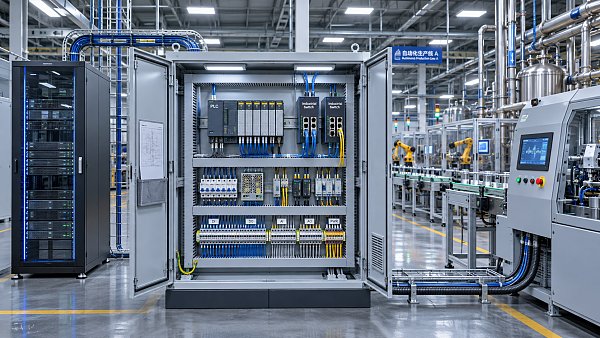
- PLCs or other controllers run programmed logic, compare measurements with setpoints, and issue commands.
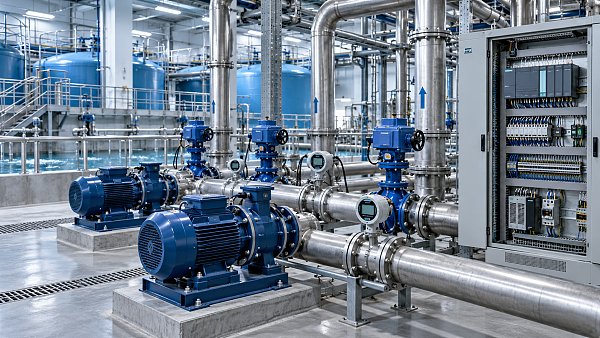
- Final control elements act on those commands. They include pumps, motor drives, valves, blowers, and chemical feed equipment.
- Human-machine interfaces (HMIs) display local process information and allow authorized operators to interact with equipment.
- SCADA software provides broader supervisory visibility, including process displays, alarms, trends, and historical records.
- Industrial networks carry information between field devices, controllers, workstations, and, where appropriate, remote sites.

Some functions must continue even if the SCADA workstation is unavailable. For that reason, essential local control is commonly assigned to PLCs or dedicated controllers, while SCADA supervises and records the process. The actual division of responsibilities should be defined during system design; a screen displaying a value is not, by itself, proof that a protective control is in place.
Where automation influences treatment performance
Intake, pumping, and storage
Water arriving at a plant rarely does so at a perfectly constant rate. Controllers use flow, pressure, and level measurements to coordinate intake pumps and storage tanks. A variable frequency drive can adjust motor speed to match demand, while control logic can alternate pumps to distribute operating hours or bring a standby unit into service when appropriate.
Pressure control is especially important when water is delivered through a distribution or process network. Excessive pressure can stress equipment, while insufficient pressure can disrupt supply. The control strategy must account for pump limits, changing demand, and the physical behavior of the system—not simply hold a number on a screen.
Coagulation and chemical dosing
Many treatment processes use chemicals to adjust pH, support particle removal, disinfect water, or meet other process requirements. Dosing systems may use flow-paced control, analyzer feedback, operator-entered setpoints, or a combination of these methods.
Flow pacing responds to the amount of water being treated, but it does not automatically account for every change in water quality. Feedback from an analyzer may improve control, although measurements can be delayed or affected by sensor condition. Plants therefore need a dosing strategy suited to the chemistry, mixing time, measurement reliability, and consequences of overfeeding or underfeeding.
Filtration and backwashing
As filters capture particles, the resistance to flow typically increases. Operators and control systems may monitor filter run time, flow, head loss, and water quality to determine when a filter needs cleaning. Automated sequences can isolate a filter, initiate backwashing, operate the required pumps and valves, and return the unit to service after the configured steps are complete.
These sequences depend on equipment status and interlocks. A controller should not assume a valve has reached its required position merely because it was commanded to move. Position feedback, permissives, and appropriately designed alarms help identify when the actual process differs from the intended sequence.
Disinfection and final quality monitoring
Disinfection control may involve measuring disinfectant residual, adjusting feed rates, monitoring flow, and recording operating conditions. For drinking water, the required treatment and monitoring approach depends on the process design and applicable local regulations. A residual reading alone does not establish that every disinfection requirement has been met; contact conditions and other treatment criteria can also matter.
Online instruments give operators timely information, but they do not eliminate the need for calibration, maintenance, and laboratory or independent verification where required. A control system is only as useful as the measurements and process assumptions on which it depends.
Wastewater aeration and solids handling
In biological wastewater treatment, dissolved oxygen measurements can guide blower or aeration controls. The aim is to provide the oxygen needed by the biological process without running equipment harder than necessary. The right response depends on factors such as loading, basin conditions, equipment capacity, and the treatment objectives.
Controllers may also manage sludge pumps, thickening equipment, or dewatering sequences. These operations illustrate an important point: water quality is not the only concern. Equipment availability, solids inventories, energy use, and safe maintenance access all influence how well a plant performs.
Automatic control is not the same as unattended operation
Automation can handle routine adjustments more consistently than a person manually changing every valve and pump setting. Operators still interpret unusual conditions, investigate alarms, maintain instruments, and make decisions when the process behaves differently from expectations.
Imagine that an online pH probe begins to drift. The controller may continue adjusting chemical feed in response to the reported value, even though the water chemistry has not changed as indicated. A well-designed system can help reveal the problem through trends, diagnostic alarms, or comparison with another measurement. It cannot make a poorly maintained instrument accurate.
Manual and automatic modes also need clear rules. Operators should understand which devices they can control locally, which commands come from the PLC or SCADA system, and what happens when control is transferred between modes. Procedures for override, restoration, and abnormal operation should be established and tested before an emergency.
Alarms, interlocks, and the importance of trustworthy data
An alarm tells someone that a condition needs attention. An interlock or protective function is designed to prevent or stop a defined action under specified conditions. They serve different purposes: an alarm may warn of a low chemical tank level, while an interlock might stop a dosing pump when the associated process flow is absent, depending on the plant design.
Too many alarms can make it difficult to identify the ones that matter. Useful alarm management assigns clear priorities, defines the expected operator response, and avoids repeated nuisance notifications. Historical trends add context: a slowly rising filter head loss calls for a different investigation from a sudden instrument failure.
Data quality deserves the same attention as the dashboard. When reviewing a process value, operators and engineers need to know:
- Where the measurement is taken and whether it represents the intended process condition.
- How frequently the value is updated and whether communication has been interrupted.
- When the instrument was last calibrated or checked.
- Whether a displayed value is live, substituted, estimated, or retained from an earlier reading.
- Who can change setpoints and whether those changes are recorded.
These details may be less visible than a control-room display, but they determine whether the information can support sound decisions.
What should a plant team consider when evaluating controls?
For an information researcher or early-stage buyer, it is tempting to begin with a list of PLC features or SCADA screens. A more useful starting point is the process: what must be measured, what equipment must respond, and what should happen when a measurement or device fails?
From there, several practical considerations shape the investment:
- Process fit: Match control strategies to the treatment stages, operating range, response times, and water quality requirements. Not every process needs the same level of automation.
- Compatibility: Check interfaces with existing instruments, motor drives, valves, networks, and third-party equipment. Confirm which communication protocols and data points are supported.
- Reliability and recovery: Identify critical components, power dependencies, backup arrangements, and the expected response to a controller, network, or instrument failure.
- Maintainability: Review access to spare parts, diagnostics, configuration tools, documentation, and technical support over the expected life of the installation.
- Operator usability: Screens, alarm messages, and operating modes should make sense to the people responsible for the plant—not just to the commissioning team.
- Lifecycle cost: Include engineering, installation, testing, training, instrument maintenance, software support, and future changes alongside equipment purchase costs.
Cybersecurity is also an operational issue. Remote access can be useful for support, but it introduces exposure that should be controlled. Network segmentation, access permissions, secure remote connections, backups, and a plan for managing updates are among the measures a plant should assess in line with its risk profile and applicable requirements.
Finally, ask how the system will be tested. Factory and site acceptance activities can check whether control sequences, alarms, communications, and failure responses behave as intended. Testing should cover realistic abnormal conditions as well as normal operation, with responsibilities agreed among the plant, integrator, and equipment suppliers.
Choosing the right level of control
A small facility may need dependable local automation and a clear operator interface more than a complex plant-wide analytics platform. A larger or geographically dispersed system may benefit from coordinated SCADA supervision, historical data, and remote visibility. Neither approach is inherently better without understanding the process and the resources available to maintain it.
The value of industrial control systems in water treatment comes from connecting dependable measurement with appropriate action and informed human oversight. When those elements are designed together, plant teams are better placed to manage changing conditions, understand equipment behavior, and maintain control of a process on which people and industries depend.
Related News
 MSHA Issues Mine Truck Safety Alert After One Death and 121 InjuriesMining Infrastructure ExpertMSHA mine truck safety alert reports one death and 121 lost-time injuries. Discover why mine operators should review safety practices.
 How to size a crushing plant for ore processingMining Infrastructure ExpertSize your ore processing equipment crushing plant with confidence. Learn how to calculate throughput, assess ore characteristics, and prevent bottlenecks.
 Trump Administration Rewrites Mining Policy to Spur Critical Minerals DevelopmentMining Infrastructure ExpertU.S. critical minerals mining policy is changing. Explore what faster approvals could mean for investment, equipment demand and supply chains.
 How IEC 62443 defines security zones for industrial communication systemsRobotics EngineerExplore industrial communication systems and IEC 62443: learn how security zones, conduits, and risk-based controls help protect plant operations.
 China-Peru Trade Agreement Upgrade Takes Effect, Easing Machinery CertificationConstruction Equipment SpecialistThe China-Peru trade agreement upgrade simplifies machinery certification. Discover what mutual recognition could mean for exporters entering Peru.
 How do industrial control systems regulate water treatment?Robotics EngineerDiscover how industrial control systems in water treatment use sensors, PLCs, and SCADA to regulate processes and help operators respond to changing conditions.
 Exotec Report: 25% of Supply Chain Leaders Regret Warehouse Automation DecisionsRobotics EngineerWarehouse automation regret affects 25% of surveyed supply chain leaders, according to Exotec. Explore the cost, contract and readiness risks before investing.
 How to set maintenance intervals for mining equipment in AustraliaMining Infrastructure ExpertMining equipment maintenance Australia: Learn how to set service intervals using operating hours, site conditions and equipment data to reduce downtime.
 EY Survey Ranks Complexity as Mining's Top Risk for 2027Mining Infrastructure ExpertMining risk in 2027 is led by complexity, EY's survey finds. Discover how aging mines, declining ore grades and supply chain pressures are reshaping the industry.
 Can asset lifecycle management automation reduce equipment downtime?IEG Heavy Machinery & Automation AnalystDiscover how asset lifecycle management automation can reduce equipment downtime through timely maintenance, faster repairs, and smarter service workflows.
 Caterpillar Q3 2026 Revenue Rises 17% to $20.7 Billion as Both Equipment Segments GrowConstruction Equipment SpecialistCaterpillar Q3 2026 revenue reportedly rose 17% to $20.7 billion. Explore equipment segment growth and what it could mean for procurement planning.
 How to choose a rugged industrial control panel for wet environmentsRobotics EngineerChoose a rugged industrial control panel for wet environments. Compare IP ratings, materials, seals, and condensation control to improve reliability.