EU Crane Safety Standard Update Takes Effect Aug. 1




On August 1, 2026, CEN put the revised EN 13001-3-1:2026 into force, tightening structural safety requirements for industrial cranes through stronger fatigue analysis and limit state verification for metal structures. This matters immediately to companies involved in exporting tower cranes, bridge cranes, and gantry cranes to the EU, as well as to importers responsible for CE compliance checks, because the update directly affects certification documents needed for market access and customs handling.
What Has Changed in the Compliance Baseline
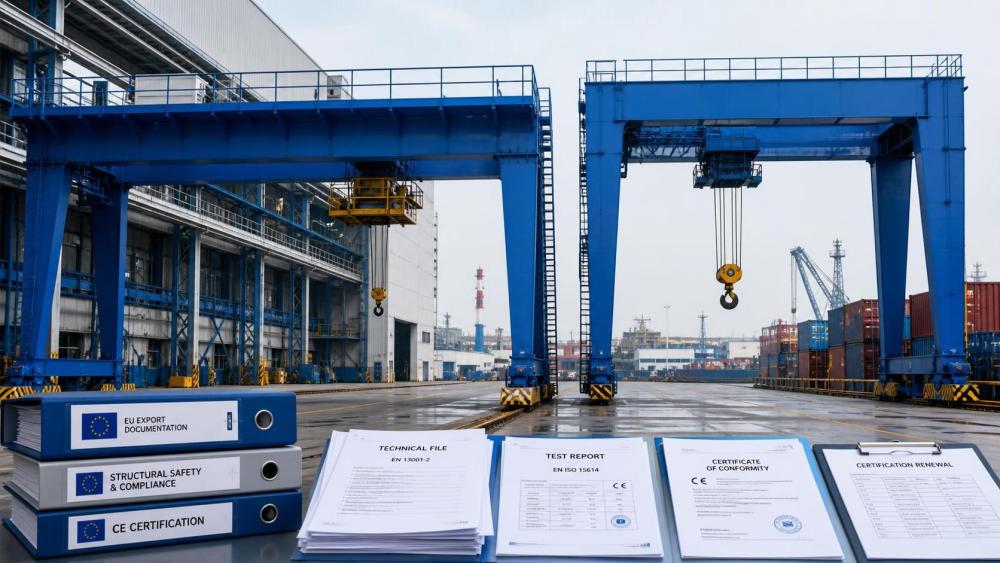
The confirmed change is that the revised EN 13001-3-1:2026 became mandatory on August 1, 2026. According to the provided information, the revision strengthens requirements related to fatigue analysis and limit state verification for industrial crane metal structures. The change directly affects the CE compliance path for tower cranes, bridge cranes, and gantry cranes exported from China to the EU.
The same information also makes clear that importers need to verify whether suppliers can provide type test reports and structural calculation documents aligned with the revised standard. Where certification has not been updated, the stated risks include customs clearance delays or a ban on placing products on the market.
Where the Immediate Pressure Falls
Export transactions tied to EU market entry
From an industry perspective, exporters shipping covered crane categories to the EU may be affected first because the revised standard is linked to the CE compliance route. The most exposed business stages are pre-shipment documentation, technical file preparation, and buyer-facing compliance confirmation.
Importer due diligence and document verification
EU importers are also directly exposed because the provided information states that they must confirm whether suppliers hold updated type test reports and structural calculation documents. The practical pressure is likely to appear in supplier screening, order approval, and customs-facing document review.
Manufacturers serving the EU-bound crane segment
For manufacturers producing tower cranes, bridge cranes, and gantry cranes for EU delivery, the main issue is whether existing structural documentation matches the revised standard. What deserves closer attention is the link between technical calculations and commercial delivery schedules, since a document gap can affect shipment timing or downstream acceptance.
Supply chain and trade service participants
Analysis shows that service providers involved in customs handling, compliance coordination, and delivery execution may also see operational impact. Their exposure is less about the standard itself and more about whether updated certification materials are complete when goods move across the border.
What Companies Should Check Now
Whether current certification materials match EN 13001-3-1:2026
The first practical issue is document validity under the revised version. Companies handling affected crane categories should focus on whether the type test report and structural calculation file presented in a transaction are aligned with EN 13001-3-1:2026 rather than an earlier basis.
Whether supplier confirmations are specific enough
Analysis shows that a general statement of compliance may not address the issue described in this update. The more relevant point is whether suppliers can provide documentation that clearly corresponds to the revised standard and can support importer review.
How compliance timing affects delivery commitments
Observably, the distinction between a policy signal and operational implementation matters here. The standard is already in force, but the business consequence appears in shipment preparation, customs handling, and market placement. Companies should therefore pay close attention to order timing, document readiness, and communication with EU-side counterparties.
How to prepare for transaction-side questions
For sales, procurement, and compliance teams, the immediate task is to align internal and external communication around the revised requirements. The practical focus is not broad management language, but whether each shipment can be supported by the specific technical documents identified in the provided information.
Why This Looks Like More Than a Routine Update
As an editorial observation, this development is better understood as an active compliance change rather than a distant policy signal. The reason is straightforward: the revised standard is already mandatory, and the stated consequences of not updating certification are concrete, namely customs delays or market restrictions.
At the same time, it is more appropriate to understand this as a targeted structural compliance issue, not as a full industry conclusion about all crane trade conditions. The current signal is strongest for products and transactions that rely directly on the affected CE pathway.
How the Market Is Likely to Read It
From an industry perspective, the significance of this update lies in its effect on access readiness rather than in any newly stated market expansion or contraction. For companies dealing in the covered crane categories, the immediate question is whether technical files and certification records have caught up with the revised EN 13001-3-1:2026 requirements.
Current observation suggests this should be treated as a near-term compliance priority with possible longer-term implications for supplier qualification and document control. It does not by itself define the whole market outlook, but it does set a clearer threshold for continued EU-facing business under the affected standard.
Basis of This Article
This article is based on the user-provided news title, event date, and event summary concerning the mandatory implementation of the revised EN 13001-3-1 standard on August 1, 2026. In this type of industry update, relevant source categories would typically include official notices, standard-setting organization documents, company disclosures, industry association releases, and authoritative media reporting.
No specific official source link was provided in the input, so the exact underlying document path still requires follow-up verification. Areas that remain worth tracking include any further official wording related to implementation, as well as market-side handling of type test reports and structural calculation documents under the revised compliance requirement.
Related News
 How crane jib length affects lifting capacity at different radiiHeavy Lifting Systems AnalystCrane jib length affects lifting capacity as radius increases. Learn how to read load charts, assess lift geometry, and select the right crane configuration safely.
 How to match construction equipment to Middle East heat and dust conditionsConstruction Equipment SpecialistConstruction equipment Middle East guide: match cooling, filtration, hydraulics, and local service support to heat and dust for reliable uptime.
 What is driving consolidation in the global equipment supplier market?IEG Heavy Machinery & Automation AnalystGlobal equipment supplier market consolidation is accelerating through technology, service, and supply-chain demands. Discover how buyers can capture value while managing risk.
 When does capital equipment investment pay back in manufacturing?IEG Heavy Machinery & Automation AnalystCapital equipment investment manufacturing: learn when equipment truly pays back by evaluating full costs, cash flow, ramp-up, operational risks, and lifecycle value.
 When does a distribution center need an automated pallet handling system?Heavy Lifting Systems AnalystPallet handling systems help distribution centers overcome labor shortages, bottlenecks, safety risks, and storage constraints. Discover the key signs it’s time to automate.
 How to build a machinery investment plan around payback periodIEG Heavy Machinery & Automation AnalystMachinery investment planning manufacturing guide: build a credible payback plan with full costs, ramp-up assumptions, lifecycle risks, and scenario-based cash benefits.
 What to Ask a Bulk Material Dust Control Supplier Before Ordering a SystemHeavy Lifting Systems AnalystBulk material dust control supplier checklist: learn the critical questions on airflow, containment, filtration, installation, and performance before ordering your system.
 Is a Cobot Palletizer Worth It for High-Mix, Low-Volume Production Lines?Robotics EngineerCobot palletizer ROI: discover whether flexible automation delivers value for high-mix, low-volume lines. Compare costs, changeovers, labor, and integration factors.
 Calculating Palletizing ROI: Labor Savings, Throughput Gains, and Payback RisksIEG Heavy Machinery & Automation AnalystROI of palletizing: learn how to calculate labor savings, throughput gains, installed costs, and payback risks for a stronger automation investment case.
 How to Specify a Modular Packaging Line for Fast Changeovers and Scalable OutputRobotics EngineerModular packaging line specification guide: achieve faster changeovers, scalable output, reliable controls, and lower lifecycle costs with practical planning.
 How industrial IoT devices reduce unplanned downtime in factoriesRobotics EngineerIndustrial IoT devices help factories detect early equipment issues, plan maintenance, and reduce costly unplanned downtime before production is disrupted.
 What is driving industrial machinery market demand in manufacturing?IEG Heavy Machinery & Automation AnalystIndustrial machinery market manufacturing demand is rising as factories pursue automation, energy efficiency, resilient supply chains, and lifecycle productivity gains.