How Often Should Bulldozer Undercarriage Components Be Replaced?




Bulldozer undercarriage components should be replaced when measured wear reaches the limits specified for that machine, or when damage makes continued operation unsafe or likely to cause further failures. Operating hours help schedule inspections and forecast expenditure, but they cannot establish a reliable replacement interval on their own. Track chains, shoes, rollers, idlers, and sprockets wear at different rates, so a single “replace every X hours” rule can lead to both premature spending and overdue repairs.
For fleet managers, the useful question is how much service remains before a component needs intervention—and whether that intervention can fit into a planned shutdown. Answering it requires repeatable measurements, an understanding of working conditions, and a repair plan that accounts for interacting wear surfaces. A bulldozer approaching a wear limit on abrasive ground needs a different maintenance response from one with stable measurements working in less demanding material.
Use hours to plan inspections, and wear limits to authorize replacement
A quoted undercarriage lifespan is meaningful only when the machine configuration, ground conditions, operating practices, and maintenance history are comparable. Even two bulldozers of the same model can reach replacement condition at different hours. One may spend much of its shift pushing through abrasive material; another may accumulate substantial idle time between short working cycles.
Total machine hours also hide the history of individual parts. A replacement roller may be relatively new while the track chain is approaching its service limit. Record installation hours for major components and retain their measurement history. Otherwise, an apparent “undercarriage age” can obscure the parts most likely to interrupt production.
The manufacturer's wear charts and service instructions provide the basis for decisions. Depending on the component, assessment may involve dimensions, track pitch, wear profiles, clearances, leakage, or structural condition. Measurements must correspond to the correct undercarriage design and part configuration; a limit taken from a similar-looking component may produce the wrong decision.
Keep three maintenance decisions separate:
- Inspection: Check condition frequently enough to detect changing wear, leakage, damage, and adjustment problems.
- Service or repair: Correct a condition that is reducing life or function, such as improper track tension, loose hardware, or a repairable component fault.
- Replacement: Remove a component that has reached its applicable limit or cannot safely and economically remain in service.
Replacement is therefore a condition-based event within a scheduled maintenance program. Calendar dates and operating hours organize the work; inspection findings determine its scope.
What tells you each component is due?
The undercarriage works as a system, but its parts do not necessarily need replacement together. Examine each component, then assess whether its condition will affect the remaining parts.
Track chains, pins, and bushings
Track-chain assessment includes link wear and, where applicable, internal pin-and-bushing wear expressed through increased track pitch. External bushing wear also matters because the bushings engage with the sprocket. These are distinct wear mechanisms, and a satisfactory measurement in one area does not establish that the chain is healthy overall.
Use the manufacturer's specified measurement method, including the required track condition and measuring locations. Increased pitch, damaged bushings, dry or seized joints, and uneven link wear deserve attention before they develop into poor engagement or additional damage. On sealed and lubricated designs, loss of lubricant can change the deterioration rate even when external wear looks manageable.
Some track designs permit a pin-and-bushing turn or another approved service intervention. That opportunity depends on construction and condition. Waiting until the chain is heavily worn may eliminate it, while assuming every track assembly can be turned can produce an unsuitable repair plan.
Track shoes and attachment hardware
Shoe replacement depends on more than remaining grouser height. Cracks, bending, worn mounting areas, and damaged or repeatedly loosening fasteners may require action even when traction remains acceptable. Evaluate whether the shoe can continue carrying its intended loads and whether its attachment to the link is sound.
Reduced traction can justify replacement before a structural limit is reached, particularly when slipping materially affects productivity. However, poor traction alone does not prove that the shoes are worn out. Ground conditions and shoe configuration also influence performance. Check those factors before purchasing a complete shoe set.
Rollers and idlers
Roller and idler inspections should combine dimensional checks with observations of leakage, rotation, tread wear, and alignment. A seized roller or a component losing lubricant requires prompt assessment, even if its outside diameter remains within a wear limit. Conversely, visible surface wear does not automatically justify replacement if measurements and function remain acceptable.
Uneven wear across rollers or between the two sides of the machine can indicate operating patterns, alignment problems, or another fault. Replacing the visibly affected part without investigating the cause can leave the new component exposed to the same damage.
Sprockets and segments
Sprocket condition must be considered alongside chain pitch and bushing wear. Tooth-profile deterioration can affect engagement, while a worn chain can impose unfavorable contact on replacement sprockets. Use the applicable wear guidance rather than deciding solely from whether the teeth look pointed.
During a track-chain replacement, assess sprockets or segments for compatibility with the new chain. The correct repair scope depends on the measured condition and the manufacturer's guidance. Replacing only the chain can be a poor economy if the retained mating surfaces shorten its useful life.
Build an inspection schedule around the job
Start with the inspection and service intervals in the machine's operation and maintenance documentation. Then shorten condition-check intervals where the operating environment or observed wear rate warrants it. A practical program combines operator observations, scheduled measurements, and additional checks triggered by changes in behavior.
At routine pre-shift checks, operators should look for loose or missing hardware, damaged shoes, leaks, packed material, and an obvious change in track sag. Unusual noise, vibration, pulling to one side, or a track repeatedly losing adjustment should enter the maintenance record. These observations help identify problems between formal wear surveys.
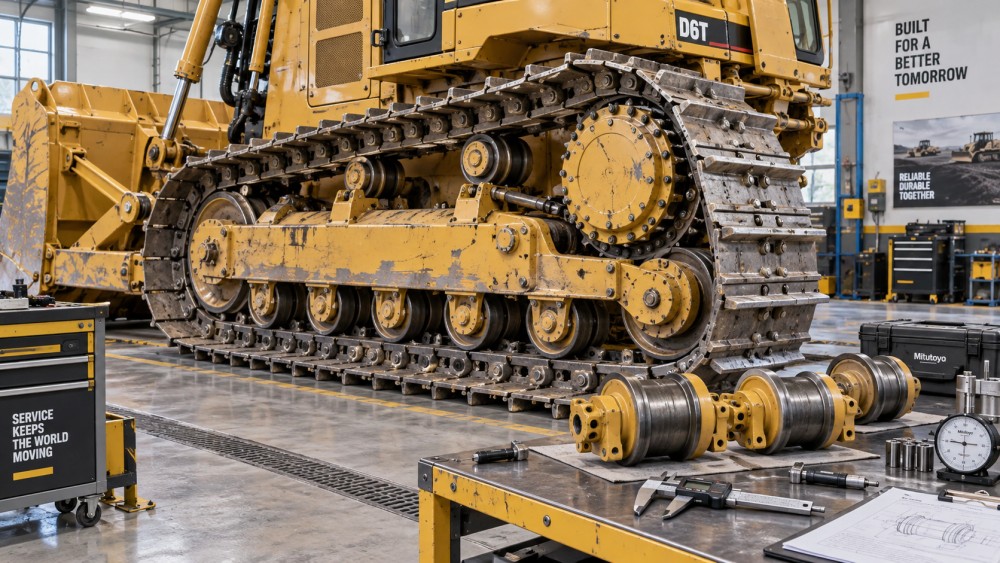
Formal inspections should use consistent measuring points and methods, with readings recorded by component and machine side. Take an initial set of measurements when equipment enters the fleet or after major undercarriage work. Without that baseline, subsequent readings reveal current condition but provide little evidence of how quickly it is changing.
Follow the specified shutdown and isolation procedure before close inspection. Track adjustment systems may contain grease under pressure, so adjustment must follow the machine's service procedure.
Several working conditions justify closer monitoring:
- Abrasive material: Sand and abrasive fines can accelerate wear at contact surfaces, particularly when material packs around components.
- Rock and debris: Impact loading can damage shoes, links, and other parts before gradual wear measurements indicate end of life.
- Slopes and repeated turning: Side loading and recurring steering patterns can produce uneven wear.
- Frequent travel: Track movement contributes to wear even when the machine is not pushing material, making travel patterns relevant to the forecast.
Track tension deserves particular attention because it affects loading throughout the undercarriage. Excessive tension increases component loads; insufficient tension can contribute to poor engagement or derailment risk. Set it using the specified method for the machine and working conditions. Repeated adjustment should prompt investigation of wear, packing, or a mechanical fault.
A major change in assignment should trigger a review of the inspection interval. A wear trend established on one site may no longer be useful after the bulldozer moves into more abrasive material or begins substantially more travel. Preserve the earlier records, but establish the new trend through closer initial checks.
Turn measurements into a replacement window
A single inspection answers whether a component is acceptable today. Repeated inspections help estimate when it will require intervention. Record operating hours, measurements, the applicable limit, and relevant changes in duty for each survey. Photographs can support the record, especially for uneven wear or damage, but they do not replace dimensional measurements.
Where deterioration is reasonably consistent, estimate remaining hours by dividing the remaining allowable dimensional change by the observed rate of change. For example, if a component has 3 millimeters of allowable wear remaining and comparable inspections indicate a loss of 1 millimeter per 200 operating hours, a simple projection gives 600 hours to the limit. This is an illustrative calculation, not a service-life specification.
That projection needs judgment. Wear may accelerate, measurement uncertainty may be significant, and structural damage can invalidate the forecast immediately. Where the manufacturer provides wear charts, use them to interpret the readings; percentage wear may not translate directly into the same percentage of remaining operating life.
Schedule the next measurement early enough to test the forecast before the component approaches its limit. As the available margin narrows, increase inspection frequency. A component close to its limit on a remote site may need replacement at the next planned shutdown because an unplanned intervention would be difficult, even though some measurable life remains.
Procurement timing should follow the same forecast. Work backward from the intended shutdown to allow for confirmed parts availability, transport, workshop capacity, and installation. Starting a purchase only when a component reaches its limit can leave the machine waiting for parts. Ordering too early without reliable measurements can tie up capital in inventory that the fleet will not soon use.
Choose between an individual repair and a broader overhaul
A failed component does not automatically justify replacing the complete undercarriage. If a roller fails while the chain, idlers, and sprockets remain serviceable, an individual replacement may be appropriate. The decision changes when multiple parts are near their limits or when retaining worn mating components would compromise the repair.
For a substantial intervention, request a documented wear assessment and a repair scope that explains which parts require replacement, which can remain, and which need further inspection. Check compatibility against the machine serial number and installed undercarriage configuration. Matching dimensions alone may not establish suitability for the intended assembly.
Compare the options over the machine's remaining assignment. The relevant cost includes parts, labor, transport, downtime, and the likelihood of another shutdown soon afterward. A larger planned repair can make sense when several components are approaching their limits. On a machine nearing retirement, replacing still-serviceable parts may offer little return.
Keep the reason for each replacement in the maintenance record: measured wear, damage, functional failure, or a planned system repair. Those distinctions improve future forecasts and help identify whether operating practices or component faults are driving expenditure. When the next shutdown arrives, the team should have a specific work list supported by condition records—and a clear view of which parts still have useful service remaining.
Related News
 MSHA Issues Mine Truck Safety Alert After One Death and 121 InjuriesMining Infrastructure ExpertMSHA mine truck safety alert reports one death and 121 lost-time injuries. Discover why mine operators should review safety practices.
 How to size a crushing plant for ore processingMining Infrastructure ExpertSize your ore processing equipment crushing plant with confidence. Learn how to calculate throughput, assess ore characteristics, and prevent bottlenecks.
 Trump Administration Rewrites Mining Policy to Spur Critical Minerals DevelopmentMining Infrastructure ExpertU.S. critical minerals mining policy is changing. Explore what faster approvals could mean for investment, equipment demand and supply chains.
 How IEC 62443 defines security zones for industrial communication systemsRobotics EngineerExplore industrial communication systems and IEC 62443: learn how security zones, conduits, and risk-based controls help protect plant operations.
 China-Peru Trade Agreement Upgrade Takes Effect, Easing Machinery CertificationConstruction Equipment SpecialistThe China-Peru trade agreement upgrade simplifies machinery certification. Discover what mutual recognition could mean for exporters entering Peru.
 How do industrial control systems regulate water treatment?Robotics EngineerDiscover how industrial control systems in water treatment use sensors, PLCs, and SCADA to regulate processes and help operators respond to changing conditions.
 Exotec Report: 25% of Supply Chain Leaders Regret Warehouse Automation DecisionsRobotics EngineerWarehouse automation regret affects 25% of surveyed supply chain leaders, according to Exotec. Explore the cost, contract and readiness risks before investing.
 How to set maintenance intervals for mining equipment in AustraliaMining Infrastructure ExpertMining equipment maintenance Australia: Learn how to set service intervals using operating hours, site conditions and equipment data to reduce downtime.
 EY Survey Ranks Complexity as Mining's Top Risk for 2027Mining Infrastructure ExpertMining risk in 2027 is led by complexity, EY's survey finds. Discover how aging mines, declining ore grades and supply chain pressures are reshaping the industry.
 Can asset lifecycle management automation reduce equipment downtime?IEG Heavy Machinery & Automation AnalystDiscover how asset lifecycle management automation can reduce equipment downtime through timely maintenance, faster repairs, and smarter service workflows.
 Caterpillar Q3 2026 Revenue Rises 17% to $20.7 Billion as Both Equipment Segments GrowConstruction Equipment SpecialistCaterpillar Q3 2026 revenue reportedly rose 17% to $20.7 billion. Explore equipment segment growth and what it could mean for procurement planning.
 How to choose a rugged industrial control panel for wet environmentsRobotics EngineerChoose a rugged industrial control panel for wet environments. Compare IP ratings, materials, seals, and condensation control to improve reliability.