How manufacturing execution systems reschedule work after downtime




How manufacturing execution systems reschedule work after downtime
When a machine goes down, restoring production requires more than moving delayed jobs to the next available slot. Effective manufacturing execution systems scheduling must account for equipment availability, material readiness, labor skills, process dependencies, and delivery priorities. Depending on system capabilities, the MES may resequence work directly or coordinate with an advanced planning and scheduling engine. For technical evaluators, the critical question is how reliably these changes translate into executable shop-floor instructions.
The difficult part is rarely drawing a new schedule. It is deciding what can genuinely move, what must remain locked, and whether the revised plan still matches conditions on the floor. A recovery plan that sends an urgent order to an unqualified machine is not recovery; it is another production problem waiting to happen.
A stop signal is not yet a scheduling decision
Downtime detection may begin with a PLC status change, an equipment alarm, a missed cycle signal, or an operator entry. These inputs describe different things. A missing heartbeat can indicate a communications failure rather than a stopped machine. An alarm may require attention without preventing production. Even a confirmed stop does not establish when the equipment will be available again.
The MES needs a usable equipment state, not simply a collection of alarms. A practical implementation separates the observed event, the production consequence, and the recovery estimate. Event timestamps and equipment identifiers must remain consistent across control systems, the MES, and maintenance software. Otherwise, delayed messages can make a recovered machine appear unavailable again.
Short interruptions may justify holding the current sequence rather than rebuilding it. Longer or uncertain outages may trigger local resequencing, while a failed bottleneck may require broader replanning. The threshold depends on process buffers, setup effort, and delivery exposure. Recalculating the entire plant schedule after every brief stop can create more disruption than the original event.
Where repair duration is unknown, the system should preserve that uncertainty. Maintenance estimates can support scenario planning, but they should not silently become firm availability commitments. A machine expected back during the shift is different from one cleared for production.
Rebuild the constraint picture before moving orders
After confirming the interruption, the MES must establish the status of the affected operation. Was it not started, partly complete, or finished but awaiting inspection? Can the remaining quantity move independently? Does the interrupted process require rework, a restart, or disposition by quality personnel? These answers determine what the scheduler is allowed to change.
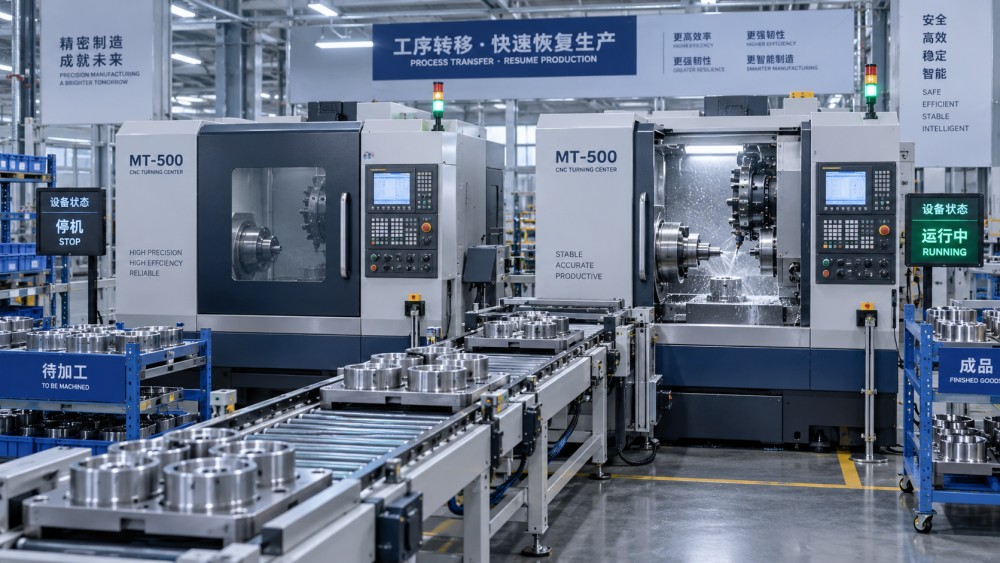
Consider a hypothetical machining cell producing components for equipment assembly. One CNC machine fails midway through an order, while another appears to have spare capacity. Moving the remaining work may be feasible, but only if the alternative has the required travel, tooling, fixtures, approved program, and process capability. The transferred parts may also need an additional setup or first-piece inspection. Nominal capacity alone is not enough.
Material availability is equally easy to misread. Stock recorded in an enterprise resource planning system may be reserved, physically inaccessible, or under a quality hold. A recovery schedule should use material that can actually reach the operation, including transfer time where it matters. Labor checks need similar detail: the presence of an operator does not establish qualification for a particular process.
Finite-capacity scheduling should also include shared resources. Two available machines may depend on the same crane, inspection station, fixture, or technician. If those dependencies are missing from the model, the revised schedule can double-book a resource while appearing feasible.
Process industry constraints can be less flexible still. An interrupted batch may have holding-time limits, temperature requirements, or restrictions on transfer between vessels. The scheduler must respect the approved process route rather than treat every unfinished operation as interchangeable work.
Where the MES stops and an APS engine takes over
Manufacturing execution systems scheduling covers a wide range of capabilities. Some products maintain dispatch lists and apply priority rules. Others offer detailed finite-capacity scheduling. In another architecture, the MES supplies actual production conditions to an advanced planning and scheduling system, which returns a revised plan. These arrangements should not be treated as equivalent.
A dispatch rule can select the next eligible job using due date, priority, or setup family. That may be adequate when the disturbance is local and routes are simple. It does not necessarily evaluate the downstream effect of delaying another order. An APS engine may examine a wider horizon and more constraints, but its result is only as trustworthy as the data and rules it receives.
ISA-95, also published through the IEC 62264 series, provides a useful framework for enterprise-control integration and manufacturing operations management. It helps structure discussions about responsibilities and information exchange. It does not prescribe a universal downtime-rescheduling algorithm, nor does referencing it establish that a product can generate a feasible recovery plan.
Similarly, OPC UA can support equipment data exchange, but connectivity does not automatically establish scheduling meaning. Integrators still need to agree on equipment states, resource identifiers, timestamps, and how estimated availability is represented. The decisive question is whether both sides interpret an update the same way.
A typical recovery information flow is:
Confirmed downtime → updated operation and resource states → feasible recovery options → approved schedule version → shop-floor dispatch → execution feedback.
Choose the recovery objective deliberately
There is no single best rescheduling objective. Protecting the earliest delivery dates may increase changeovers. Keeping a bottleneck busy may build inventory that downstream operations cannot consume. Minimizing schedule changes may leave an urgent customer order late. The system needs an explicit policy for resolving these conflicts.
A useful distinction is between hard constraints and preferences. Equipment qualification, process precedence, and mandatory quality holds should not be relaxed merely because an order is urgent. Due-date protection, setup reduction, and load balancing can be weighted objectives, subject to the plant’s operating rules.
Suppose a failed machine feeds an assembly line. Prioritizing its oldest queued order may look reasonable, yet another order may contain the only missing component for an otherwise complete assembly kit. Where material pegging or order dependency data is available, the scheduler can evaluate that relationship instead of relying on queue age alone.
Schedule stability deserves its own protection. Started operations, staged materials, and committed setups often belong inside a frozen or controlled-change window. Without one, repeated recalculation can send operators conflicting instructions and leave material handlers chasing obsolete priorities. A good recovery plan changes enough to address the outage, not everything the solver happens to improve.
Release instructions that the floor can execute
A revised schedule is not operational until the correct people and systems receive it. The release should identify the affected operations, assigned resources, sequence, quantities, and any changed setup or routing requirements. Superseded instructions must be withdrawn or clearly marked, particularly where operators use printed travelers alongside digital terminals.
Approval can be automatic for low-risk changes and manual for exceptions, depending on site policy. Reordering unstarted jobs on the same qualified machine is different from changing a route, authorizing overtime, or transferring partially processed material. The approval path should reflect that difference rather than force every adjustment through the same workflow.
Version control matters here. If an APS calculation used an earlier production snapshot, an operation may have started before the revised plan returns. The MES should reconcile the proposed plan with current execution state and reject conflicting changes. Resent messages should not create duplicate work, and a failed interface should leave users with a clear last-approved schedule.
Equipment return also needs controlled handling. Repair completion may precede inspection, calibration, warm-up, or trial production. The scheduler should restore capacity according to the actual release state and any temporary restrictions. It should not assume immediate full-rate production because a maintenance task has closed.
Test the recovery chain, not just the scheduling screen
A meaningful technical evaluation uses representative routes and deliberately awkward interruptions. A polished demonstration with unlimited alternative capacity reveals little about performance under real constraints. Ask the supplier to demonstrate the following conditions:
- A bottleneck fails with partially completed work and no confirmed repair time.
- An alternative machine is free, but its required fixture or qualified operator is unavailable.
- An urgent order competes with a committed setup inside the frozen scheduling window.
- A material hold arrives after calculation but before schedule release.
- The MES–APS connection fails, recovers, and resends an earlier message.
For each test, inspect the rejected options as well as the selected plan. The system should explain which constraint prevented a move, what changed, and who approved the release. Measure event-to-dispatch time separately from calculation time: fast optimization is of limited use when operators receive stale instructions.
This fits Industrial Edge Global’s broader equipment-lifecycle perspective: production software should be assessed alongside machine compatibility, maintenance readiness, and operating constraints, not as an isolated feature purchase. If a proposed recovery depends on an alternative asset, verify that asset’s actual capability and support requirements before assigning value to the scheduling function.
The strongest acceptance test is straightforward: introduce a realistic outage, let conditions change while replanning is underway, and follow the resulting instructions onto the floor. If the system preserves process restrictions, explains its decisions, and prevents stale work from being released, it is demonstrating recovery capability—not merely a rearranged chart.
Related News
 MSHA Issues Mine Truck Safety Alert After One Death and 121 InjuriesMining Infrastructure ExpertMSHA mine truck safety alert reports one death and 121 lost-time injuries. Discover why mine operators should review safety practices.
 How to size a crushing plant for ore processingMining Infrastructure ExpertSize your ore processing equipment crushing plant with confidence. Learn how to calculate throughput, assess ore characteristics, and prevent bottlenecks.
 Trump Administration Rewrites Mining Policy to Spur Critical Minerals DevelopmentMining Infrastructure ExpertU.S. critical minerals mining policy is changing. Explore what faster approvals could mean for investment, equipment demand and supply chains.
 How IEC 62443 defines security zones for industrial communication systemsRobotics EngineerExplore industrial communication systems and IEC 62443: learn how security zones, conduits, and risk-based controls help protect plant operations.
 China-Peru Trade Agreement Upgrade Takes Effect, Easing Machinery CertificationConstruction Equipment SpecialistThe China-Peru trade agreement upgrade simplifies machinery certification. Discover what mutual recognition could mean for exporters entering Peru.
 How do industrial control systems regulate water treatment?Robotics EngineerDiscover how industrial control systems in water treatment use sensors, PLCs, and SCADA to regulate processes and help operators respond to changing conditions.
 Exotec Report: 25% of Supply Chain Leaders Regret Warehouse Automation DecisionsRobotics EngineerWarehouse automation regret affects 25% of surveyed supply chain leaders, according to Exotec. Explore the cost, contract and readiness risks before investing.
 How to set maintenance intervals for mining equipment in AustraliaMining Infrastructure ExpertMining equipment maintenance Australia: Learn how to set service intervals using operating hours, site conditions and equipment data to reduce downtime.
 EY Survey Ranks Complexity as Mining's Top Risk for 2027Mining Infrastructure ExpertMining risk in 2027 is led by complexity, EY's survey finds. Discover how aging mines, declining ore grades and supply chain pressures are reshaping the industry.
 Can asset lifecycle management automation reduce equipment downtime?IEG Heavy Machinery & Automation AnalystDiscover how asset lifecycle management automation can reduce equipment downtime through timely maintenance, faster repairs, and smarter service workflows.
 Caterpillar Q3 2026 Revenue Rises 17% to $20.7 Billion as Both Equipment Segments GrowConstruction Equipment SpecialistCaterpillar Q3 2026 revenue reportedly rose 17% to $20.7 billion. Explore equipment segment growth and what it could mean for procurement planning.
 How to choose a rugged industrial control panel for wet environmentsRobotics EngineerChoose a rugged industrial control panel for wet environments. Compare IP ratings, materials, seals, and condensation control to improve reliability.