What Annual Inspection Requirements Apply to Construction Cranes?




Construction cranes covered by U.S. OSHA’s construction crane rules must receive an annual comprehensive inspection by a qualified person at least every 12 months. The inspection must cover the equipment’s condition and include functional testing to establish that it performs as intended. Findings must be documented, and the annual inspection record must be retained for at least 12 months. Safety hazards identified during the inspection must be corrected before the affected equipment returns to service.
That requirement does not replace shift inspections, monthly inspections, or inspections triggered by assembly, repairs, modifications, or severe service. The applicable schedule also reflects manufacturer instructions, crane type, and jurisdiction. An annual inspection report therefore establishes one part of compliance; it does not authorize unrestricted operation for the following year.
Establish which requirements apply to the crane
The principal federal reference is 29 CFR 1926.1412, within OSHA’s construction rules for cranes and derricks. Its annual comprehensive inspection provisions apply to equipment covered by that subpart. Mobile cranes, crawler cranes, and tower cranes commonly fall within this framework when used in covered construction activities, although equipment-specific provisions also matter.
Start with the equipment’s classification and actual work. A machine’s commercial name alone does not determine its regulatory treatment. Equipment used for construction lifting can be governed differently from equipment operating in a manufacturing facility, and some equipment categories have exclusions or special provisions. Overhead and gantry cranes require particular attention to the provisions applicable to their installation and use.
Location also changes the compliance review. State-plan requirements and local rules must be considered where applicable. Outside the United States, an examination regime might use different intervals, inspector qualifications, or reporting requirements. A U.S. annual inspection report should not automatically be treated as satisfying another country’s requirements.
Manufacturer procedures remain part of the inspection basis. Under OSHA’s inspection framework, manufacturer procedures that are more comprehensive or prescribe more frequent inspections must be followed. A manufacturer’s service manual cannot be used to lengthen an applicable regulatory inspection interval.
Keep the annual inspection separate from other inspection intervals
The annual requirement establishes a maximum interval between comprehensive inspections. Scheduling by calendar year alone can create a gap longer than 12 months: an inspection early in one year followed by an inspection late in the next year would exceed the permitted interval.
A competent person must be able to identify existing and predictable hazards and have authority to take prompt corrective measures. A qualified person must possess the knowledge, training, experience, or recognized qualifications needed to resolve problems related to the work. These are distinct requirements, even when one individual meets both.
Current annual paperwork cannot compensate for missing monthly inspections or an unresolved defect found during a shift. Conversely, a series of monthly visual inspections does not provide the depth required for the annual comprehensive examination.
Select an inspector whose qualifications match the equipment
OSHA requires a qualified person for the annual inspection; the federal provision does not impose a universal requirement to hire an independent inspection company. An appropriately qualified employee can perform the work. A third-party inspector is also an option, particularly where local rules, contracts, or available technical expertise support that choice.
Qualifications must fit the inspection. Experience with one crane type does not automatically establish competence with another crane’s structural arrangement, control system, or manufacturer-specific procedures. Operator certification alone does not establish that someone is qualified to perform an annual comprehensive inspection.
The inspection assignment should identify the crane model, attachments, configuration, manuals, and relevant service history. If the work requires specialized examination, such as nondestructive testing of a suspected crack, the personnel performing and interpreting that examination need qualifications appropriate to the method. A general inspection credential does not establish expertise in every diagnostic technique.
Define the examination before taking the crane out of service
The annual inspection includes the items covered by the shift inspection and additional components specified in OSHA’s annual provisions. Its scope reaches beyond visible damage: wear, alignment, connection integrity, fluid-system condition, and operating performance all require attention.
Prepare access to the crane’s identification, current load charts, operating and maintenance manuals, previous inspection findings, and repair records. Record the installed boom, jib, counterweight arrangement, hook blocks, and other relevant attachments. This makes it possible to connect the report to the equipment actually examined and identify components that were absent.
Organizing the work around component groups helps expose gaps in the examination:
- Structure and connections: Crane members, welds, pins, bolts, and locking devices require examination for conditions such as deformation, cracking, corrosion, looseness, and wear. A distorted boom section requires assessment against applicable criteria, rather than acceptance because the crane still moves normally.
- Hoisting and rotating machinery: Shafts, gears, bearings, brakes, locking devices, drums, and sheaves need attention to wear, alignment, secure mounting, and operating condition.
- Hydraulic and pneumatic systems: Hoses, fittings, pumps, motors, valves, and cylinders must be examined for the conditions specified by the inspection requirements. Leakage at a cylinder seal and damage to a load-holding circuit have different implications and need separate evaluation.
- Supporting equipment: Outriggers, stabilizers, travel components, tires where fitted, and associated structures affect the crane’s ability to support and control loads.
- Controls and protective devices: Functional testing must establish that the equipment performs as intended. The inspection must address applicable controls, safety devices, and operational aids using the relevant procedures.
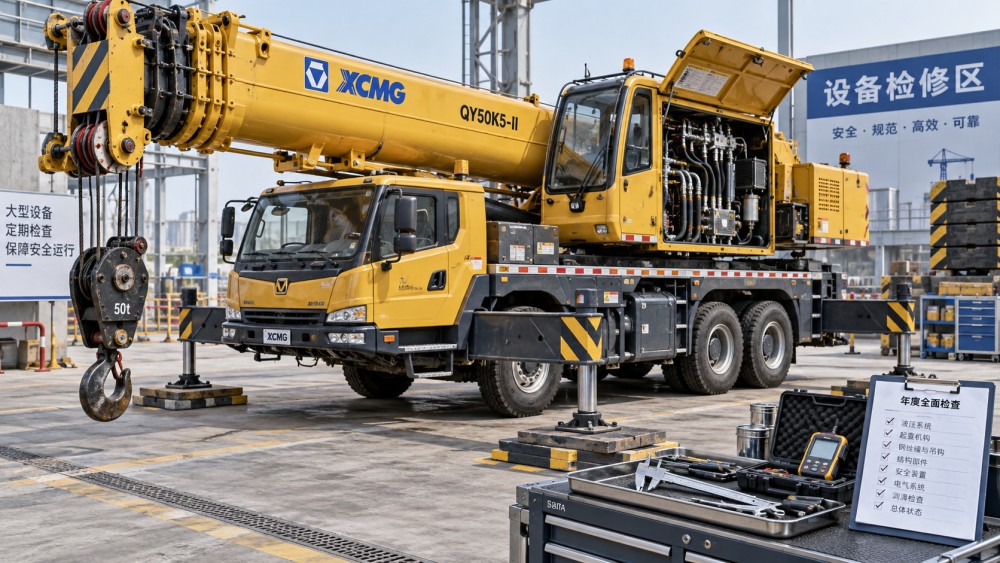
Disassembly must be performed as necessary to complete the annual inspection. An exterior walkaround cannot establish the condition of a concealed component that requires access. OSHA provides limited treatment for circumstances where disassembly is not required or inspection is deferred; such exceptions must meet the rule’s conditions. Convenience alone does not justify omitting an inaccessible item.
Record access limitations explicitly. “No defects observed” is misleading when a component was never examined. The report should distinguish completed inspection work from any permissible deferred work and explain the basis for that treatment.
Include wire rope under its specific inspection provisions
Wire rope has separate requirements under 29 CFR 1926.1413. The annual comprehensive rope inspection must be performed by a qualified person and cover the rope’s surface along its length, subject to the rule’s specific provisions concerning inaccessible portions.
Particular attention belongs at areas associated with deterioration: reverse bends, drum crossover and repetitive pickup points, sections near terminal ends, and portions passing over sheaves. Broken wires, diameter reduction, corrosion, crushing, kinking, and heat damage require assessment against applicable criteria.
Do not apply one generic broken-wire limit to every rope. Rope construction, function, manufacturer criteria, and the relevant regulatory provisions affect the evaluation. A replacement rope must also match the crane’s required specification; matching nominal diameter alone is insufficient.
Determine whether load testing is actually required
OSHA’s annual comprehensive inspection requires functional testing, but it does not establish a universal annual proof-load test for every construction crane. Treating these as interchangeable can lead either to unnecessary testing or to an incomplete inspection.
Functional testing establishes whether the equipment operates as intended. A proof-load test follows a defined procedure involving a specified test load. Whether such testing is required must be determined from the applicable equipment provisions, manufacturer instructions, local requirements, and the circumstances of repairs or modifications.
Where a load test is required, its procedure must address configuration, radius, supporting conditions, test load, and acceptance criteria. Lifting an arbitrary heavy object does not create a valid test record. A successful lift also does not establish that every structural component or concealed mechanism is free of defects.
Turn inspection findings into an operating decision
Under the annual inspection provisions, the qualified person must determine whether an identified deficiency constitutes a safety hazard. Equipment with such a hazard must be taken out of service until corrected, except where specific alternative measures are permitted by the applicable rules.
A deficiency that is not presently a safety hazard still needs a clear disposition. When the qualified person determines that it requires monitoring, OSHA requires monthly inspections to monitor it. The finding should identify the component, condition, and basis for evaluation so that subsequent inspections can recognize deterioration.
Useful documentation separates observation from judgment. “Wear present” does little to support follow-up. Identifying the location, measured condition where relevant, applicable acceptance criterion, and required action makes the record usable. Photographs can support the finding, but do not replace the evaluation.
After repair, determine which inspection provisions apply before releasing the crane. Work affecting safe operation can trigger a qualified-person inspection under OSHA’s repair or adjustment provisions. An earlier annual inspection cannot establish the condition of a newly repaired component.
Maintain a record that connects the report to the crane
The required annual documentation includes the items checked, inspection results, and the name and signature of the person conducting the inspection. Retain it for at least 12 months. Equipment identification, inspection date, configuration, supporting measurements, and repair references make that minimum record substantially more useful.
A sticker marked “annual inspection complete” does not contain the required inspection detail. Likewise, a report listing only “pass” without identifying the items checked provides little evidence of the examination’s scope. Any unresolved findings must remain visible alongside the inspection status.
For rental equipment, match the report to the machine’s serial number and supplied attachments. A report for the base crane does not establish the condition of a different jib or hook block delivered later. Inspection status, component identity, and repair history should remain traceable when equipment moves between projects.
Account for events that change the inspection schedule
An annual inspection date does not control every inspection trigger. Assembly, modifications, repairs affecting safe operation, and severe service can create separate requirements. Shock loading, contact with an obstruction, or suspected structural damage warrants evaluation under the applicable provisions rather than waiting for the next annual appointment.
OSHA also addresses equipment that has been idle for three months or more, requiring inspection before initial use under its specified framework. Tower cranes have additional equipment-specific provisions, so a generic mobile-crane inspection form should not be assumed to cover the complete scope.
Plan the annual examination early enough to allow access, specialist testing where needed, repairs, and the required verification before the next scheduled lift. If a defect requires replacement parts, the operating decision follows the defect’s safety significance. A delivery delay does not extend the inspection interval or justify continued operation with an unresolved safety hazard.
Related News
 MSHA Issues Mine Truck Safety Alert After One Death and 121 InjuriesMining Infrastructure ExpertMSHA mine truck safety alert reports one death and 121 lost-time injuries. Discover why mine operators should review safety practices.
 How to size a crushing plant for ore processingMining Infrastructure ExpertSize your ore processing equipment crushing plant with confidence. Learn how to calculate throughput, assess ore characteristics, and prevent bottlenecks.
 Trump Administration Rewrites Mining Policy to Spur Critical Minerals DevelopmentMining Infrastructure ExpertU.S. critical minerals mining policy is changing. Explore what faster approvals could mean for investment, equipment demand and supply chains.
 How IEC 62443 defines security zones for industrial communication systemsRobotics EngineerExplore industrial communication systems and IEC 62443: learn how security zones, conduits, and risk-based controls help protect plant operations.
 China-Peru Trade Agreement Upgrade Takes Effect, Easing Machinery CertificationConstruction Equipment SpecialistThe China-Peru trade agreement upgrade simplifies machinery certification. Discover what mutual recognition could mean for exporters entering Peru.
 How do industrial control systems regulate water treatment?Robotics EngineerDiscover how industrial control systems in water treatment use sensors, PLCs, and SCADA to regulate processes and help operators respond to changing conditions.
 Exotec Report: 25% of Supply Chain Leaders Regret Warehouse Automation DecisionsRobotics EngineerWarehouse automation regret affects 25% of surveyed supply chain leaders, according to Exotec. Explore the cost, contract and readiness risks before investing.
 How to set maintenance intervals for mining equipment in AustraliaMining Infrastructure ExpertMining equipment maintenance Australia: Learn how to set service intervals using operating hours, site conditions and equipment data to reduce downtime.
 EY Survey Ranks Complexity as Mining's Top Risk for 2027Mining Infrastructure ExpertMining risk in 2027 is led by complexity, EY's survey finds. Discover how aging mines, declining ore grades and supply chain pressures are reshaping the industry.
 Can asset lifecycle management automation reduce equipment downtime?IEG Heavy Machinery & Automation AnalystDiscover how asset lifecycle management automation can reduce equipment downtime through timely maintenance, faster repairs, and smarter service workflows.
 Caterpillar Q3 2026 Revenue Rises 17% to $20.7 Billion as Both Equipment Segments GrowConstruction Equipment SpecialistCaterpillar Q3 2026 revenue reportedly rose 17% to $20.7 billion. Explore equipment segment growth and what it could mean for procurement planning.
 How to choose a rugged industrial control panel for wet environmentsRobotics EngineerChoose a rugged industrial control panel for wet environments. Compare IP ratings, materials, seals, and condensation control to improve reliability.