How multi-deck vibrating screens improve material separation accuracy




Multi-deck vibrating screens improve material separation accuracy by performing several size cuts in sequence within one screening machine. That advantage is real, but it is often misunderstood. Adding decks does not automatically produce cleaner fractions. Accuracy improves only when the screen is configured so that each deck receives a manageable particle-size distribution, sufficient opportunity for stratification, and an aperture that matches the required separation point.
The practical value lies in controlling the path from feed to product. A correctly designed three-deck screen, for example, can remove oversize, produce one or two controlled intermediate fractions, and separate fines in a single pass. A poorly specified unit can create persistent near-size contamination, overload lower decks, blind screen media, and make downstream crushers, washers, classifiers, or conveyors operate outside their intended range.
Accuracy is determined by probability, not by aperture alone
Every particle approaching a screen opening has a probability of passing. That probability depends on whether the particle reaches the screen surface, presents its smallest effective dimension to the opening, and encounters an unobstructed aperture. Multi-deck vibrating screens raise the total number of useful separation opportunities by distributing material across several screening surfaces and by dividing the feed into progressively narrower size ranges.
This is especially important near the cut size. Particles substantially smaller than an opening generally pass readily; particles substantially larger are retained. The difficult material is the near-size fraction, whose dimensions sit close to the aperture. A nominally 10 mm particle may behave differently depending on its shape, moisture content, orientation, and whether it is carried within a dense layer of larger particles. Screen performance should therefore be assessed by the percentage of undersize recovered through a deck and the percentage of oversize retained, not simply by the stated mesh or panel opening.
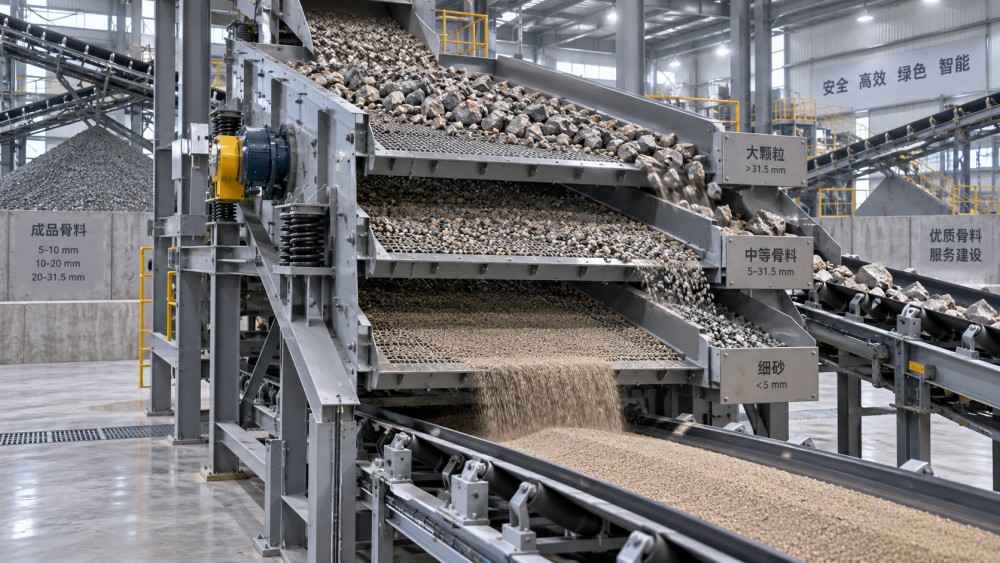
In a multi-deck arrangement, the upper deck normally removes the largest material and reduces the burden presented to lower decks. The next deck receives a feed that is already narrower in top size. This allows the lower deck to work on a more controlled particle population rather than attempting to separate fines beneath a thick bed containing large stones, scrap, lumps, or agglomerates. The result can be sharper separation boundaries and more consistent product gradations.
What each deck contributes to the separation process
The decks in a vibrating screen are not independent layers. Their performance is linked by feed preparation, deck order, open area, vibration characteristics, and discharge conditions. An upper deck that retains excessive material may starve downstream equipment or overload the oversize discharge. Conversely, an upper deck with openings that are too large may pass too much coarse material downward, reducing the effectiveness of the finer decks.
A common configuration uses decreasing aperture sizes from top to bottom. Feed enters at the upper end of the screen box. Large particles are discharged from the top deck, while smaller particles pass to successively lower decks until they either pass through a selected aperture or leave the final deck as the finest oversize fraction. This arrangement enables multiple saleable or process-specific products to be generated from one feed stream.
- Top deck: protects lower decks from coarse loading, removes oversize, and establishes the initial bed depth.
- Intermediate deck or decks: make the principal commercial or process cuts, often where product specification is most sensitive.
- Bottom deck: separates the finest target fraction, removes fines from a coarser product, or prepares material for washing, classification, filtration, or further processing.
The lower deck is usually the most vulnerable to poor upstream decisions. It has the smallest apertures, may have less effective screening area because of support structures, and receives material that can include moisture, clay, fibers, flakes, or particles prone to pegging. A specification that focuses only on total machine area can miss this limitation. Effective area on each deck, not the overall footprint, is what determines whether each cut can be achieved at the required feed rate.
Stratification is the mechanism behind cleaner fractions
Vibration causes a material bed to loosen, convey, and stratify. Smaller particles migrate toward the screen surface, while larger particles remain closer to the top of the bed. This movement is essential because a fine particle cannot pass through an opening while trapped above a dense layer of coarser material.
Multi-deck screens support accuracy when their motion gives each deck enough time and amplitude to establish stratification without carrying material across the surface too quickly. If conveying velocity is excessive, particles leave the deck before sufficient fine material reaches the apertures. If movement is too slow, bed depth can build up, capacity falls, and material may accumulate around openings. Neither condition is corrected simply by installing a finer screen panel.
Stroke, frequency, vibration angle, and screen inclination work together. Longer stroke can improve the movement of coarse or difficult material, but may be too aggressive for fragile particles or fine separations. Higher frequency can improve the number of opportunities for fine particles to pass, provided the screen body and media are suited to that operating regime. Inclination influences conveying speed and residence time. Horizontal or low-angle arrangements can offer extended screening time for difficult fine separations, while inclined screens are often effective where throughput and rapid material transport are priorities.
Motion type also matters. Circular, elliptical, and linear vibration patterns distribute energy differently across the deck. The appropriate motion depends on particle size, bulk density, feed moisture, required cut point, and whether the material is prone to stratify or to form a compacted bed. It is not technically sound to treat one motion pattern as universally more accurate than another.
Deck spacing and feed distribution can limit a nominally correct design
Deck spacing is often treated as a mechanical packaging issue, but it affects separation performance and maintainability. Insufficient clearance can restrict the movement of retained material, make screen media replacement difficult, and increase the chance of buildup beneath upper decks. Excessive spacing increases machine height and may complicate support steel, chute design, access platforms, and plant layout. The necessary clearance depends on the largest retained particles, expected bed depth, screen panel profile, and the clearance required for inspection and maintenance.
Feed distribution is equally important. Material should enter in a manner that spreads across the usable deck width early enough to use the available area. A narrow central stream can overload one section while outer areas remain underused. Uneven distribution produces uneven wear, local blinding, and inconsistent fraction quality. It can also create misleading performance data: a screen may appear to have enough installed area while only part of that area is doing meaningful separation work.
Feed boxes, feed chutes, and impact zones should be evaluated together with the screen. High-impact feed can damage media and disturb the bed before screening begins. In some duties, a short blank section before the first apertures is useful because it allows the feed to settle and distribute before it reaches active screening area. The value of such a section depends on the feed condition; it reduces immediate impact loading but also reduces nominal open screening length.
Screen media selection changes both capacity and precision
Screen media is not merely a wear component. Aperture geometry, open area, wire or ligament thickness, panel stiffness, surface finish, and anti-blinding features all influence separation. Woven wire mesh can provide high open area and precise apertures for many dry screening duties. Polyurethane or rubber panels can offer longer wear life and lower noise in abrasive applications, but their lower open area may require more deck area or a lower feed rate to achieve the same cut efficiency. Perforated plate is robust for coarse duty but often has less open area than woven media.
The right selection depends on what is limiting the process. Where capacity is constrained and material is dry, free-flowing, and not highly abrasive, high-open-area media may be beneficial. Where wear, noise, impact, or particle degradation is the main concern, modular elastomeric panels may offer a better lifecycle balance. For damp, sticky, fibrous, or irregular materials, self-cleaning wire, flexible elements, or other anti-blinding designs can keep apertures active, although their aperture control and wear behavior must still be evaluated against the product requirement.
Nominal aperture is not always equivalent to effective cut size. Worn wire can enlarge openings. Plugged or blinded media reduces active open area. Elongated slots can behave differently depending on particle orientation and material shape. In recycled materials, flakes and flat particles may pass an opening that a more equant particle of similar nominal size would not. A screen specification should therefore define the required product size distribution and allowable contamination, then confirm that the chosen media geometry can deliver that outcome for the actual particle morphology.
Moisture and particle shape are frequent sources of separation error
Dry, cubical aggregate and damp clay-bearing feed do not respond to the same screen configuration. Moisture creates adhesion between particles and between particles and screen media. Fine material can coat larger particles, forming temporary agglomerates that behave as oversize. It can also adhere directly to apertures, reducing effective open area and causing blinding. A multi-deck screen does not eliminate this problem; lower decks can become particularly sensitive because their openings are smaller.
Particle shape introduces another error source. Flat, elongated, needle-like, and flaky particles have orientation-dependent passage behavior. Their classification may vary with vibration intensity and travel direction. When the downstream process requires a tight size envelope, size screening alone may not be sufficient to control particle shape. The required specification should distinguish between a sieve-based size cut and a broader product-quality requirement involving shape, contamination, or moisture.
Feed variability deserves the same attention as average feed size. A screen sized only against average conditions may lose accuracy when the proportion of fines rises, when crusher settings change, when recycled feed composition shifts, or when moisture increases. Technical evaluation should examine the full expected feed envelope: top size, percentage passing each critical cut, bulk density, moisture condition, abrasive content, clay or organic content, and the likely frequency of abrupt changes.
Capacity and separation accuracy must be balanced deck by deck
A multi-deck vibrating screen can reduce the number of machines in a plant, but compactness should not be confused with unlimited capacity. Each deck has its own screening duty. The deck handling the highest volume, the finest aperture, the greatest near-size fraction, or the most difficult material frequently becomes the controlling point. Adding a third or fourth deck may increase the number of outputs, yet it also adds weight, height, maintenance access requirements, and constraints on the space available between decks.
For this reason, screen selection should start with a deck-by-deck mass balance rather than a single total feed-rate figure. For each deck, establish the feed tonnage, size distribution entering that deck, desired undersize recovery, allowable misplaced material, screen aperture, available area, and expected operating condition. The resulting assessment reveals whether a stated capacity is achievable at the required separation quality.
A useful distinction is between capacity and screening efficiency. Capacity describes the mass rate processed. Efficiency describes how effectively material is separated at a defined cut. A machine can process a high tonnage while producing unacceptable carryover of fines in oversize or oversize contamination in undersize. It can also achieve a clean cut by operating at a feed rate too low for the plant’s throughput target. The required operating point is the one that meets both production and product-quality requirements.
How to evaluate a multi-deck screen beyond brochure specifications
Published dimensions, installed motor power, and nominal deck area are necessary but incomplete inputs. The following questions expose whether the proposed configuration is technically aligned with the duty:
- What is the complete feed gradation at the maximum and minimum expected operating conditions?
- Which deck is expected to make each critical size cut, and what amount of near-size material reaches that deck?
- How much effective screening area remains after feed zones, support bars, panel arrangements, and unusable edge areas are considered?
- What vibration motion, stroke, frequency, and inclination are specified, and can they be adjusted within a safe operating range?
- What media type, aperture geometry, open area, and retention method are proposed for each deck?
- How will moisture, clay, fibers, or flat particles affect blinding, pegging, and particle passage?
- Can operators inspect and replace lower-deck media without extensive removal of upper components?
- What performance acceptance criteria define the required product fractions and permissible contamination?
Acceptance criteria deserve particular attention. “High efficiency” is not a measurable requirement unless it is tied to a feed condition, aperture, sampling method, and mass-based product analysis. Sampling should distinguish the products from each deck and account for changes in feed composition over the test period. A single short-duration sample taken under stable conditions may not represent normal operation, especially where the feed is variable.
Structural and operational factors also affect long-term accuracy. Loose screen panels, damaged support rails, cracked side plates, worn bearings, or changes in vibration amplitude can alter material travel and active aperture area. Excessive vibration transmitted to supporting steel may indicate an isolation or structural issue that should be addressed before it affects alignment and reliability. Maintenance planning is therefore part of separation control, not a separate concern after commissioning.
More decks are useful only when the process needs more controlled cuts
The strongest case for vibrating screens with multiple decks is not simply that they produce more product streams. Their value is the ability to manage particle populations progressively, preserve usable screening area for each cut, and create more repeatable feed conditions for downstream equipment. That can improve crusher protection, reduce recirculating loads, support grading specifications, and stabilize processes that depend on a narrow size range.
There is also a limit. When feed is sticky, extremely fine, highly variable, or dominated by difficult near-size material, adding decks may not solve the underlying separation problem. The better solution may involve feed conditioning, washing, dewatering, different media, altered crushing strategy, additional classification equipment, or a revised product specification. A technically sound screen decision begins with the required separation result and the behavior of the actual material—not with the number of decks available on a catalogue page.
Related News
 MSHA Issues Mine Truck Safety Alert After One Death and 121 InjuriesMining Infrastructure ExpertMSHA mine truck safety alert reports one death and 121 lost-time injuries. Discover why mine operators should review safety practices.
 How to size a crushing plant for ore processingMining Infrastructure ExpertSize your ore processing equipment crushing plant with confidence. Learn how to calculate throughput, assess ore characteristics, and prevent bottlenecks.
 Trump Administration Rewrites Mining Policy to Spur Critical Minerals DevelopmentMining Infrastructure ExpertU.S. critical minerals mining policy is changing. Explore what faster approvals could mean for investment, equipment demand and supply chains.
 How IEC 62443 defines security zones for industrial communication systemsRobotics EngineerExplore industrial communication systems and IEC 62443: learn how security zones, conduits, and risk-based controls help protect plant operations.
 China-Peru Trade Agreement Upgrade Takes Effect, Easing Machinery CertificationConstruction Equipment SpecialistThe China-Peru trade agreement upgrade simplifies machinery certification. Discover what mutual recognition could mean for exporters entering Peru.
 How do industrial control systems regulate water treatment?Robotics EngineerDiscover how industrial control systems in water treatment use sensors, PLCs, and SCADA to regulate processes and help operators respond to changing conditions.
 Exotec Report: 25% of Supply Chain Leaders Regret Warehouse Automation DecisionsRobotics EngineerWarehouse automation regret affects 25% of surveyed supply chain leaders, according to Exotec. Explore the cost, contract and readiness risks before investing.
 How to set maintenance intervals for mining equipment in AustraliaMining Infrastructure ExpertMining equipment maintenance Australia: Learn how to set service intervals using operating hours, site conditions and equipment data to reduce downtime.
 EY Survey Ranks Complexity as Mining's Top Risk for 2027Mining Infrastructure ExpertMining risk in 2027 is led by complexity, EY's survey finds. Discover how aging mines, declining ore grades and supply chain pressures are reshaping the industry.
 Can asset lifecycle management automation reduce equipment downtime?IEG Heavy Machinery & Automation AnalystDiscover how asset lifecycle management automation can reduce equipment downtime through timely maintenance, faster repairs, and smarter service workflows.
 Caterpillar Q3 2026 Revenue Rises 17% to $20.7 Billion as Both Equipment Segments GrowConstruction Equipment SpecialistCaterpillar Q3 2026 revenue reportedly rose 17% to $20.7 billion. Explore equipment segment growth and what it could mean for procurement planning.
 How to choose a rugged industrial control panel for wet environmentsRobotics EngineerChoose a rugged industrial control panel for wet environments. Compare IP ratings, materials, seals, and condensation control to improve reliability.