Matching Pump Capacity and Soil Conditions to Dredging Equipment Selection




A dredger can be correctly sized on paper and still perform poorly when its pump, pipeline, cutter, and hull configuration are not matched to the material being excavated. The usual cause is a simplified assumption: that production depends mainly on installed pump power or nominal discharge diameter. In practice, soil behavior controls how easily material enters the suction line, how much water must be transported with it, how quickly particles settle, and how rapidly wear components degrade.
For technical evaluators, dredging equipment selection begins with a workable description of the deposit rather than a target production figure alone. A pumping system that handles loose fine sand efficiently may lose output in compacted sand, clay-bound material, gravel, or mixed deposits containing debris. Conversely, a machine selected only for difficult soil may carry unnecessary power, steel weight, and fuel demand on a soft-sediment project.
Start with the material, not the pump curve
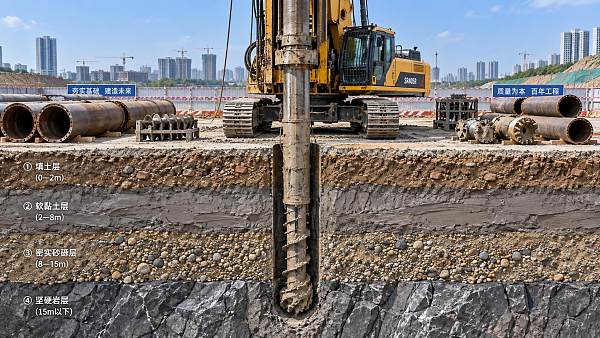
Soil investigation for dredging should address more than a broad label such as “sand” or “silt.” A deposit can vary substantially across a borrow area, channel, pond, or mining zone. Fine sand may sit over dense sand layers; clay lenses may interrupt an otherwise free-flowing deposit; oversize stones may be present near shorelines or old river channels. The selected dredger must be capable of dealing with the limiting condition that is likely to govern real operating time.
Useful pre-selection information includes particle-size distribution, in-situ density, moisture condition, clay and organic content, expected oversize fraction, abrasiveness, depth of cut, and required transport distance. Where sampling is limited, the procurement specification should identify the uncertainty rather than treating assumed material properties as confirmed facts.
Material characteristics influence two separate parts of the process:
- Excavation: breaking, loosening, or fluidizing the soil so that it can enter the suction inlet.
- Hydraulic transport: maintaining sufficient velocity and pressure to move the slurry through the pump and pipeline without excessive wear, blockage, or settling.
A high-capacity pump cannot compensate for poor excavation. If a cutterhead cannot penetrate compacted material, or if the suction inlet is positioned badly, the pump may draw mostly water. At the other extreme, aggressive cutting combined with inadequate pump capacity can overload the intake with solids, causing unstable vacuum, fluctuating discharge pressure, and repeated interruptions.
How pump capacity should be interpreted
Pump capacity is often described by flow rate, head, power, and solids-handling capability. These values need to be assessed together. Flow rate indicates how much slurry volume the system can move, but slurry volume includes both water and solids. Head represents the pressure energy available to overcome elevation, pipeline friction, bends, valves, floating hose movement, and losses in the suction arrangement. Power must be sufficient to sustain the operating point without continuously overloading the engine or electric drive.
The duty point is where the pump curve intersects the system resistance curve. Changes in soil and pipeline configuration shift that operating point. A longer discharge line, higher lift, tighter bends, or thicker slurry raises resistance. A pump that appears adequate for short-distance discharge may be unsuitable once pipeline extensions are added. This is particularly relevant in mining operations, where discharge locations can move as stockpiles, settling areas, or processing plants change.
Technical teams should distinguish between water performance and slurry performance. Manufacturers commonly provide pump curves based on water testing. In dredging service, slurry density, particle size, and solids concentration alter losses and reduce practical output. The evaluation should ask how the proposed configuration accounts for these conditions, rather than assuming the published water curve translates directly into production.
Soil conditions that change equipment selection
Fine sand and loose granular material
Loose fine sand is generally favorable for hydraulic excavation, provided the suction inlet is controlled and the line velocity remains high enough to prevent deposition. The risk is often not inability to pump, but excessive dilution. When too much water enters with the solids, the dredger may show high flow on instruments while delivering disappointing dry-tonnage output.
For this material, cutterhead design, suction geometry, and operator control can be as important as a larger pump. The evaluator should review how the equipment regulates ladder depth, swing speed, and cutter rotation. A system with stable control may produce a more consistent slurry than a larger unit operated without feedback from pressure, vacuum, and discharge density.
Compacted sand and dense mineral-bearing deposits
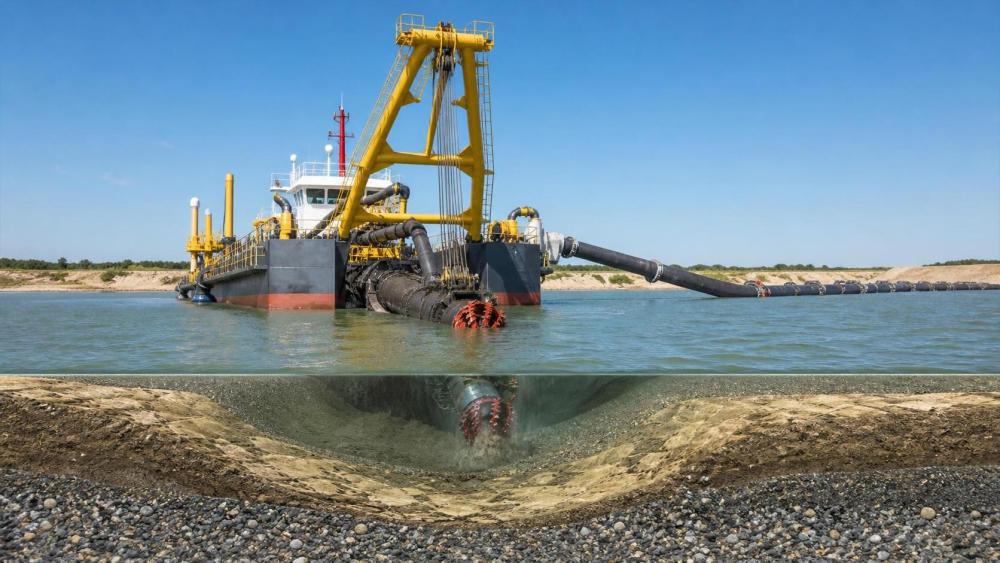
Dense sand requires more excavation energy before the pump can transport it. A cutter suction dredger may need sufficient cutter torque, ladder strength, and swing force to maintain penetration. Selecting a larger slurry pump without confirming cutter capability can lead to a machine that has transport capacity but cannot feed itself effectively.
Where valuable mineral fractions are present, dilution has a further consequence: downstream screening, classification, or concentration equipment may receive an inconsistent feed. A balanced design aims for stable solids delivery within the operating range of the processing circuit, not simply the highest possible pump throughput.
Clay, silt, and cohesive soils
Cohesive material can resist breakup and form lumps that behave differently from free-flowing sand. Clay may smear around cutters, block screens, adhere to internal surfaces, or create unstable slurry concentrations. In some applications, a cutterhead alone may not be the decisive feature; agitation, mechanical loosening, specialized teeth, or a different excavation method may need consideration.
Fine silts can be readily suspended but may create disposal and water-management issues. If discharge enters a settling pond, the available retention time and overflow arrangement should be reviewed alongside the pump selection. A dredger sized only for excavation may create a downstream bottleneck if the containment system cannot manage the water and fines it receives.
Gravel, cobbles, and abrasive mixtures
Coarse material presents both passage and wear concerns. The pump, casing, impeller, suction pipe, and elbows must tolerate the expected particle size and abrasiveness. Oversize particles can bridge at the inlet or lodge in bends, particularly where flow velocity falls during startup or shutdown. A larger discharge pipe is not automatically safer if it permits velocity to drop below the level needed to keep the material moving.
Abrasive sand and gravel also change lifecycle calculations. Wear liners, impellers, cutter teeth, and pipe sections may require planned replacement. For remote overseas sites, spare-parts availability and interchangeability can be more consequential than a modest difference in initial equipment price.
Balancing pump, cutter, and pipeline as one system
The dredging system should be evaluated as a chain of constraints. The cutterhead creates loosened material. The suction side captures it. The pump accelerates it. The pipeline carries it to the discharge point. Production is limited by the weakest or least compatible element.
Pipeline velocity deserves particular attention. If velocity is too low, coarse solids may settle and create a blockage that is difficult to clear. If it is unnecessarily high, pipe wear, energy consumption, and turbulence increase. The appropriate range depends on material size, concentration, and pipe geometry, so it should be calculated for the expected slurry rather than copied from another project.
Choosing between capacity reserve and oversizing
Capacity reserve is prudent when deposits are variable, pipeline routes may expand, or production interruptions carry substantial operational cost. Yet excessive oversizing can create its own problems. An oversized pump may operate far from its efficient region, force high line velocities in short pipelines, consume more power than required, and accelerate wear. It can also make fine control difficult when the work involves thin layers, environmental boundaries, or restricted excavation zones.
A practical approach is to define several operating cases: normal material at the expected discharge distance, difficult material at the maximum anticipated distance, startup and shutdown conditions, and a reduced-production case. The selected equipment should operate acceptably across those cases, with clear limits identified for each. This is more useful than evaluating a single “maximum capacity” condition.
Where the project may develop in stages, modular pipeline planning can be preferable to buying a main pump solely for an uncertain future distance. Similarly, provision for a booster connection may offer flexibility without requiring continuous operation at excessive pressure.
What overseas buyers should request from an OEM supplier
Mining dredger procurement from China or any export market requires a document-based review, especially when the buyer will not inspect every fabrication stage in person. A dredging equipment manufacturer should be assessed on the clarity and completeness of its technical submission, not on a headline production claim.
The request-for-quotation package should state the intended soil conditions, excavation depth, design discharge distance, elevation profile, required operating hours, power source, site climate, transport limitations, and destination-country electrical requirements. Omitting these details encourages suppliers to quote on different assumptions, making price comparisons unreliable.
Technical evaluators can request the following items before finalizing a purchase decision:
- A general arrangement drawing showing hull layout, ladder, pump position, winches, control cabin, discharge connection, and access points.
- Pump performance data identifying the proposed operating range and assumptions used for slurry duty.
- Details of wetted wear parts, including material specification where available, expected service access, and recommended spare-part scope.
- Cutterhead, gearbox, and drive information matched to the stated soil type rather than described only in general terms.
- Pipeline calculations or a stated basis for discharge-distance capability, including whether booster pumping is assumed.
- An equipment list that separates standard supply, optional equipment, commissioning tools, and site-installed items.
- Inspection, testing, packing, and shipping documentation requirements that can be incorporated into the contract.
For overseas shipment, dimensions and modularity affect more than freight cost. They influence port handling, inland transport permits, site assembly time, and the need for lifting equipment. A dredger designed for containerized or sectional transport may simplify mobilization, but each field joint, cable connection, and pipe flange should be considered in the commissioning plan.
Factory acceptance and site acceptance should test the right risks
A factory inspection can confirm workmanship, major component identity, assembly quality, and basic operation before shipment. It cannot fully replicate the buyer’s material, discharge route, or weather conditions. The acceptance plan should separate factory-verifiable items from site-verifiable performance.
At the factory stage, checks may include dimensional conformity, welding and coating condition, component documentation, rotation checks, control functions, leak checks where applicable, and confirmation that supplied spares match the packing list. Site commissioning should then verify priming, suction stability, discharge pressure, pipeline integrity, cutter operation, winch response, safety interlocks, and actual behavior in representative soil.
Production acceptance needs careful wording. If site geology is uncertain, a guaranteed output should not be stated without defining material characteristics, discharge distance, operating depth, solids basis, and measurement method. A transparent test protocol is more defensible than an undefined capacity claim.
Decision discipline prevents expensive mismatches
The strongest selection process connects the soil report, pump duty calculation, cutter demand, pipeline layout, and acceptance criteria before equipment is ordered. It also identifies what remains uncertain and assigns responsibility for resolving it through sampling, test dredging, site surveys, or staged commissioning.
For mining and aggregate applications, the objective is not simply to install the largest available pump. It is to maintain a controllable slurry stream, transport it reliably over the required route, protect wear-prone components, and deliver feed that downstream handling systems can manage. Equipment selection becomes more defensible when every claimed capability can be traced back to a defined soil condition and operating case.
Related News
 What is driving consolidation in the global equipment supplier market?IEG Heavy Machinery & Automation AnalystGlobal equipment supplier market consolidation is accelerating through technology, service, and supply-chain demands. Discover how buyers can capture value while managing risk.
 When does capital equipment investment pay back in manufacturing?IEG Heavy Machinery & Automation AnalystCapital equipment investment manufacturing: learn when equipment truly pays back by evaluating full costs, cash flow, ramp-up, operational risks, and lifecycle value.
 When does a distribution center need an automated pallet handling system?Heavy Lifting Systems AnalystPallet handling systems help distribution centers overcome labor shortages, bottlenecks, safety risks, and storage constraints. Discover the key signs it’s time to automate.
 How to build a machinery investment plan around payback periodIEG Heavy Machinery & Automation AnalystMachinery investment planning manufacturing guide: build a credible payback plan with full costs, ramp-up assumptions, lifecycle risks, and scenario-based cash benefits.
 How to Specify a Modular Packaging Line for Fast Changeovers and Scalable OutputRobotics EngineerModular packaging line specification guide: achieve faster changeovers, scalable output, reliable controls, and lower lifecycle costs with practical planning.
 How industrial IoT devices reduce unplanned downtime in factoriesRobotics EngineerIndustrial IoT devices help factories detect early equipment issues, plan maintenance, and reduce costly unplanned downtime before production is disrupted.
 What is driving industrial machinery market demand in manufacturing?IEG Heavy Machinery & Automation AnalystIndustrial machinery market manufacturing demand is rising as factories pursue automation, energy efficiency, resilient supply chains, and lifecycle productivity gains.
 316L Stainless Steel Pipe Tube Technical Factors That Shape Buyer DecisionsCNC Machining AnalystA technical analysis for 316L stainless steel pipe tube buyers, covering corrosion expectations, pipe route choice, tolerance, surface, and inspection.
 How ground conditions determine crawler piling equipment selectionConstruction Equipment SpecialistCrawler piling equipment selection starts with ground conditions. Learn how soil, rock, groundwater and site constraints shape safer, more productive piling solutions.
 3300mm CNC Beam Saw Sheet Capacity: Layout Checks Before PurchaseCNC Machining AnalystZhongding ZD330 beam saw specifications: assess 3300mm sheet capacity, layout clearances, handling flow, and acceptance checks before buying.
 How Bucket Chain Diamond Dredgers Meet ISO 12100 Safety Requirements in Alluvial Mining ProjectsMining Infrastructure ExpertBucket chain diamond dredger safety made real: how ISO 12100 compliance ensures operator protection, reliability & zero lost-time injuries in alluvial mining.
 Modular Packaging for High-Mix Automotive Assembly Lines: How Standardized Load Units Reduce Line Changeover Time by 37% — Case Study from Tier-1 Supplier in GuangdongHeavy Lifting Systems AnalystModular packaging slashes automotive line changeover time by 37%—discover how standardized load units boost OEE, cut labor costs, and enable seamless high-mix assembly.