Cutter Suction Dredger Procurement: Verifying Slurry Output Claims




A cutter suction dredger’s advertised output is only useful when the quotation explains what is being measured. Pumped water-and-solids volume, dry solids mass, and in-situ excavation volume are different quantities. A large figure expressed in cubic metres per hour may describe a mostly water-filled pipeline rather than the quantity of material removed from the dredging area.
Procurement teams should require every production claim to state its material assumptions, pipeline configuration, measurement basis, and operating conditions. The buying decision then becomes a comparison of achievable excavation performance rather than brochure numbers. The distinction between hydraulic transport and excavation production is central to the dredging methods described in USACE guidance and technical literature on cutter suction dredgers.[1][2]
Establish exactly what “output” means
Before comparing suppliers, put the production units into a common format. The following quantities answer different procurement questions and should not be accepted as interchangeable.
For a clearly defined mixture, solids volume flow equals mixture flow multiplied by the solids concentration by volume. That relationship does not make the result an in-situ excavation rate: undisturbed sediment includes pore space, while transported particle volume does not. Concentration by mass also cannot be substituted directly for concentration by volume. These distinctions follow the mixture and solids accounting used in hydraulic dredging analysis.[1][2]
Use a deliberately hypothetical illustration: a mixture flow of 4,000 m³/h at 10% solids by volume carries 400 m³/h of solid particles. At 5%, the same mixture flow carries 200 m³/h. These are arithmetic examples, not equipment ratings or predictions. They show why a flow figure without concentration provides insufficient evidence of useful production.
The time denominator matters just as much. Ask whether “per hour” means an hour of stable pumping, an hour with the cutter engaged, or an elapsed operating hour that includes repositioning and interruptions. A pumping-hour guarantee cannot be compared directly with a shift-average commitment.
What a 26-inch description does—and does not—establish
A request for a 26-inch dredger needs a written definition of the dimension. Does it refer to the pump discharge connection, the discharge pipeline’s nominal size, or another component? Ask for actual internal diameters and the proposed pipeline specification rather than assuming that every supplier uses the designation consistently.
When evaluating a slurry dredging dredger, treat the product description as the starting point for a technical clarification schedule. Request a dimensioned arrangement, pump identification, power allocation, and the proposed duty point. Do not infer a 26-inch configuration or a guaranteed production rate from a model name or product category alone.
Pipe diameter influences the relationship between flow and velocity, but diameter alone does not establish excavation output. The dredger must cut or loosen material, capture it at the suction inlet, and transport it through the pipeline. Cutter performance, suction conditions, pump characteristics, and discharge resistance can each constrain the system.[2]
For a company offering this size class, procurement scrutiny should extend beyond equipment dimensions. Establish who is responsible for the production calculation, which proposed components it covers, and whether the supplying entity will stand behind that calculation contractually. A technical proposal assembled from several subcontractors needs a clearly identified party responsible for integrated performance.
Rebuild the claim around the intended dredging site
A credible quotation should connect its production estimate to the buyer’s site information. USACE guidance describes dredging equipment selection in relation to material characteristics, excavation conditions, transport, and placement requirements.[1] The practical procurement response is to issue a common operating envelope to every bidder.
That envelope should describe the dredging depth range, sediment investigation, proposed pipeline route, discharge elevation, and receiving-area restrictions. If information is preliminary, identify it as preliminary. Asking bidders to state their assumptions is more useful than allowing uncertainty to disappear inside an apparently precise output number.
Material resistance and suction behaviour
Loose sand, cohesive sediment, gravel-bearing deposits, and cemented layers should not be treated as equivalent duties. A cutter and suction arrangement that feeds one material effectively may perform differently in another. In cohesive ground, cutting and material handling may restrict production even when the pump has hydraulic capacity available; debris can introduce interruptions unrelated to the advertised flow.[2]
Ask the supplier to identify the material properties behind its estimate. Depending on the deposit, these may include particle-size distribution, solids density, cohesion, and the presence of oversize material. Where investigation coverage is limited, request separate assessments for expected and adverse conditions rather than one unconditional rate.
Pipeline resistance and discharge conditions
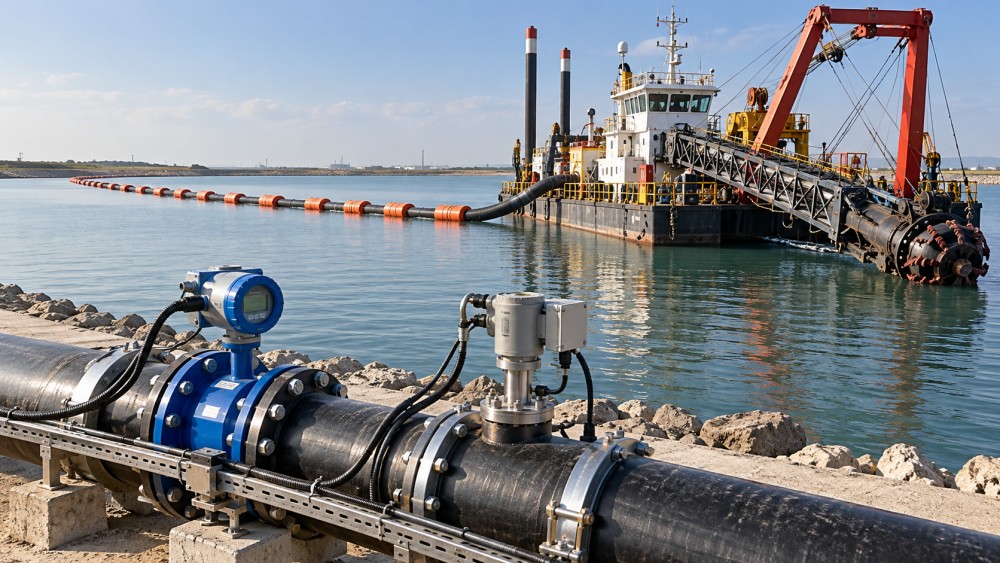
The proposed route should include floating, submerged, and shore sections, together with bends, changes in elevation, and the discharge arrangement. Hydraulic transport performance depends on the full system, not simply the straight-line distance from the dredger to the receiving area.[1][2]
Require the bidder’s hydraulic calculation to identify the assumed slurry concentration, pipe internal diameter, and pump operating speed. Where booster pumps are proposed, their location, power requirement, and operating responsibility belong in the comparison. A base dredger quotation and a quotation including the equipment needed to reach a distant placement area are not equivalent offers.
Ask for an evidence chain, not a single performance curve
A pump curve is relevant evidence, but it is not a complete dredger production guarantee. It describes pump performance under stated conditions; excavation performance also depends on material feed and operating arrangements.[2] The supplier should explain how its pump information supports the proposed slurry duty and how that duty translates into the quoted excavation rate.
A procurement review can follow four linked questions:
- What is the underlying evidence? Identify whether the submission uses a tested curve, a calculation, or operating records from another installation.
- What configuration does it cover? Match pump model, impeller, speed, drive power, and pipeline arrangement to the offered equipment.
- Which assumptions bridge the gaps? Require explanations for slurry corrections, material concentration, and any conversion to in-situ volume.
- How will the claim be checked? Connect the estimate to a measurable acceptance criterion and an agreed test procedure.
Operating records from another site may help assess plausibility, but they need context. Request the material description, dredging depth, pipeline configuration, measurement method, and recorded downtime. Without those details, a production log demonstrates a recorded result somewhere else, not necessarily performance under the buyer’s conditions.
Also check simultaneous power demand. Ask for a power balance covering the proposed operating condition rather than assuming that every installed drive can deliver its maximum output concurrently. The balance should distinguish pump, cutter, winch, and auxiliary loads and state any operational limitations used in the estimate.
Write the acceptance procedure before awarding the contract
The following items are recommended purchasing controls, not a universal statutory test standard. They should be adapted by the buyer’s technical adviser to the project, measurement equipment, and contract.
Define the guaranteed quantity. Select a primary measure that matches the commercial requirement. If the project is paid by surveyed excavation volume, a mixture-flow guarantee alone leaves a gap. Agree how any supporting density or flow measurements will relate to the accepted production quantity.
Define valid test conditions. Record the material range, dredging depth, pipeline configuration, discharge level, and equipment settings. Specify what happens if actual ground conditions fall outside the agreed range. Otherwise, a disappointing result can become an argument about whether the test represented the contract at all.
Agree measurement and data handling. Identify instrument locations, calibration evidence, sampling procedures, recording intervals, and responsibility for retaining raw data. Where density is used to calculate solids concentration, document the assumed carrier-fluid and particle densities. The conversion basis must be available for review, not embedded invisibly in a display reading.
Use a representative test window. Specify the duration and treatment of startup, flushing, blockages, and repositioning. Avoid accepting selected peak readings as proof of sustained performance. Equally, distinguish a test intended to verify stable pumping from one intended to demonstrate elapsed-time production.
Set remedies and retesting rules. Define who pays for investigation, modifications, and repeat trials if the agreed result is not achieved. Record whether proposed remedies may alter fuel demand, wear exposure, staffing, or delivered scope. A remedy that requires additional equipment can change the economics of the original bid.
Compare bids on accepted production and accountable scope
A useful bid comparison separates three layers: hydraulic capacity, expected excavation production, and contractual responsibility. Two offers can show similar mixture flow while relying on different solids concentrations or operating-time assumptions. They can also assign very different obligations for pipeline supply, commissioning, or performance testing.
For cost evaluation, request a consistent estimate of fuel use, wear-part consumption assumptions, maintenance requirements, and supporting equipment. Treat these as bidder submissions to be examined, not verified outcomes. Calculate a planning cost per accepted unit of production using the same time basis across bids, then test how that cost changes if concentration or operating availability falls below the quoted assumption.
Supplier documentation should distinguish workshop checks from site demonstration. A workshop inspection may establish that specified components are installed and functioning; it does not, by itself, demonstrate excavation output in the buyer’s sediment and pipeline system. The acceptance schedule should state which obligations are satisfied before shipment and which remain open until commissioning.
The strongest purchasing position is a traceable chain from site conditions to equipment selection, from equipment selection to calculated performance, and from that calculation to a witnessed acceptance method. Where a bidder cannot explain one of those links, treat the output claim as an unresolved commercial risk rather than a confirmed production commitment.
Technical references
[1] U.S. Army Corps of Engineers, EM 1110-2-5025: Dredging and Dredged Material Management. Reference for dredging methods, equipment selection, sediment characteristics, and transport and placement considerations.
[2] W. J. Vlasblom, Delft University of Technology, Designing Dredging Equipment, chapter “The Cutter Suction Dredger.” Reference for cutter suction dredger systems, production constraints, and hydraulic transport relationships.
Related News
 MSHA Issues Mine Truck Safety Alert After One Death and 121 InjuriesMining Infrastructure ExpertMSHA mine truck safety alert reports one death and 121 lost-time injuries. Discover why mine operators should review safety practices.
 How to size a crushing plant for ore processingMining Infrastructure ExpertSize your ore processing equipment crushing plant with confidence. Learn how to calculate throughput, assess ore characteristics, and prevent bottlenecks.
 Trump Administration Rewrites Mining Policy to Spur Critical Minerals DevelopmentMining Infrastructure ExpertU.S. critical minerals mining policy is changing. Explore what faster approvals could mean for investment, equipment demand and supply chains.
 How IEC 62443 defines security zones for industrial communication systemsRobotics EngineerExplore industrial communication systems and IEC 62443: learn how security zones, conduits, and risk-based controls help protect plant operations.
 China-Peru Trade Agreement Upgrade Takes Effect, Easing Machinery CertificationConstruction Equipment SpecialistThe China-Peru trade agreement upgrade simplifies machinery certification. Discover what mutual recognition could mean for exporters entering Peru.
 How do industrial control systems regulate water treatment?Robotics EngineerDiscover how industrial control systems in water treatment use sensors, PLCs, and SCADA to regulate processes and help operators respond to changing conditions.
 Exotec Report: 25% of Supply Chain Leaders Regret Warehouse Automation DecisionsRobotics EngineerWarehouse automation regret affects 25% of surveyed supply chain leaders, according to Exotec. Explore the cost, contract and readiness risks before investing.
 How to set maintenance intervals for mining equipment in AustraliaMining Infrastructure ExpertMining equipment maintenance Australia: Learn how to set service intervals using operating hours, site conditions and equipment data to reduce downtime.
 EY Survey Ranks Complexity as Mining's Top Risk for 2027Mining Infrastructure ExpertMining risk in 2027 is led by complexity, EY's survey finds. Discover how aging mines, declining ore grades and supply chain pressures are reshaping the industry.
 Can asset lifecycle management automation reduce equipment downtime?IEG Heavy Machinery & Automation AnalystDiscover how asset lifecycle management automation can reduce equipment downtime through timely maintenance, faster repairs, and smarter service workflows.
 Caterpillar Q3 2026 Revenue Rises 17% to $20.7 Billion as Both Equipment Segments GrowConstruction Equipment SpecialistCaterpillar Q3 2026 revenue reportedly rose 17% to $20.7 billion. Explore equipment segment growth and what it could mean for procurement planning.
 How to choose a rugged industrial control panel for wet environmentsRobotics EngineerChoose a rugged industrial control panel for wet environments. Compare IP ratings, materials, seals, and condensation control to improve reliability.