How ground conditions determine crawler piling equipment selection




Ground conditions do not merely influence drilling speed; they determine whether a crawler piling rig can be mobilized safely, remain stable under load, achieve the specified pile geometry, and maintain the construction programme. A rig that appears adequately sized on paper can become inefficient or unsafe if its operating weight, mast configuration, drilling tool, crowd force, and support requirements are poorly matched to the soil profile and working platform.
The practical selection question is therefore not “Which crawler piling equipment has the highest torque or deepest drilling depth?” It is whether the complete rig-and-tooling combination can install the required foundation through the actual ground sequence without creating unacceptable risks in stability, pile quality, spoil handling, access, or production continuity.
Start with the ground model, not the rig specification sheet
A geotechnical report is often treated as a design document rather than an equipment-selection document. For piling operations, it must serve both purposes. The relevant information is not limited to a broad soil classification. Equipment planning depends on how ground strength, density, stiffness, obstructions, groundwater, and rockhead vary across the pile locations and through depth.
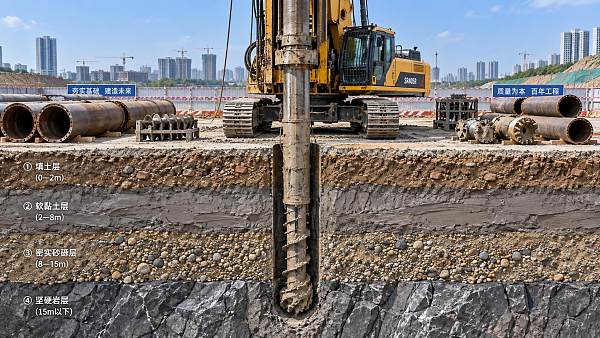
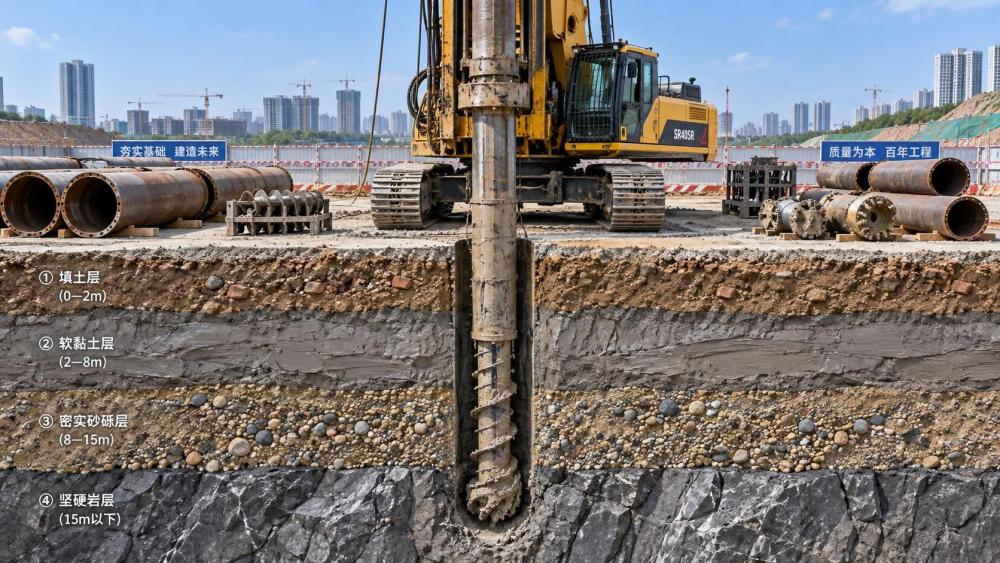
A useful ground model for crawler piling equipment should identify the expected sequence from working-platform level to final pile toe, including fill, soft cohesive soils, loose sand, dense granular layers, weathered rock, competent rock, boulders, buried concrete, old foundations, and man-made obstructions. It should also show where these conditions change laterally. A site with a consistent borehole log may support a relatively stable production plan; a site with variable fill depth or an irregular rockhead requires more operational flexibility and contingency capacity.
Equipment selection should be based on the most demanding credible conditions within the work area, not on the average borehole result. This does not mean choosing the largest available rig in every case. Oversizing can increase platform loading, transport complexity, fuel use, and restricted-access problems. It means identifying the condition most likely to interrupt production or compromise pile installation, then selecting a rig, tool set, and support arrangement capable of managing it.
Working-platform capacity is a machine-selection constraint
The crawler undercarriage gives piling rigs low nominal ground pressure compared with wheeled equipment, but this should not be confused with unlimited suitability on weak ground. A piling rig applies dynamic and changing loads during travel, mast raising, crowd application, winching, casing installation, and slewing. The machine’s centre of gravity also changes as the mast is positioned and as rotary tools, casings, reinforcement cages, or concrete handling activities take place around it.
Soft clay, uncontrolled fill, recently placed earthworks, peat, saturated granular soils, and platforms near excavations or retaining edges require particular attention. The platform must carry not only the rig’s static load but also operational effects, local bearing stresses under the tracks, repeated trafficking, and the load of support equipment such as service cranes, excavators, spoil trucks, concrete pumps, and casing handling units.
Where platform capacity is marginal, the apparent solution of using a lighter crawler piling rig may be incomplete. A smaller machine can reduce imposed loading, but it may also lack the torque, crowd force, winch capacity, or casing oscillator compatibility required by the deeper or harder sections of the ground profile. The better decision may involve engineered platform improvement, temporary load-distribution measures, a revised rig travel route, or a different piling method rather than simply reducing rig size.
Platform design and verification should be coordinated before mobilization. The equipment supplier’s machine weight, track dimensions, transport configuration, mast operating positions, and any additional attachment weights need to be included. Assumptions based only on brochure operating mass can underestimate actual site loads when kelly bars, drilling tools, full casings, counterweights, and temporary support equipment are considered.
Soft cohesive soils change the balance between reach, stability, and productivity
In soft clays and silts, the principal issue is often not penetration resistance but machine support and bore stability. The rig may drill readily, yet lose time because of track settlement, poor access, spoil congestion, or borehole instability when the tool is withdrawn. High groundwater and sensitive soils can further complicate excavation, particularly if the piling method relies on open-hole drilling rather than temporary casing or support fluid.
For these conditions, a crawler rig with a stable undercarriage, suitable track width, and controlled movement characteristics can be more valuable than maximum rotary torque. Mast length and crowd arrangement still matter, especially where long casings or deeper piles are required, but stability in the real working position is decisive. The selected configuration should be evaluated with the mast inclined or offset as needed for pile location, not only in its most favourable vertical position.
Temporary casing may be necessary to control loose upper layers, prevent necking, isolate groundwater, or maintain bore alignment. That requirement affects equipment choice significantly. The rig must have sufficient torque and crowd capability to install and extract casing, while the site layout must accommodate casing storage and handling. In some conditions, a separate casing oscillator or rotator is required. Selecting a drilling rig without confirming how casing will be driven, advanced, extracted, and managed can leave a project with an apparently capable rig but an incomplete installation system.
Soft ground also makes logistics more consequential. A rig may be able to work at a pile point but not travel reliably between pile points once surface rutting develops. Planned haul roads, turning areas, spoil zones, and crane standing areas should therefore be considered part of piling equipment selection. A productive drilling cycle is of limited value if the rig repeatedly waits for ground repairs or cannot be safely repositioned.
Dense sand, gravel, and mixed granular layers demand torque and bore control
Dense granular strata typically raise the demand for rotary torque, crowd force, tool durability, and spoil-removal efficiency. Gravel and cobbles can reduce penetration rates, increase wear on augers and buckets, and cause deviations when the tool encounters uneven resistance. In saturated sand, maintaining bore stability is frequently as important as achieving penetration.
A crawler piling rig intended for these conditions should be assessed as a system: rotary head torque, crowd and pull-down force, winch line pull, kelly bar type, drill tool range, and casing capacity all interact. High torque alone does not guarantee efficient drilling if the rig cannot apply adequate crowd, if spoil cannot be cleared from the tool, or if the bore collapses after withdrawal.
Interlocking kelly bars may provide the force needed for difficult penetration, but their operating characteristics, stroke limitations, and transport implications should be checked against pile depth and site constraints. Friction kelly bars can offer advantages in certain depth-focused applications, but they do not replace the need to confirm torque transfer and crowd requirements in dense layers. These choices are operational rather than purely technical: the wrong kelly configuration can increase cycle times, tool changes, and recovery work.
Groundwater in granular soils often shifts the selection decision toward methods that provide positive bore support. Depending on design and local execution requirements, this may involve temporary casing, polymer or bentonite slurry, continuous flight auger methods, or alternative foundation solutions. The appropriate approach cannot be selected from soil description alone; it requires consideration of pile diameter, depth, adjacent structures, environmental controls, concrete placement sequence, and the consequences of local collapse.
Rockhead profile matters more than the presence of rock
“Rock encountered” is not sufficient information for selecting crawler piling equipment. The key questions are at what depth rock begins, whether the rockhead is level or highly irregular, how weathered it is, whether it contains hard bands or voids, and whether the pile design requires socketing into competent material.
A shallow and uneven rockhead can be more disruptive than deeper uniform rock because pile lengths vary, drilling tools encounter abrupt changes in resistance, and casing or bore alignment can be affected at the soil-rock interface. If foundation elements must terminate at variable rock levels, the selected rig needs enough effective drilling depth and operational reserve to accommodate the deepest expected pile without continually changing configuration.
For weathered rock, suitable augers, buckets, core barrels, or rock drilling tools may be sufficient, depending on strength and fracture condition. Competent rock or specified sockets may require higher torque, more robust rotary head capacity, specialist tooling, and a realistic allowance for tool wear. The required output should be expressed in terms of installed pile quality and achievable cycle time, not simply nominal drilling depth. A rig advertised for a particular maximum depth may achieve that depth only under favourable soil conditions and with a reduced diameter or different tool configuration.
Where hard rock is intermittent, equipment flexibility becomes important. Frequent switching between soil tools, casing operations, and rock tools can create substantial non-productive time. The value of a rig with rapid tool handling, adequate auxiliary winch arrangements, and accessible maintenance points may exceed the benefit of a marginal increase in maximum torque.
Obstructions require an explicit recovery strategy
Urban redevelopment sites, former industrial land, reclaimed areas, and sites with historical structures may contain buried slabs, timber, masonry, steel, old pile remnants, rubble, or isolated boulders. These conditions are commonly underestimated because boreholes cannot identify every local obstruction. A piling rig chosen only for the expected natural strata may be unable to proceed when it encounters artificial materials near the surface.
The selection process should distinguish between predictable obstructions identified by investigation and residual obstruction risk that must be managed operationally. Predictable obstructions may justify pre-drilling, trenching, removal works, casing, or dedicated rock and coring tools. Residual risk requires a plan for tool recovery, obstruction removal, equipment standby, and rapid engineering decisions when pile locations cannot be advanced as designed.
Tool extraction capacity deserves attention in these environments. A tool jammed on reinforcement, timber, or buried debris can create a recovery event far more disruptive than a slow drilling cycle. Main winch capacity, auxiliary winch arrangement, access for lifting support, and the availability of appropriate recovery tools should be reviewed before work begins. The relevant question is not whether the rig can drill through an obstruction, but whether the project can safely recover when it cannot.
Ground conditions influence the preferred piling method
Crawler piling equipment is not a single category with a universal application. Rotary bored piling rigs, diaphragm wall equipment, continuous flight auger rigs, driven piling systems, and vibro-based solutions interact with ground in different ways. Selection should begin with the required foundation system, but ground conditions may expose limitations in the originally assumed method.
For example, open bored piles can be effective where bore stability is manageable and spoil handling is practical. Temporary casing becomes central where loose or water-bearing upper soils threaten collapse. Continuous flight auger installation can reduce open-bore exposure in suitable cohesive or granular materials, but it requires tight control of concrete pressure, extraction rate, and ground response; it is not a simple substitute where hard obstructions or demanding rock penetration are present. Driven systems can avoid spoil generation but may create vibration, noise, or refusal issues in dense layers and may be unsuitable near sensitive structures.
The equipment decision should therefore follow the interaction between soil, pile design, and surrounding constraints. Changing the rig without reconsidering the method often addresses only part of the problem.
Site geometry can override nominal machine capability
Limited headroom, overhead power lines, adjacent buildings, sloping terrain, narrow working corridors, and proximity to excavations can prevent use of an otherwise suitable crawler rig. A tall mast may offer the needed drilling depth but be impossible to raise safely within the available clearance. A rig with adequate track width may be unable to turn or align at edge pile locations. Long casing sections may be technically required but impractical to handle beneath restricted overhead conditions.
These constraints need to be tested against the operating envelope rather than the transport dimensions alone. Clearance must account for mast erection, tool lifting, casing handling, rig slewing, and safe separation from overhead hazards. On constrained sites, compact rigs, low-headroom masts, sectional casing arrangements, or alternative pile sequencing may be more effective than forcing a larger standard configuration into the available space.
Water management also belongs in this assessment. High groundwater, surface runoff, and poorly drained platforms can quickly alter trafficability and bearing conditions. Pumping arrangements, settlement controls, slurry management where relevant, and safe spoil storage should be established as part of the operating plan. Dewatering can affect surrounding ground and structures, so it should not be treated as a simple equipment-side solution without geotechnical and environmental review.
Evaluate production assumptions against the difficult intervals
Programme risk often emerges from optimistic cycle-time assumptions. A drilling cycle includes positioning, setting out, drilling, tool cleaning, casing handling, bore cleaning, inspection, reinforcement installation, concreting, extraction of temporary works, and movement to the next position. Ground conditions affect nearly every part of that sequence.
Dense gravel may slow drilling and accelerate tool wear. Soft ground may slow travel and require platform repairs. Variable rockhead may increase depth uncertainty. Collapsible sand may extend bore-cleaning and casing time. Obstructions may require recovery operations that cannot be absorbed by a standard production rate. The appropriate productivity basis is therefore not a single nominal metres-per-hour figure. It is a realistic range tied to the hardest expected soil transitions, pile diameter, depth, tooling changes, and support activities.
Equipment capacity should include a margin for these conditions. A rig operating at the edge of its torque, crowd, or depth capability may complete a trial pile yet perform poorly across a full pile schedule. Reserve capacity is especially important where ground investigation coverage is limited, because unexpected variations are more likely to be discovered during installation.
A disciplined selection decision links machine data to field controls
A sound procurement or deployment decision can be tested through a short set of project-specific questions:
- Can the working platform support the rig in all planned operating positions and travel routes?
- Does the selected rotary head, kelly bar, winch system, and tooling package address the hardest expected strata, not only the predominant soil?
- How will groundwater, loose layers, and bore instability be controlled?
- Can the rig install, extract, and handle the required casing or other temporary support system?
- Are rockhead variability, obstructions, and tool recovery included in the operational contingency?
- Can the machine be transported, assembled, positioned, and operated within the site’s geometric and overhead restrictions?
- Do projected cycle times include support operations and ground-related interruptions rather than drilling alone?
The final choice of crawler piling equipment should be documented alongside the ground assumptions that justify it. This creates a clearer basis for method statements, platform design, subcontractor coordination, tool procurement, and programme allowances. It also makes changes easier to manage when site conditions differ from investigation results.
Ground is not a passive backdrop to piling work. It governs the forces imposed on the rig, the tools required at the boreface, the temporary works needed to preserve pile integrity, and the practical rate at which foundations can be delivered. Selecting the machine around those conditions—rather than around headline drilling capacity—provides a stronger foundation for safety, quality, and schedule control.
Related News
 What is driving consolidation in the global equipment supplier market?IEG Heavy Machinery & Automation AnalystGlobal equipment supplier market consolidation is accelerating through technology, service, and supply-chain demands. Discover how buyers can capture value while managing risk.
 When does capital equipment investment pay back in manufacturing?IEG Heavy Machinery & Automation AnalystCapital equipment investment manufacturing: learn when equipment truly pays back by evaluating full costs, cash flow, ramp-up, operational risks, and lifecycle value.
 When does a distribution center need an automated pallet handling system?Heavy Lifting Systems AnalystPallet handling systems help distribution centers overcome labor shortages, bottlenecks, safety risks, and storage constraints. Discover the key signs it’s time to automate.
 How to build a machinery investment plan around payback periodIEG Heavy Machinery & Automation AnalystMachinery investment planning manufacturing guide: build a credible payback plan with full costs, ramp-up assumptions, lifecycle risks, and scenario-based cash benefits.
 How to Specify a Modular Packaging Line for Fast Changeovers and Scalable OutputRobotics EngineerModular packaging line specification guide: achieve faster changeovers, scalable output, reliable controls, and lower lifecycle costs with practical planning.
 How industrial IoT devices reduce unplanned downtime in factoriesRobotics EngineerIndustrial IoT devices help factories detect early equipment issues, plan maintenance, and reduce costly unplanned downtime before production is disrupted.
 What is driving industrial machinery market demand in manufacturing?IEG Heavy Machinery & Automation AnalystIndustrial machinery market manufacturing demand is rising as factories pursue automation, energy efficiency, resilient supply chains, and lifecycle productivity gains.
 316L Stainless Steel Pipe Tube Technical Factors That Shape Buyer DecisionsCNC Machining AnalystA technical analysis for 316L stainless steel pipe tube buyers, covering corrosion expectations, pipe route choice, tolerance, surface, and inspection.
 How ground conditions determine crawler piling equipment selectionConstruction Equipment SpecialistCrawler piling equipment selection starts with ground conditions. Learn how soil, rock, groundwater and site constraints shape safer, more productive piling solutions.
 3300mm CNC Beam Saw Sheet Capacity: Layout Checks Before PurchaseCNC Machining AnalystZhongding ZD330 beam saw specifications: assess 3300mm sheet capacity, layout clearances, handling flow, and acceptance checks before buying.
 How Bucket Chain Diamond Dredgers Meet ISO 12100 Safety Requirements in Alluvial Mining ProjectsMining Infrastructure ExpertBucket chain diamond dredger safety made real: how ISO 12100 compliance ensures operator protection, reliability & zero lost-time injuries in alluvial mining.
 Modular Packaging for High-Mix Automotive Assembly Lines: How Standardized Load Units Reduce Line Changeover Time by 37% — Case Study from Tier-1 Supplier in GuangdongHeavy Lifting Systems AnalystModular packaging slashes automotive line changeover time by 37%—discover how standardized load units boost OEE, cut labor costs, and enable seamless high-mix assembly.