Reliability engineering methods for recurring excavator failures




A recurring excavator failure should trigger an investigation when a repaired machine returns with the same symptom, when replacement components fail unusually early, or when similar faults appear across several machines. Replacing another pump, hose, sensor, or seal may restore operation, but the next repair decision should depend on evidence about what caused the damage and whether that cause remains present.
For after-sales teams, the most useful equipment reliability engineering methods form a connected workflow: define the failure precisely, use root cause analysis to test competing explanations, prioritize corrective work through failure mode and effects analysis, and monitor the machine to verify the result. These methods are particularly valuable when repeat failures cause substantial downtime, create safety concerns, or generate disputes about component quality and operating conditions.
Establish whether the same failure is actually recurring
“Hydraulic problem” is too broad to support a reliability investigation. Slow attachment movement, internal leakage, overheating, and intermittent loss of pilot pressure can produce overlapping complaints while requiring different corrective actions. Even repeated replacement of the same component does not prove that each component failed through the same mechanism.
Separate the operator’s complaint, the observed loss of function, and the physical damage. For example, “the excavator loses digging performance after warming up” describes a symptom and operating condition. “Measured pressure or flow falls outside the manufacturer’s specification under a defined test” provides diagnostic evidence. Scoring, damaged bearings, or deteriorated seals provide further evidence, but still require interpretation.
Build a repeat-failure record around information that helps distinguish explanations:
- Machine identity, configuration, attachment, service hours, and hours since the previous repair.
- The affected function and whether the fault occurs cold, hot, under load, or intermittently.
- Fault codes, measurements, oil findings, photographs, and retained failed parts where practical.
- Parts replaced, adjustments made, fluid and filter changes, and cleaning or flushing performed.
- Application conditions, including attachment duty, ambient conditions, material handled, and recent changes.
Record what technicians actually found separately from what they suspected. A service note stating “pump failed because of contamination” should identify the supporting evidence. Without that distinction, an early assumption can become the accepted explanation simply because later reports repeat it.
Compare machines by operating exposure as well as calendar time. A machine working intermittently with a bucket and one operating an approved hydraulic attachment for long periods may accumulate different thermal and hydraulic loads despite similar meter hours. Grouping them together can conceal an application-related pattern.
Use root cause analysis to choose the next diagnostic test
Root cause analysis is most effective when it narrows uncertainty before further parts are ordered. Begin with a clear problem statement, such as: “After reaching operating temperature during attachment use, the machine loses hydraulic performance; the previous pump replacement did not prevent recurrence.” Avoid embedding an unproven cause in that statement.
Then develop a small set of plausible mechanisms. For hydraulic performance loss, these might include excessive internal leakage, inadequate supply to the pump, incorrect control settings, restricted flow paths, or excessive operating temperature. Several mechanisms can interact, so the investigation should allow for more than one contributing cause.
Follow the damage back through the system
A damaged part provides a starting point. Ask what physical process could produce the observed damage, what operating condition would enable that process, and what evidence would support or contradict it. The “five whys” can help organize this discussion, but there is no requirement to stop after five questions or force the answer into a single chain.
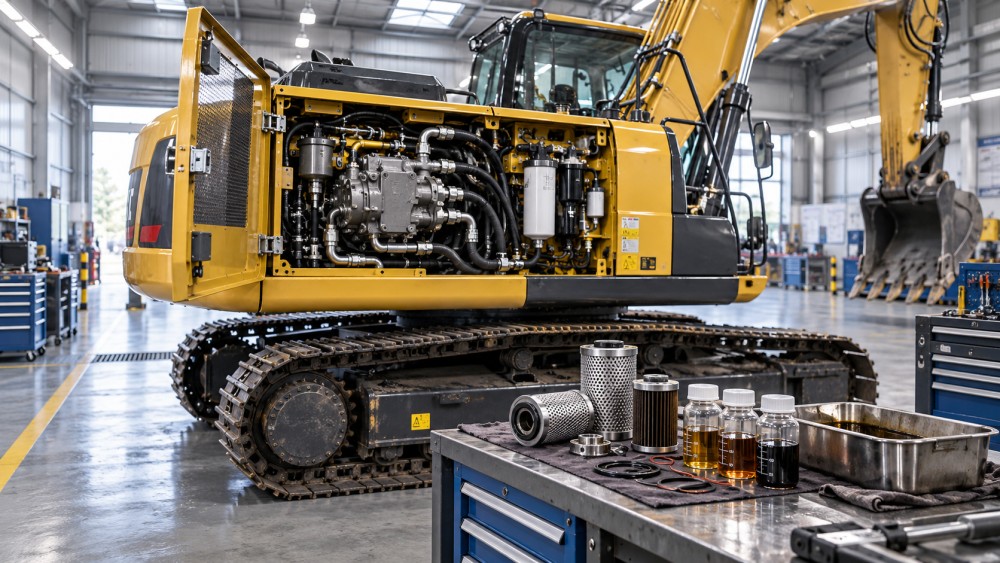
Consider a hypothetical repeat pump failure. Replacing the pump without examining the suction circuit, fluid condition, control settings, and contamination left by the earlier failure leaves several credible causes unresolved. Conversely, finding metal in the oil after a pump failure does not establish that contamination initiated the event; the damaged pump may have generated the particles.
Preserve useful evidence before cleaning or dismantling destroys it. Capture filter condition, debris location, hose routing, connector condition, and relevant settings. Take fluid samples using a consistent procedure and record whether sampling occurred before or after a fluid change. Where a warranty investigation is involved, coordinate component handling and teardown requirements with the responsible supplier.
Test explanations under the conditions that reproduce the complaint
Choose measurements that separate competing explanations. A pressure reading alone may not establish available hydraulic flow. A temperature reading taken after idling may miss the condition associated with sustained attachment use. A stored electrical fault code can identify a circuit requiring investigation without proving that its sensor needs replacement.
For overheating, establish which system is overheating and when. Check the cooling package, airflow, fan operation, fluid levels, and relevant controls against the machine’s service requirements. If hydraulic heat remains excessive, investigate potential sources such as sustained relief operation, excessive internal leakage, or an attachment circuit configuration that does not suit the attachment’s requirements. Cleaning the cooler may improve heat rejection while leaving excessive heat generation unresolved.
Use manufacturer procedures and model-specific limits for pressure, flow, temperature, and case-drain measurements. Case-drain flow, for example, requires interpretation alongside temperature, load, speed, and the specified test arrangement. Testing also needs controlled access, secure attachments, and safe management of stored hydraulic energy; an improvised connection can create a hazard and invalidate the result.
Close the diagnostic stage with an evidence-based explanation: the observed damage, the mechanism that best explains it, the contributing conditions, and the findings that rule out credible alternatives. If uncertainty remains, identify the next discriminating test rather than presenting a suspected cause as established.
Use FMEA to decide what must change before return to service
Once a mechanism is understood, failure mode and effects analysis (FMEA) helps the team examine whether the proposed repair addresses the wider risk. For a recurring service problem, a focused analysis of the affected function is usually more practical than a lengthy review of the entire excavator.
For each relevant failure mode, document its effect, likely causes, existing controls, and proposed action. A hose rupture, for example, could involve abrasion, unsuitable routing, incorrect assembly, pressure transients, or a specification mismatch. Each explanation implies a different preventive action. Replacing the hose with an identical assembly addresses only part of that investigation.
Prioritize actions using three considerations: how serious the consequence would be, how likely recurrence appears from available evidence, and how effectively existing checks can detect deterioration before failure. Numerical scoring can help teams compare issues, but a combined score should never conceal a severe safety consequence. A lower-frequency failure affecting load holding may warrant action ahead of a frequent nuisance alarm.
Useful corrective actions connect directly to a verified mechanism:
- If residual debris threatens a replacement component, define the cleaning, flushing, filtration, and verification work required by the affected system.
- If a hose repeatedly abrades, correct routing, support, clearances, and movement through the relevant operating envelope.
- If an attachment creates unsuitable circuit conditions, check compatibility, approved settings, return arrangements, and operating restrictions.
- If moisture or connector damage causes intermittent signals, address sealing, harness support, and the source of ingress.
“Operator error” is an incomplete corrective-action statement. Establish the specific action, whether it was permitted by the instructions, and whether the machine configuration, controls, or working conditions encouraged it. Training can address a knowledge gap, but cannot compensate for an unsuitable attachment configuration or an unresolved equipment defect.
Each action needs an owner, completion evidence, and an acceptance criterion. A workshop can then distinguish between a repair that restores function and additional work needed to prevent recurrence. Where the proposed change affects settings, structural parts, controls, or approved configurations, obtain the appropriate engineering or manufacturer authorization before implementation.
Monitor the mechanism and verify the repair under representative duty
Condition monitoring adds value when the measured condition has a credible relationship to the suspected failure. Collecting more readings does little if the team has no baseline, no consistent sampling method, and no action linked to an abnormal result.
Choose monitoring according to the mechanism. Fluid analysis may help track contamination, water, viscosity changes, or wear-related trends. Temperature measurements can reveal changes in thermal behavior. Pressure and flow tests can assess hydraulic performance under defined conditions. Electrical measurements and event logs can help investigate intermittent control faults. Visual checks remain important for routing, leakage, mounting, and cooling-system obstruction.
Interpret trends with their operating context. Hydraulic temperature depends on duty, ambient conditions, and the point of measurement. Wear-related results depend partly on fluid service history and sampling practice. A single result should not automatically trigger component replacement unless its meaning and the applicable action limit are clear.
Define acceptance before the machine leaves the workshop
A successful idle check is weak evidence for a fault that appeared only after sustained loaded operation. The verification plan should reproduce the relevant duty as safely and practically as possible, using the approved attachment and configuration. Record the conditions so that a later technician can repeat the assessment.
Acceptance criteria should cover the original complaint and the suspected mechanism. Following a hydraulic repair, this might include satisfactory function at operating temperature, measurements within the manufacturer’s specified limits, no leakage, and evidence that the contamination-control work met the prescribed requirements. The exact checks depend on the failure; a universal checklist cannot replace the model-specific procedure.
Some failures require follow-up exposure before the corrective action can be judged. Set the follow-up around operating hours and comparable duty, with a clear trigger for inspection or sampling. If a component previously failed after a particular period of service, an uneventful workshop test alone cannot demonstrate improved service life.
Track repeat failures by mode, operating exposure, and consequence. Mean time between failures can be useful for a sufficiently consistent group, but a fleet average may hide a problem concentrated in one attachment configuration or application. Pair failure frequency with downtime and repair effort to understand whether reliability and service recovery are improving.
For a machine already returning repeatedly, the next service order should contain more than a replacement part number. It should state the failure being investigated, the evidence supporting the repair, the condition that must be corrected, and how the result will be checked. That record gives the next technician a defensible starting point—and gives the maintenance team a practical basis for deciding whether the excavator is ready to return to its actual work.
Related News
 MSHA Issues Mine Truck Safety Alert After One Death and 121 InjuriesMining Infrastructure ExpertMSHA mine truck safety alert reports one death and 121 lost-time injuries. Discover why mine operators should review safety practices.
 How to size a crushing plant for ore processingMining Infrastructure ExpertSize your ore processing equipment crushing plant with confidence. Learn how to calculate throughput, assess ore characteristics, and prevent bottlenecks.
 Trump Administration Rewrites Mining Policy to Spur Critical Minerals DevelopmentMining Infrastructure ExpertU.S. critical minerals mining policy is changing. Explore what faster approvals could mean for investment, equipment demand and supply chains.
 How IEC 62443 defines security zones for industrial communication systemsRobotics EngineerExplore industrial communication systems and IEC 62443: learn how security zones, conduits, and risk-based controls help protect plant operations.
 China-Peru Trade Agreement Upgrade Takes Effect, Easing Machinery CertificationConstruction Equipment SpecialistThe China-Peru trade agreement upgrade simplifies machinery certification. Discover what mutual recognition could mean for exporters entering Peru.
 How do industrial control systems regulate water treatment?Robotics EngineerDiscover how industrial control systems in water treatment use sensors, PLCs, and SCADA to regulate processes and help operators respond to changing conditions.
 Exotec Report: 25% of Supply Chain Leaders Regret Warehouse Automation DecisionsRobotics EngineerWarehouse automation regret affects 25% of surveyed supply chain leaders, according to Exotec. Explore the cost, contract and readiness risks before investing.
 How to set maintenance intervals for mining equipment in AustraliaMining Infrastructure ExpertMining equipment maintenance Australia: Learn how to set service intervals using operating hours, site conditions and equipment data to reduce downtime.
 EY Survey Ranks Complexity as Mining's Top Risk for 2027Mining Infrastructure ExpertMining risk in 2027 is led by complexity, EY's survey finds. Discover how aging mines, declining ore grades and supply chain pressures are reshaping the industry.
 Can asset lifecycle management automation reduce equipment downtime?IEG Heavy Machinery & Automation AnalystDiscover how asset lifecycle management automation can reduce equipment downtime through timely maintenance, faster repairs, and smarter service workflows.
 Caterpillar Q3 2026 Revenue Rises 17% to $20.7 Billion as Both Equipment Segments GrowConstruction Equipment SpecialistCaterpillar Q3 2026 revenue reportedly rose 17% to $20.7 billion. Explore equipment segment growth and what it could mean for procurement planning.
 How to choose a rugged industrial control panel for wet environmentsRobotics EngineerChoose a rugged industrial control panel for wet environments. Compare IP ratings, materials, seals, and condensation control to improve reliability.