What data does predictive maintenance for mining trucks need?




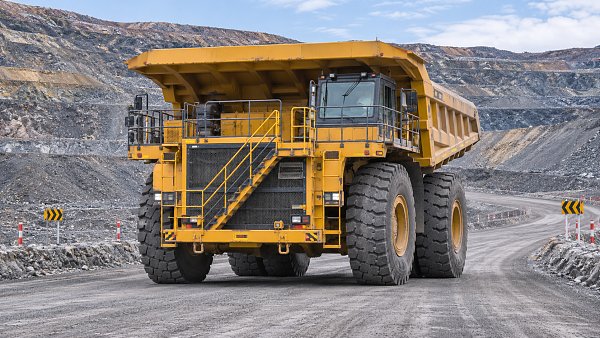
Predictive maintenance for mining trucks needs four connected types of data: component condition signals, operating conditions, maintenance history, and reliable asset identification. Temperature, pressure, vibration, oil analysis, and fault codes can reveal deterioration, but their meaning depends on the truck’s load, route, operating state, and service history.
The required dataset depends on the failure being targeted. Detecting cooling-system degradation calls for different measurements than identifying wheel-bearing damage or electric-drive insulation problems. A useful starting point is therefore a specific component, a plausible warning signal, and a maintenance action that can follow early enough to matter.
Start with the failure mode and the maintenance decision
“Predict truck failures” is too broad to define a data specification. A more practical objective is to detect a developing cooling restriction early enough to inspect the radiator during a planned stop. That objective identifies relevant measurements, the operating conditions needed for comparison, and the warning time required.
Separate three levels of capability. Condition monitoring describes the current state. Anomaly detection identifies behavior that differs from an established baseline. Failure prediction estimates the likelihood of a defined event within a specified period. Remaining useful life estimation goes further by estimating how much service remains before a defined limit is reached.
Each level requires stronger evidence. Normal operating data may support anomaly detection, while a credible failure forecast generally needs historical examples linking earlier signals to confirmed outcomes. A system should not present an unusual temperature pattern as a precise estimate of remaining component life.
Which data sources reveal truck deterioration?
Existing onboard systems provide a useful foundation, but coverage varies by truck model, drivetrain, and installed options. The following sources serve different purposes; no individual source provides complete coverage.
Temperature and pressure need operating context
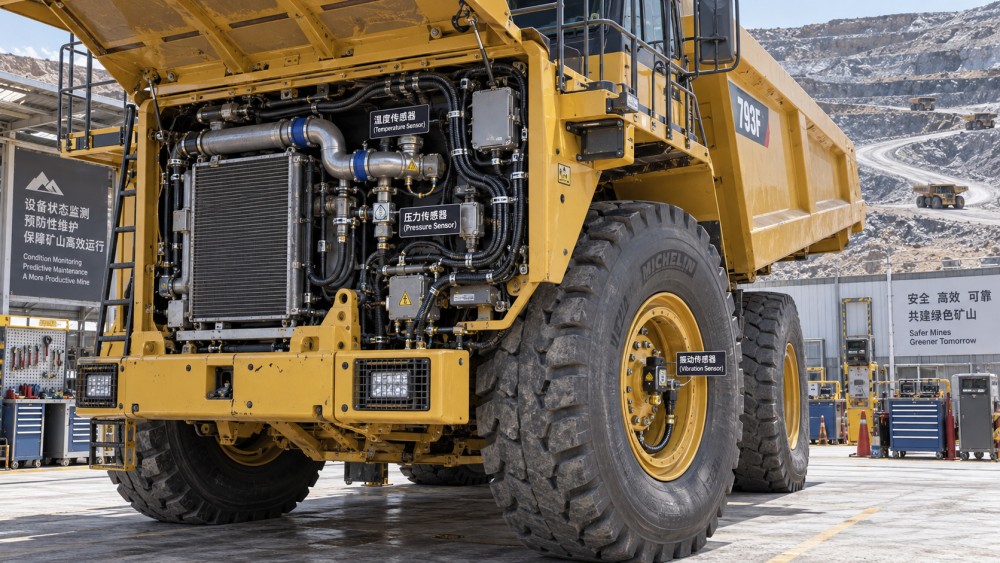
Coolant temperature, engine oil pressure, transmission temperature, and hydraulic pressure can support useful monitoring without additional sensors. Their value usually comes from relationships and trends. Oil pressure should be interpreted alongside oil temperature and engine speed. A coolant-temperature increase becomes more informative when compared at similar engine load, ambient temperature, and travel conditions.
For a diesel-electric haul truck, relevant channels may also include traction-motor temperatures, electrical currents, inverter events, and cooling-system measurements. Mechanical-drive trucks require a different emphasis, including transmission behavior and drivetrain lubrication. A common fleet dashboard should preserve these differences.
Vibration requires more than a dashboard trend
A low-rate vibration summary may reveal broad changes but cannot preserve all the frequency content needed for bearing or gear diagnosis. Diagnostic value depends on sensor location, mounting, measurement direction, bandwidth, and sampling rate. The acquisition system also needs appropriate filtering to prevent higher-frequency content from appearing as misleading lower-frequency signals.
On a mining truck, road impacts can dominate the measurement. Compare recordings from suitable operating windows and retain speed information where rotating frequencies change. Continuous waveform transmission is not always necessary: an onboard device can calculate features and preserve raw recordings when an event warrants investigation.
Fluid analysis needs service history attached
Wear-metal concentrations become more useful when the record includes the sampled compartment, lubricant type, hours on the fluid, component hours, and recent top-ups or changes. A falling concentration after an oil change does not by itself demonstrate reduced wear.
Sampling location and procedure should remain consistent. Different analysis methods also capture different aspects of contamination and wear; a single wear-metal result cannot represent every particle size or damage mechanism. Interpret laboratory results alongside inspections, filter findings, and operating trends.
Operating context separates heavy work from developing faults
A truck climbing a steep ramp under full payload will behave differently from the same truck returning empty. Without that distinction, a model can repeatedly flag normal production work as abnormal.
Useful context includes payload, travel speed, road grade, engine load, braking or retarding activity, ambient temperature, and cycle stage. Location can help distinguish route effects, especially where road roughness or gradients vary. Tire monitoring may also need inflation history and load exposure to interpret pressure and temperature changes.
Consider a rising drivetrain temperature. If it appears only after assignment to a more demanding route, the change may reflect operating conditions. If the temperature continues rising under comparable loads and ambient conditions, inspection becomes more justified. Context makes that comparison possible.
Baselines should account for truck configuration and component age. Comparing a recently rebuilt assembly with an older unit without recognizing the difference can distort the assessment. Operator identity is not always necessary; measurable behavior such as harsh braking or prolonged idling may provide the relevant context more directly.
Maintenance records turn signals into usable evidence
A sensor trend can show that something changed. Maintenance records establish what the change meant. To support failure prediction, connect the signal history to the affected component, observed symptoms, inspection findings, repair action, and subsequent operating condition.
A work order stating “transmission replaced” is incomplete evidence. The replacement could follow internal damage, an external leak, a scheduled overhaul, or troubleshooting that did not confirm the original diagnosis. Those events should not all receive the same failure label.
Record when the symptom was first observed, when the truck stopped, and when technicians confirmed the cause. These times serve different purposes. The work-order closing date may be much later than the physical event and can produce misleading warning-time calculations.
Track component identity separately from truck identity. Engines, wheel motors, transmissions, and other assemblies may move between trucks or return after rebuilding. Their operating history should follow the component, with installation and removal dates linking it to each vehicle.
Healthy histories also matter, although “no recorded failure” does not always mean a healthy component. A truck may leave the dataset, undergo preventive replacement, or remain in service when observation ends. These incomplete histories need appropriate treatment, particularly in remaining-life models.
Data quality requirements that affect technical feasibility
A large archive is useful only if its records support the intended diagnosis. Before selecting an analytics platform, examine whether the data can answer the following questions consistently.
- Can every measurement be traced to the correct asset? Use stable truck and component identifiers, including sensor replacements and configuration changes.
- Do timestamps represent the measurement event? Preserve source timestamps and distinguish them from upload times. Delayed transmission should not change the apparent sequence of events.
- Are units and signal meanings explicit? Document scaling, measurement location, valid ranges, and whether a value is instantaneous, averaged, or calculated.
- Are missing and invalid readings recognizable? Communication gaps, sensor faults, and unavailable channels should remain distinguishable from genuine zero values.
- Is the sampling rate suitable? Slow thermal changes and fast vibration events require different acquisition strategies. One fleet-wide interval rarely suits every signal.
Time alignment deserves particular attention. A temperature rise paired with the wrong payload cycle can create a false relationship. The required timing precision depends on the event: thermal analysis can tolerate coarser alignment than a short electrical or pressure transient. Clock drift and inconsistent time-zone handling can undermine both.
There is no universal minimum history duration or dataset size. Adequacy depends on failure frequency, seasonal variation, truck diversity, and the prediction objective. Millions of normal readings cannot replace missing examples of the failure being modeled.
Integration and standards: specify what must be accessible
Truck networks, OEM telematics services, laboratory systems, dispatch software, and maintenance platforms often expose different parts of the required history. A documented interface alone does not establish that the necessary data is available. Check actual channel coverage, refresh rates, historical depth, export options, and usage rights.
Standardized vehicle-network messages can simplify access to some measurements, while other channels depend on manufacturer-specific definitions. Signal interpretation may also change with controller software versions. Retain decoding information and configuration history so that a software update does not silently alter the dataset’s meaning.
For condition-monitoring architecture, recognized standards can provide a framework for organizing acquisition, processing, health assessment, and advisory functions. They do not establish a universal sensor list or guarantee predictive accuracy. Acceptance requirements still need to identify the target failure modes, available measurements, data-quality limits, and expected outputs.
Mine connectivity requires practical design choices. Onboard buffering preserves measurements through coverage gaps. Local processing can support timely alerts and reduce waveform transmission. Recovery after an outage should preserve timestamps and prevent duplicate records. Data collection should use approved interfaces and respect the truck’s control-network boundaries.
Prove that the available data supports a useful warning
A pilot should test a defined maintenance decision. Select a component with meaningful downtime consequences, plausible observable degradation, accessible signals, and records detailed enough to assess outcomes. Confirm that an alert could lead to inspection, parts preparation, or a planned intervention.
Historical evaluation should recreate what would have been known when an alert occurred. Repair notes, later laboratory results, and post-failure measurements must not enter earlier predictions. This form of information leakage can make an ineffective system appear accurate.
Use time-based testing and, where relevant, hold out trucks or operating conditions to assess transferability. Randomly splitting adjacent sensor readings can place nearly identical operating periods in both training and test datasets, overstating performance.
Assess missed events, false alerts, usable warning time, and the workload imposed on maintenance teams. Count alerts as operational episodes rather than treating every repeated reading as a separate successful prediction. A warning is useful only when its timing and diagnostic detail support a feasible response.
If verified failure examples are scarce, begin with condition monitoring, engineering thresholds, or anomaly detection while improving inspection feedback. Ask for a representative data extract before committing to a larger deployment. Trace one component from installation through operation, an abnormal event, and a confirmed maintenance outcome. That exercise reveals whether the available information can support a predictive claim and which missing data deserves investment first.
Related News
 MSHA Issues Mine Truck Safety Alert After One Death and 121 InjuriesMining Infrastructure ExpertMSHA mine truck safety alert reports one death and 121 lost-time injuries. Discover why mine operators should review safety practices.
 How to size a crushing plant for ore processingMining Infrastructure ExpertSize your ore processing equipment crushing plant with confidence. Learn how to calculate throughput, assess ore characteristics, and prevent bottlenecks.
 Trump Administration Rewrites Mining Policy to Spur Critical Minerals DevelopmentMining Infrastructure ExpertU.S. critical minerals mining policy is changing. Explore what faster approvals could mean for investment, equipment demand and supply chains.
 How IEC 62443 defines security zones for industrial communication systemsRobotics EngineerExplore industrial communication systems and IEC 62443: learn how security zones, conduits, and risk-based controls help protect plant operations.
 China-Peru Trade Agreement Upgrade Takes Effect, Easing Machinery CertificationConstruction Equipment SpecialistThe China-Peru trade agreement upgrade simplifies machinery certification. Discover what mutual recognition could mean for exporters entering Peru.
 How do industrial control systems regulate water treatment?Robotics EngineerDiscover how industrial control systems in water treatment use sensors, PLCs, and SCADA to regulate processes and help operators respond to changing conditions.
 Exotec Report: 25% of Supply Chain Leaders Regret Warehouse Automation DecisionsRobotics EngineerWarehouse automation regret affects 25% of surveyed supply chain leaders, according to Exotec. Explore the cost, contract and readiness risks before investing.
 How to set maintenance intervals for mining equipment in AustraliaMining Infrastructure ExpertMining equipment maintenance Australia: Learn how to set service intervals using operating hours, site conditions and equipment data to reduce downtime.
 EY Survey Ranks Complexity as Mining's Top Risk for 2027Mining Infrastructure ExpertMining risk in 2027 is led by complexity, EY's survey finds. Discover how aging mines, declining ore grades and supply chain pressures are reshaping the industry.
 Can asset lifecycle management automation reduce equipment downtime?IEG Heavy Machinery & Automation AnalystDiscover how asset lifecycle management automation can reduce equipment downtime through timely maintenance, faster repairs, and smarter service workflows.
 Caterpillar Q3 2026 Revenue Rises 17% to $20.7 Billion as Both Equipment Segments GrowConstruction Equipment SpecialistCaterpillar Q3 2026 revenue reportedly rose 17% to $20.7 billion. Explore equipment segment growth and what it could mean for procurement planning.
 How to choose a rugged industrial control panel for wet environmentsRobotics EngineerChoose a rugged industrial control panel for wet environments. Compare IP ratings, materials, seals, and condensation control to improve reliability.