Can Automated Guided Vehicles Handle Uneven Factory Floors?




Can automated guided vehicles handle uneven factory floors? Yes, but only when the vehicle, route, payload, and floor condition are evaluated as one system. A minor expansion joint that causes no problem for a forklift can create repeated stops, load sway, sensor errors, or premature wheel wear for an AGV. The practical question is not whether a floor is perfectly flat. It is whether its irregularities stay within the operating limits of the selected vehicle and its safety design.
Many automation projects run into trouble because floor quality is treated as a civil-maintenance issue after the AGV decision has already been made. In reality, cracks, joint gaps, local depressions, ramps, drainage channels, damaged coatings, and uneven transitions are part of the mobile robot’s operating environment. They should be inspected before a route is approved, not after the first vehicle starts stopping in production.
Can Automated Guided Vehicles Handle Uneven Factory Floors?
They can handle some unevenness, but not every type of unevenness and not at every load level. A low-profile tugger moving empty carts on smooth concrete has very different tolerances from a counterbalanced AGV carrying a tall pallet of fragile components. Wheel diameter, ground clearance, suspension, drive-wheel arrangement, chassis stiffness, speed settings, navigation method, and load center all affect the result.
Here is the short answer: AGVs are usually reliable on sound industrial floors with small, gradual surface variations. They become less reliable where there are abrupt height changes, wide cracks, loose edges, steep ramps, standing water, or damaged joints. A route may still be feasible, but it may require floor repair, slower travel zones, different wheels, a more suitable vehicle type, or a redesigned material flow.
The mistake is assuming that an AGV is simply a driverless forklift. A human driver can see a broken joint, reduce speed instinctively, correct steering, or avoid a rough patch. An AGV follows programmed operating rules. Its sensors and controls can respond to certain conditions, but they cannot make a poor route disappear.
What “Uneven” Means in a Working Factory
Factory floors rarely fail in one dramatic way. More often, the route contains a collection of small defects that become significant once a vehicle passes through them hundreds of times per shift.
Expansion and construction joints are common examples. A narrow, clean joint may be acceptable, while a joint with broken edges can create a sharp impact. The concern is not only whether the AGV can cross it. Repeated impact can loosen loads, affect onboard electronics, damage wheels, increase maintenance, and make positioning less repeatable at pickup or drop-off stations.
Floor cracks require the same judgment. A hairline crack in stable concrete is different from a widening crack with crumbling edges or vertical displacement. The latter can catch small wheels and casters, especially on pallet trucks, unit-load AGVs, and carts being towed behind a vehicle.
Ramps deserve special attention because they combine grade, traction, braking, and load stability. A ramp that is manageable when dry and unloaded may become unsafe when the vehicle carries a heavy pallet, encounters dust, or stops partway through the climb. Door thresholds and transitions between old and new slabs are similarly easy to underestimate. They are short, but their abrupt profile can be more disruptive than a longer, gentle slope.
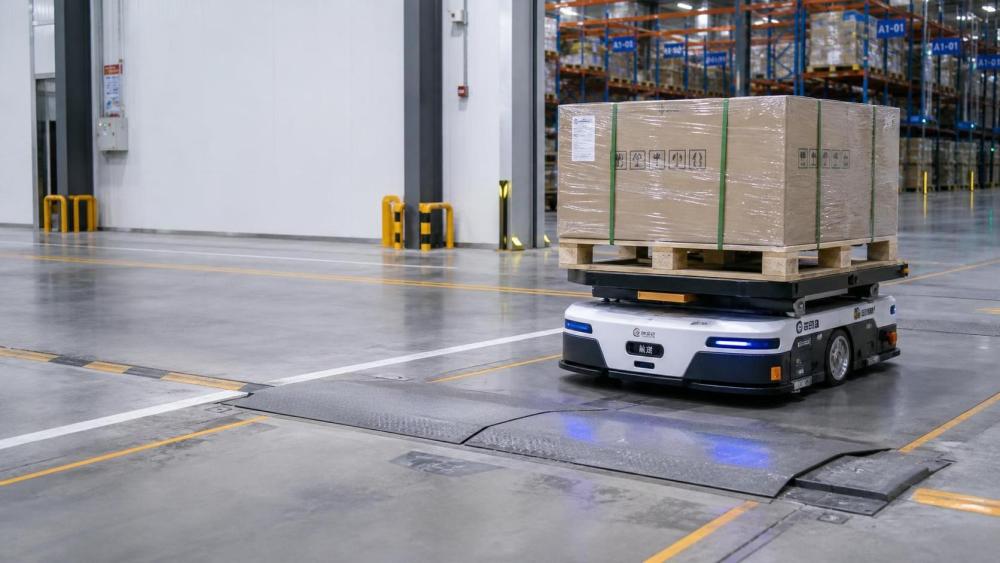
Surface condition also changes over time. Areas near loading docks, presses, washdown zones, ovens, and high-traffic forklift lanes often deteriorate faster than the rest of the plant. That is why a one-time survey before installation is necessary but insufficient. The route needs an ownership plan: who reports damage, who decides whether an area is safe, and how route restrictions are updated after repairs or layout changes.
The Vehicle Design Matters More Than the Label “AGV”
There is no universal answer for all automated guided vehicles. The same floor may be suitable for one platform and unsuitable for another.
Vehicles with larger wheels generally cross small gaps and rough transitions more easily than units with small, hard wheels. Pneumatic or compliant wheels may improve ride quality and traction, although they bring their own maintenance and load-capacity considerations. A vehicle with a low chassis can be vulnerable to raised joints or debris even when its wheels cross the obstacle without difficulty.
Drive configuration also changes behavior. Some AGVs rely on a drive wheel that must maintain consistent contact for steering and traction. Others use multiple powered wheels or more stable wheel arrangements. A vehicle that pitches or rocks on an uneven surface may lose traction, stop because of a safety condition, or struggle to align accurately with conveyors, racks, or docking fixtures.
Payload changes the calculation again. With a centered, low load, a modest floor variation may only reduce ride comfort. With a tall load or a load whose center of gravity shifts during travel, that same variation can create a stability concern. Containers holding liquids, stacked cartons, precision parts, or exposed assemblies may need tighter route conditions than the vehicle itself.
Ask suppliers for route-specific limits rather than a general statement that the AGV “handles uneven floors.” Useful questions include:
- What maximum step, gap, ramp, and cross-slope can the vehicle cross under the planned load?
- Do the limits change at full payload, with a raised load, or while towing multiple carts?
- What wheel material and diameter are specified for this floor?
- What happens when a wheel loses traction or the vehicle detects excessive tilt?
- Can the supplier demonstrate the proposed route with representative loads and normal operating speeds?
A responsible supplier should be willing to discuss these questions in concrete terms. If the answer stays vague, the project team should treat floor compatibility as unresolved.
Navigation May Be Affected, but It Is Not the Main Problem
Navigation technology matters, though it is often blamed for problems caused by mechanical conditions. Laser-based navigation, natural-feature navigation, QR-code guidance, magnetic guidance, and other methods each have different dependencies. A sudden jolt can cause an AGV to slow down, trigger a protective stop, or require a position check. Yet a vehicle that physically cannot cross a damaged joint safely will not become suitable because its navigation is more advanced.
Natural-feature and laser-navigation systems may need adequate environmental reference points and clean sensor views. Magnetic or embedded guidance can provide repeatable paths, but it does not correct poor ride quality. Vision-based systems can be affected by lighting, glare, dust, and floor markings. The right decision starts with vehicle-road interaction, then checks whether the navigation system remains dependable in that environment.
There is another practical issue: docking accuracy. A floor defect near a conveyor transfer, charging station, rack interface, or robot cell can change the vehicle’s final position by enough to interrupt an otherwise well-designed automated handoff. The route may look fine during travel but fail at the points where accuracy matters most. Inspect approach zones and stopping positions with the same care as the main aisle.
Start With a Route Survey, Not a Vehicle Brochure
The best way to evaluate an AGV project on uneven factory floors is to map the actual route in operating conditions. Do not rely only on building drawings or a quick walk-through. The route should include every pickup point, drop-off point, ramp, doorway, charger approach, aisle turn, and place where people or forklifts create congestion.
First, identify visible defects: broken concrete, chipped joint edges, gaps, patches, floor drains, cable covers, worn coatings, and areas where water or oil collects. Then look for less obvious issues. Check whether racking settlement has altered a slab, whether dock plates introduce a sharp transition, and whether seasonal temperature changes affect joints. In older plants, separate construction phases can leave subtle level changes between bays.
Next, measure rather than estimate. The required measurement method depends on the AGV supplier and the risk level of the application, but the assessment should capture the size, shape, and location of discontinuities. Photos help, but they are not a substitute for dimensions. Record the condition under which the AGV will operate: dry or wet, loaded or unloaded, empty cart or maximum train length, normal speed or peak throughput speed.
Then classify each issue. Some defects should be repaired before commissioning. Others can be managed by reducing speed, defining a no-load route, adding a transition plate, changing a wheel specification, or rerouting traffic. The key is to avoid treating every defect the same way. A small isolated transition in a low-speed zone may be manageable. The same transition at the end of a long run, where a vehicle needs to stop precisely with a high load, may not be.
Common Fixes That Work, and a Few That Do Not
Floor repair is often the best long-term answer when damage is localized and the route is strategically important. Repairing broken joint edges, filling severe cracks, grinding abrupt lips, and improving transitions can benefit forklifts and pedestrians as well as AGVs. It can also reduce the need to overspecify the vehicle.
Transition plates can help across certain joints, thresholds, or small level differences. They must be securely installed and designed for the wheel loads, cleaning practices, and traffic pattern of the site. A loose plate simply creates a new hazard. Likewise, coatings can improve surface protection but may affect traction when contaminated. The relevant question is not whether a surface looks smoother after treatment; it is whether it performs predictably under actual vehicle and load conditions.
Speed zoning is useful when the issue is isolated and the vehicle can cross safely at lower speed. It is not a cure for a route that is fundamentally unsuitable. Slowing a vehicle at every rough point may reduce impact, but it can also undermine the throughput case used to justify automation.
Changing AGV type may be sensible when floor repair would be extensive or when the route includes outdoor links, dock transitions, or mixed industrial surfaces. In some facilities, an autonomous mobile robot with a more suitable chassis, wheel package, and navigation design may fit the environment better. That does not remove the need for assessment. It changes the capability envelope that must be verified.
A common poor fix is to run a lightly loaded demonstration and assume full production will be equally stable. Another is to test only a clean, dry route. Real operating conditions include dust, pallet variation, worn wheels, traffic delays, charging cycles, and occasional route obstruction. Acceptance testing should reflect the work the system will actually perform.
When an AGV Project Should Pause
Pause the purchase decision when the floor has active structural movement, frequent water intrusion, loose or rapidly deteriorating concrete, major unprotected changes in level, or a route that depends on repeated travel across unsuitable thresholds. These conditions do not always mean automation is impossible. They do mean that the project scope should include civil work, a different vehicle concept, or a revised flow design.
Also pause when the operating team cannot define the real payload. “Up to this weight” is not enough. The AGV provider needs the load dimensions, center of gravity, pallet condition, container stability, towing resistance, and expected traffic volume. A vehicle may have adequate rated capacity while still being a poor choice for a tall, unstable load on an uneven route.
Industrial Edge Global approaches equipment decisions as lifecycle decisions rather than simple product comparisons. For AGV planning, that means accounting for floor preparation, commissioning, maintenance access, spare wheels, route changes, service support, safety validation, and the cost of downtime alongside the initial vehicle price. That broader view often reveals whether a floor upgrade is an expense or a necessary part of a reliable material-handling investment.
A Practical Decision Before You Commit
Can automated guided vehicles handle uneven factory floors? They can, within defined limits, and the limits must be proven on the intended route with representative loads. A clean route survey, supplier-specific capability data, realistic testing, and a clear plan for repairs will give a far better answer than a generic yes or no.
Do not ask the AGV alone to compensate for an uncontrolled environment. Fix the defects that create safety or reliability risk, choose a vehicle suited to the remaining conditions, and test the interfaces where precise positioning matters. That is how a floor assessment becomes a dependable automation decision rather than an expensive commissioning surprise.
Frequently Asked Questions
Can AGVs cross expansion joints?
Often, yes, if the joint width, edge condition, height difference, and vehicle wheel design are within the supplier’s stated limits. Damaged or uneven joint edges are usually more problematic than a clean, narrow joint.
Are AGVs suitable for cracked concrete floors?
It depends on the crack. Stable hairline cracks may have little operational effect. Cracks with gaps, loose material, vertical displacement, or water ingress should be assessed and commonly repaired before regular AGV traffic begins.
Can slower AGV speeds solve a rough-floor problem?
Slower speed can reduce shock and improve control at a limited number of rough locations. It cannot make an unsafe crossing safe, restore lost traction, or protect a poorly supported load from repeated instability.
Should the floor be repaired before selecting an AGV?
Inspect it before selection, then decide which repairs are necessary based on the chosen vehicle’s verified limits and the planned load. Repairing critical defects early usually reduces commissioning delays and avoids selecting an unnecessarily expensive vehicle.
Related News
 What is driving consolidation in the global equipment supplier market?IEG Heavy Machinery & Automation AnalystGlobal equipment supplier market consolidation is accelerating through technology, service, and supply-chain demands. Discover how buyers can capture value while managing risk.
 When does capital equipment investment pay back in manufacturing?IEG Heavy Machinery & Automation AnalystCapital equipment investment manufacturing: learn when equipment truly pays back by evaluating full costs, cash flow, ramp-up, operational risks, and lifecycle value.
 When does a distribution center need an automated pallet handling system?Heavy Lifting Systems AnalystPallet handling systems help distribution centers overcome labor shortages, bottlenecks, safety risks, and storage constraints. Discover the key signs it’s time to automate.
 How to build a machinery investment plan around payback periodIEG Heavy Machinery & Automation AnalystMachinery investment planning manufacturing guide: build a credible payback plan with full costs, ramp-up assumptions, lifecycle risks, and scenario-based cash benefits.
 How to Specify a Modular Packaging Line for Fast Changeovers and Scalable OutputRobotics EngineerModular packaging line specification guide: achieve faster changeovers, scalable output, reliable controls, and lower lifecycle costs with practical planning.
 How industrial IoT devices reduce unplanned downtime in factoriesRobotics EngineerIndustrial IoT devices help factories detect early equipment issues, plan maintenance, and reduce costly unplanned downtime before production is disrupted.
 What is driving industrial machinery market demand in manufacturing?IEG Heavy Machinery & Automation AnalystIndustrial machinery market manufacturing demand is rising as factories pursue automation, energy efficiency, resilient supply chains, and lifecycle productivity gains.
 316L Stainless Steel Pipe Tube Technical Factors That Shape Buyer DecisionsCNC Machining AnalystA technical analysis for 316L stainless steel pipe tube buyers, covering corrosion expectations, pipe route choice, tolerance, surface, and inspection.
 How ground conditions determine crawler piling equipment selectionConstruction Equipment SpecialistCrawler piling equipment selection starts with ground conditions. Learn how soil, rock, groundwater and site constraints shape safer, more productive piling solutions.
 3300mm CNC Beam Saw Sheet Capacity: Layout Checks Before PurchaseCNC Machining AnalystZhongding ZD330 beam saw specifications: assess 3300mm sheet capacity, layout clearances, handling flow, and acceptance checks before buying.
 How Bucket Chain Diamond Dredgers Meet ISO 12100 Safety Requirements in Alluvial Mining ProjectsMining Infrastructure ExpertBucket chain diamond dredger safety made real: how ISO 12100 compliance ensures operator protection, reliability & zero lost-time injuries in alluvial mining.
 Modular Packaging for High-Mix Automotive Assembly Lines: How Standardized Load Units Reduce Line Changeover Time by 37% — Case Study from Tier-1 Supplier in GuangdongHeavy Lifting Systems AnalystModular packaging slashes automotive line changeover time by 37%—discover how standardized load units boost OEE, cut labor costs, and enable seamless high-mix assembly.