How Quickly Do Industrial Robot Makers Respond to Breakdown Calls?




An industrial robot maker can begin responding to a breakdown within minutes if the plant has access to a staffed emergency support channel. Getting a qualified engineer on site is a separate commitment, and restoring production may take longer still. Without a service agreement that defines these stages, “fast response” is not a reliable measure of downtime protection.
There is no single response time that applies across manufacturers, locations, and robot models. The useful question is whether the supplier can commit to technical engagement, dispatch, parts delivery, and recovery support at the specific installation address—and what happens when any of those commitments cannot be met.
Separate the first reply from the return to production
A breakdown call starts several different clocks. Confusing them makes service offers look more comparable than they really are.
A promise to “respond within two hours,” for example, could mean a telephone consultation rather than an engineer arriving within two hours. That wording is an illustrative contract term, not an industry benchmark. Its value depends entirely on the definition attached to it.
Repair and recovery also need separate treatment. A replaced servo motor may clear a controller fault, but the robot may still require mastering checks, position verification, and application testing. In welding, dispensing, or precision handling, movement alone does not prove that acceptable production has resumed.
What determines how quickly useful support begins?
The first constraint is service coverage. A continuously monitored emergency line can accept a call during a night shift; a business-hours help desk may not begin technical work until its next operating period. A website that accepts tickets around the clock does not establish that engineers are available around the clock.
Contract priority matters as well. Suppliers may distinguish a complete production stop from reduced performance, intermittent alarms, or a nonurgent programming request. A stopped robot in a redundant cell can have a different production impact from a failed robot that blocks the only route through a line. The severity definition should capture that impact rather than rely only on the equipment’s condition.
Technical coverage is another limit. A support agent may answer immediately but need to escalate the problem to someone familiar with an older controller, a specific software option, or an unusual application. The meaningful response is the point at which someone capable of advancing the diagnosis becomes involved.
Geography affects field attendance more directly than telephone support. Engineer availability, travel distance, border crossings, site access, and competing emergency calls all influence arrival. A service office in the same country is not evidence that a suitably qualified engineer is stationed near the factory.
For an installation purchased through an overseas exporter or distributor, the service provider must be identified explicitly. The seller, robot manufacturer, local dealer, and system integrator may have different obligations. Warranty eligibility does not by itself establish an emergency arrival commitment or who pays travel expenses.
Make the first breakdown call diagnostic, not merely urgent
A call stating that “the robot has stopped” leaves the support team with too many possible causes. The same visible symptom can originate in the robot controller, a safety circuit, the cell PLC, an end-effector, or upstream equipment. Providing a concise fault record helps the supplier direct the incident to the right specialist without repeated handoffs.
The initial report should include:
- The robot model, controller type, serial number, and installation location.
- The exact alarm code and message, including associated alarms and their sequence.
- The operating mode and task being performed when the stop occurred.
- Whether one robot, the whole cell, or several connected machines are affected.
- Any preceding collision, maintenance work, software change, power interruption, or tooling change.
- Relevant photographs, controller logs, and the availability of current backups.
- The production impact, safe access conditions, and an authorized site contact.
Preserve fault information before clearing alarms or restarting equipment, where this can be done safely. Repeated resets can remove useful evidence or expose the equipment to further damage if the underlying problem is mechanical or electrical.
Remote diagnosis is useful when the controller remains accessible and the fault can be investigated through logs, status information, or authorized tests. It cannot establish every physical condition. Suspected gearbox damage, damaged cables, loose connections, or a failed component can still require on-site inspection.
Remote access should be prepared before a breakdown, with approved credentials, network permissions, and clear authorization. During an incident, an unresolved access request can delay diagnosis even when the supplier has an engineer ready. Remote instructions must remain within site safety procedures; production urgency is not a reason to bypass interlocks or enter a hazardous area.
Resolve the boundary between robot support and cell support
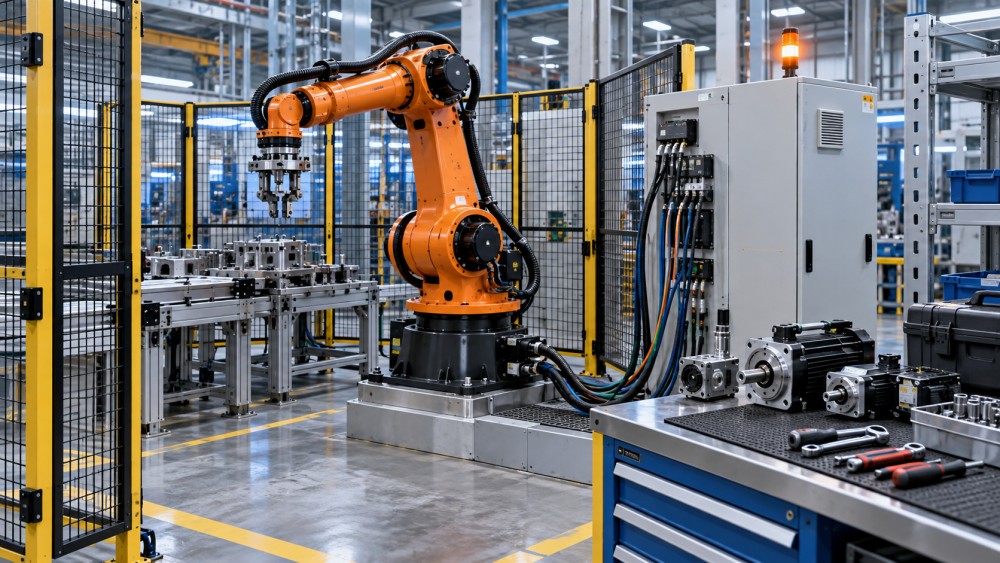
A robot is one part of an automation system. The manufacturer may support its arm, controller, drives, and supplied software while the integrator supports sequence logic, tooling, vision, conveyors, and interfaces with other equipment.
This division becomes critical when the robot appears healthy but cannot proceed. It may be waiting for a PLC signal, a gripper confirmation, or a safety condition. The manufacturer can confirm the robot’s status without being responsible for correcting the external cause.
The service arrangement should name an incident coordinator for faults that cross these boundaries. That party needs access to the relevant specialists and authority to keep the investigation moving. Otherwise, each supplier can fulfill a narrow response obligation while the production line remains stopped.
Responsibility should also cover modifications made after commissioning. A changed gripper, revised PLC program, or altered safety configuration can invalidate old documentation and complicate diagnosis. Maintaining current drawings, software versions, and change records is therefore part of reducing recovery time, not simply an administrative task.
Parts availability can outweigh a fast engineer arrival
Once a fault requires a replacement part, the recovery schedule depends on more than technical support. The relevant question is not whether the supplier stocks spare parts somewhere, but whether the correct part is available, compatible, and deliverable to the installation.
Compatibility can depend on controller generation, hardware revision, firmware, motor configuration, or licensed software. A component that looks interchangeable may need configuration or may not suit the installed system. Stock claims should be checked against the actual robot and controller, not just the product family.
Cross-border supply adds further conditions: export processing, customs clearance, transport schedules, and responsibility for import documentation. Local stock can avoid some of these steps, but “available locally” should distinguish physically held inventory from parts that can be ordered through a local office.
For critical components, establish:
- Where the compatible spare is held and whether it is reserved or shared.
- How emergency release works outside normal warehouse hours.
- Whether the part is new, repaired, or supplied through an exchange program.
- Who installs it and performs configuration, calibration, or mastering.
- What support remains available for discontinued hardware.
Holding spares on site can shorten recovery, but only if they are maintained appropriately and someone is qualified to use them. An unconfigured controller or an incorrectly stored component is not equivalent to a ready-to-install spare.
The stocking decision should weigh the consequence of waiting against the purchase price, storage requirements, shelf life, and obsolescence risk. It does not require stocking every possible failure item. It requires identifying which unavailable components could create an unacceptable production interruption.
Write service commitments that can be measured
A useful service-level agreement defines the event that starts each clock, the actions required, the applicable hours, and the permitted exclusions. “Priority support” or “rapid assistance” provides little basis for comparing offers unless those terms are translated into operational commitments.
The start time deserves particular attention. Does it begin when the emergency call connects, when a ticket is submitted, or when the supplier accepts the severity classification? If essential information is missing, the agreement should explain whether a clock pauses and how that pause is recorded.
Separate technical response from on-site attendance. Where attendance depends on location, the commitment should refer to the actual site rather than a broad regional coverage statement. Define weekends, public holidays, local time zones, and whether the service window matches the factory’s operating schedule.
Recovery guarantees need closer scrutiny than response guarantees. A fixed repair deadline may have exclusions for unavailable parts, external equipment, customer access restrictions, or damage outside the contract. These can be legitimate limitations, but they materially change the protection being purchased.
Also specify the escalation route, update frequency, and responsibilities while the incident remains unresolved. A named escalation contact and a written recovery plan are more useful during a prolonged outage than repeated assurances that the case is urgent. Service credits may compensate for a missed commitment, but they do not replace lost output.
Compare evidence at the site level
Brand reputation alone cannot establish response speed at a particular factory. Request evidence relevant to the installation: coverage hours, engineer qualifications, dispatch arrangements, compatible spare inventory, and support for the installed controller generation.
Where service records are available, distinguish call-answer time from qualified technical response, arrival time, and restoration time. An average can hide a small number of lengthy incidents. Records are more informative when they identify fault type, location, service coverage, and delays caused by parts or access restrictions.
A planned support exercise can test the contact route and escalation process without pretending there is a real breakdown. Verify that the emergency number works, the equipment record is recognized, authorized contacts are listed, and remote access can be established under approved conditions.
The purchasing decision should ultimately rest on a credible recovery path: who diagnoses the fault, who owns the complete cell problem, who can attend, and how the necessary parts reach the site. A quick acknowledgment is useful, but dependable breakdown support is the ability to move from that acknowledgment to safe, verified production with clearly assigned responsibilities.
Related News
 MSHA Issues Mine Truck Safety Alert After One Death and 121 InjuriesMining Infrastructure ExpertMSHA mine truck safety alert reports one death and 121 lost-time injuries. Discover why mine operators should review safety practices.
 How to size a crushing plant for ore processingMining Infrastructure ExpertSize your ore processing equipment crushing plant with confidence. Learn how to calculate throughput, assess ore characteristics, and prevent bottlenecks.
 Trump Administration Rewrites Mining Policy to Spur Critical Minerals DevelopmentMining Infrastructure ExpertU.S. critical minerals mining policy is changing. Explore what faster approvals could mean for investment, equipment demand and supply chains.
 How IEC 62443 defines security zones for industrial communication systemsRobotics EngineerExplore industrial communication systems and IEC 62443: learn how security zones, conduits, and risk-based controls help protect plant operations.
 China-Peru Trade Agreement Upgrade Takes Effect, Easing Machinery CertificationConstruction Equipment SpecialistThe China-Peru trade agreement upgrade simplifies machinery certification. Discover what mutual recognition could mean for exporters entering Peru.
 How do industrial control systems regulate water treatment?Robotics EngineerDiscover how industrial control systems in water treatment use sensors, PLCs, and SCADA to regulate processes and help operators respond to changing conditions.
 Exotec Report: 25% of Supply Chain Leaders Regret Warehouse Automation DecisionsRobotics EngineerWarehouse automation regret affects 25% of surveyed supply chain leaders, according to Exotec. Explore the cost, contract and readiness risks before investing.
 How to set maintenance intervals for mining equipment in AustraliaMining Infrastructure ExpertMining equipment maintenance Australia: Learn how to set service intervals using operating hours, site conditions and equipment data to reduce downtime.
 EY Survey Ranks Complexity as Mining's Top Risk for 2027Mining Infrastructure ExpertMining risk in 2027 is led by complexity, EY's survey finds. Discover how aging mines, declining ore grades and supply chain pressures are reshaping the industry.
 Can asset lifecycle management automation reduce equipment downtime?IEG Heavy Machinery & Automation AnalystDiscover how asset lifecycle management automation can reduce equipment downtime through timely maintenance, faster repairs, and smarter service workflows.
 Caterpillar Q3 2026 Revenue Rises 17% to $20.7 Billion as Both Equipment Segments GrowConstruction Equipment SpecialistCaterpillar Q3 2026 revenue reportedly rose 17% to $20.7 billion. Explore equipment segment growth and what it could mean for procurement planning.
 How to choose a rugged industrial control panel for wet environmentsRobotics EngineerChoose a rugged industrial control panel for wet environments. Compare IP ratings, materials, seals, and condensation control to improve reliability.