Is AGV Path Planning Complex in Facilities with Many Obstacles?




A forklift pauses at an intersection. A pallet sits halfway outside its marked bay. An operator steps into the aisle to check a machine. For an automated guided vehicle (AGV), these ordinary factory moments can turn a straightforward delivery route into a coordination problem.
Yes, AGV path planning becomes more complex in facilities with many obstacles—but obstacle count alone does not determine whether automation will work. What matters is how obstacles move, how much maneuvering space remains, whether alternative routes exist, and how the fleet responds when a route becomes unavailable.
Plant managers and procurement teams also need to look beyond navigation demonstrations. Just as capital equipment buyers ask, “What residual value do construction equipment retain after five years of use,” automation buyers should evaluate long-term usefulness, maintenance exposure, and recoverable asset value. A vehicle that navigates impressively in a demonstration may still struggle to deliver consistent throughput on a busy production floor.
The difficult part is not always finding a path
A route between two stations may be easy to calculate on a clean digital map. The harder task is executing it repeatedly while maintaining safe clearances, meeting delivery windows, and avoiding conflicts with other traffic.
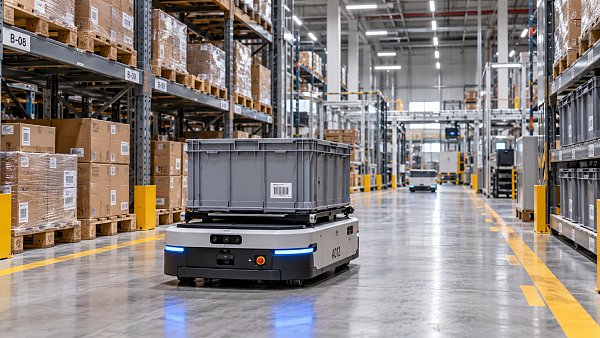
Consider a narrow aisle with storage racks on both sides. If an AGV encounters a parked pallet, there may be no safe space to pass. More sophisticated planning software cannot create physical clearance. The operational choice becomes waiting, reversing under an approved procedure, using another aisle, or requesting human assistance.
Obstacle-heavy environments therefore create several different problems:
- Geometric constraints: tight corners, narrow aisles, load overhang, and limited turning space.
- Dynamic uncertainty: pedestrians, forklifts, carts, and other vehicles moving unpredictably.
- Localization challenges: changing surroundings, obscured landmarks, or unsuitable sensor conditions.
- Traffic conflicts: several vehicles competing for intersections, doors, or single-lane passages.
- Operational variability: temporary staging areas and production changes that invalidate previously workable routes.
These problems need different remedies. Treating all of them as “obstacle avoidance” can lead to purchasing the wrong navigation system—or expecting software to compensate for a poorly organized floor.
Start with a floor survey, not an algorithm comparison
Before comparing suppliers, walk the intended routes during representative operating periods. A quiet inspection between shifts rarely reveals the actual navigation challenge. Observe replenishment activity, shift changes, production peaks, and maintenance work.
Mark permanent structures separately from temporary and moving obstacles. Columns and fixed machines can be mapped. A pallet repeatedly left beside a loading station needs a staging rule. Forklift crossings require traffic coordination and a site-specific safety assessment.
Map the vehicle’s full operating envelope, not just its chassis width. Include the load, attachments, turning sweep, docking movement, and required safety clearances. A route that looks adequate on a floor plan may be unsuitable for a loaded vehicle approaching a corner.
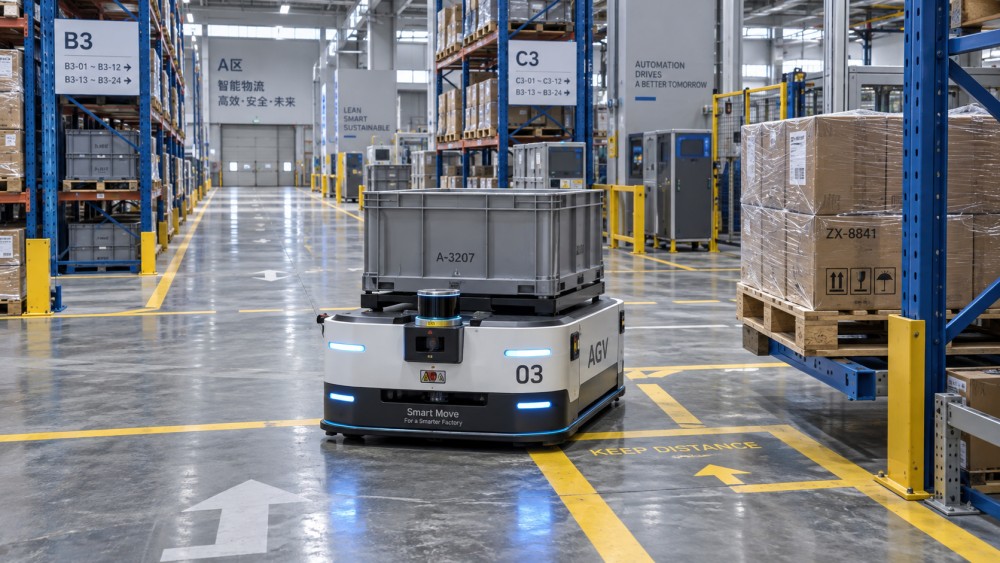
A useful annotated layout should show intersections, bottlenecks, waiting locations, charging access, and routes that remain available when a main aisle is blocked. This gives engineering, operations, and suppliers a common basis for discussion.
Choose navigation according to the operating environment
Industrial terminology is not always consistent. AGVs generally follow defined guidance or configured routes, while autonomous mobile robots (AMRs) typically offer greater freedom to calculate routes within a mapped area. Some products combine characteristics of both. Buyers should confirm actual behavior rather than rely on the label.
Defined-route guidance can be appropriate in orderly facilities
Magnetic tape, embedded guidance, markers, and other fixed-route approaches can suit repeatable transport tasks. Their strength is predictable movement along an established network. Their limitation is reduced flexibility when an obstruction blocks that network.
For a stable production line, waiting safely and requesting clearance may be more practical than navigating around the blockage. However, if routes change frequently, modifying guidance infrastructure can become a recurring operating burden.
Map-based navigation offers flexibility, with conditions
Laser- or vision-based systems may use installed reference features, natural features, or simultaneous localization and mapping (SLAM). Depending on the product and configuration, the vehicle may follow approved routes, choose among alternatives, or perform local obstacle avoidance.
These capabilities are not interchangeable. Detecting an obstacle does not mean the vehicle can safely drive around it. A detour must still satisfy clearance, traffic, load stability, and safety requirements. Reflective surfaces, lighting changes, dust, repetitive geometry, or substantial layout changes can also affect particular sensing and localization methods.
Ask suppliers to demonstrate the proposed configuration in comparable conditions. “Supports SLAM” is not a complete answer to whether a vehicle can handle your busiest aisle.
Separate route planning, traffic management, and safety
A reliable installation needs several coordinated functions. Route planning identifies an allowable way to reach a destination. Local motion control executes movement and responds to nearby conditions. Fleet management assigns tasks and coordinates shared spaces. Safety-related systems provide protective functions within the validated application.
At the algorithm level, suppliers may use graph search, optimization, or other planning methods. For most equipment buyers, the practical question is less about whether the system uses A* or another algorithm and more about how it behaves when its assumptions stop matching the floor.
Important questions include:
- Can the vehicle choose another approved route when an aisle is blocked?
- Does it reserve an intersection before entering?
- How does the fleet prevent two vehicles from entering a single-lane section from opposite ends?
- What happens when localization confidence drops or communication is interrupted?
- Who receives an alert when an obstruction cannot be resolved automatically?
Path-planning software should not be treated as a substitute for safety engineering. Depending on the jurisdiction and application, requirements such as ISO 3691-4 may be relevant. The installed system needs an appropriate risk assessment covering vehicles, loads, transfer stations, human interaction, and site conditions.
Safe behavior can involve slowing down or stopping rather than completing the shortest route. That is why throughput forecasts must account for protective stops and cautious operation around people—not just nominal travel speed.
Build an operating strategy for bottlenecks
In crowded facilities, fleet coordination can matter as much as the intelligence of an individual vehicle. Adding more AGVs to a congested network may increase waiting time rather than increase output.
A single-lane aisle, for example, can be managed as a reserved section. Vehicles wait outside until access is granted. At busy intersections, priority rules can favor time-sensitive deliveries while preventing lower-priority tasks from waiting indefinitely. Dispatching should also consider destination availability; sending a vehicle to an occupied unloading station simply moves the queue onto the floor.
Practical controls may include:
- One-way routes where the layout permits them.
- Waiting bays outside pedestrian crossings and production access points.
- Separate staging zones for empty and loaded pallets.
- Task scheduling that avoids unnecessary empty travel.
- Defined recovery procedures for stalled vehicles and blocked routes.
These measures are often less disruptive than extensive reconstruction. Still, some facilities need physical changes. If every useful route passes through the same constrained doorway, that doorway is a capacity limit, regardless of how advanced the fleet software becomes.
Test performance under disruption, not just ideal conditions
A successful demonstration should answer more than “Did the vehicle reach the destination?” It should establish whether the transport system supports production when normal interruptions occur.
Begin with representative routes and actual load configurations. Where possible, use simulation to compare fleet sizes, dispatch rules, and traffic patterns before on-site trials. Simulation is useful for identifying likely bottlenecks, but its conclusions depend on realistic assumptions about handling times, congestion, stops, and charging.
During controlled commissioning tests, assess planned scenarios such as a blocked aisle, an occupied transfer station, or simultaneous arrivals at an intersection. Do not create unsafe encounters to test obstacle avoidance; use an agreed test procedure and appropriate supervision.
Record measures that reflect operational performance:
- Delivery completion time: both typical performance and variation during busy periods.
- Waiting and stopped time: separated by traffic, obstruction, station delay, and fault.
- Human interventions: how frequently assistance is required and why.
- Docking reliability: successful transfers under representative load and alignment conditions.
- Recovery time: how quickly normal service resumes after a disruption.
- Fleet throughput: completed transport tasks rather than vehicle utilization alone.
Agree on acceptance criteria before commissioning. A system can achieve a high average delivery rate while still causing unacceptable delays at a critical production station. Variation and recovery behavior deserve as much attention as averages.
Assess lifecycle value without assuming resale value
The construction-equipment residual-value question offers a useful investment principle: purchase price is only one part of asset economics. However, construction equipment resale patterns should not be transferred directly to AGVs. Mobile automation combines hardware with software, batteries, site integration, and support arrangements.
After several years, an AGV’s usable or resale value may depend on battery condition, component availability, software licensing, supplier support, and whether it can be redeployed. Customized load-handling equipment may remain valuable in its original application but have limited appeal elsewhere.
Request clarity on recurring fees, battery replacement, spare parts, maintenance access, and the cost of remapping or modifying routes. Establish what happens if the facility expands, production stations move, or the fleet-management platform changes. Do not assume purchased software licenses or configuration data can transfer to a future owner.
Industrial Edge Global’s equipment lifecycle perspective is especially relevant here: evaluate the transport system as a long-term productive asset. Include floor modifications, integration work, commissioning, training, downtime exposure, and support—not just the vehicle quotation.
When is an obstacle-heavy facility a good candidate?
A crowded facility can still be suitable when transport demand is repeatable, route clearance is sufficient, staging rules are enforceable, and alternative paths or controlled waiting areas exist. The strongest projects combine appropriate navigation with disciplined material flow.
Warning signs include persistent aisle obstruction, unpredictable load placement, no space for safe recovery, and a business case that assumes uninterrupted full-speed travel. In these conditions, reorganizing traffic or changing the transport concept may be more valuable than selecting a more sophisticated vehicle.
The right question is not simply whether AGV path planning is complex. It is whether that complexity can be managed predictably, safely, and economically. Start with the real floor, validate the difficult movements, and purchase against measurable operating requirements. That approach gives plant managers a clearer investment decision—and a better chance of automation that keeps working after the demonstration ends.
Related News
 MSHA Issues Mine Truck Safety Alert After One Death and 121 InjuriesMining Infrastructure ExpertMSHA mine truck safety alert reports one death and 121 lost-time injuries. Discover why mine operators should review safety practices.
 How to size a crushing plant for ore processingMining Infrastructure ExpertSize your ore processing equipment crushing plant with confidence. Learn how to calculate throughput, assess ore characteristics, and prevent bottlenecks.
 Trump Administration Rewrites Mining Policy to Spur Critical Minerals DevelopmentMining Infrastructure ExpertU.S. critical minerals mining policy is changing. Explore what faster approvals could mean for investment, equipment demand and supply chains.
 How IEC 62443 defines security zones for industrial communication systemsRobotics EngineerExplore industrial communication systems and IEC 62443: learn how security zones, conduits, and risk-based controls help protect plant operations.
 China-Peru Trade Agreement Upgrade Takes Effect, Easing Machinery CertificationConstruction Equipment SpecialistThe China-Peru trade agreement upgrade simplifies machinery certification. Discover what mutual recognition could mean for exporters entering Peru.
 How do industrial control systems regulate water treatment?Robotics EngineerDiscover how industrial control systems in water treatment use sensors, PLCs, and SCADA to regulate processes and help operators respond to changing conditions.
 Exotec Report: 25% of Supply Chain Leaders Regret Warehouse Automation DecisionsRobotics EngineerWarehouse automation regret affects 25% of surveyed supply chain leaders, according to Exotec. Explore the cost, contract and readiness risks before investing.
 How to set maintenance intervals for mining equipment in AustraliaMining Infrastructure ExpertMining equipment maintenance Australia: Learn how to set service intervals using operating hours, site conditions and equipment data to reduce downtime.
 EY Survey Ranks Complexity as Mining's Top Risk for 2027Mining Infrastructure ExpertMining risk in 2027 is led by complexity, EY's survey finds. Discover how aging mines, declining ore grades and supply chain pressures are reshaping the industry.
 Can asset lifecycle management automation reduce equipment downtime?IEG Heavy Machinery & Automation AnalystDiscover how asset lifecycle management automation can reduce equipment downtime through timely maintenance, faster repairs, and smarter service workflows.
 Caterpillar Q3 2026 Revenue Rises 17% to $20.7 Billion as Both Equipment Segments GrowConstruction Equipment SpecialistCaterpillar Q3 2026 revenue reportedly rose 17% to $20.7 billion. Explore equipment segment growth and what it could mean for procurement planning.
 How to choose a rugged industrial control panel for wet environmentsRobotics EngineerChoose a rugged industrial control panel for wet environments. Compare IP ratings, materials, seals, and condensation control to improve reliability.