How to Compare Machine Guarding Systems in the UK




How to Compare Machine Guarding Systems in the UK
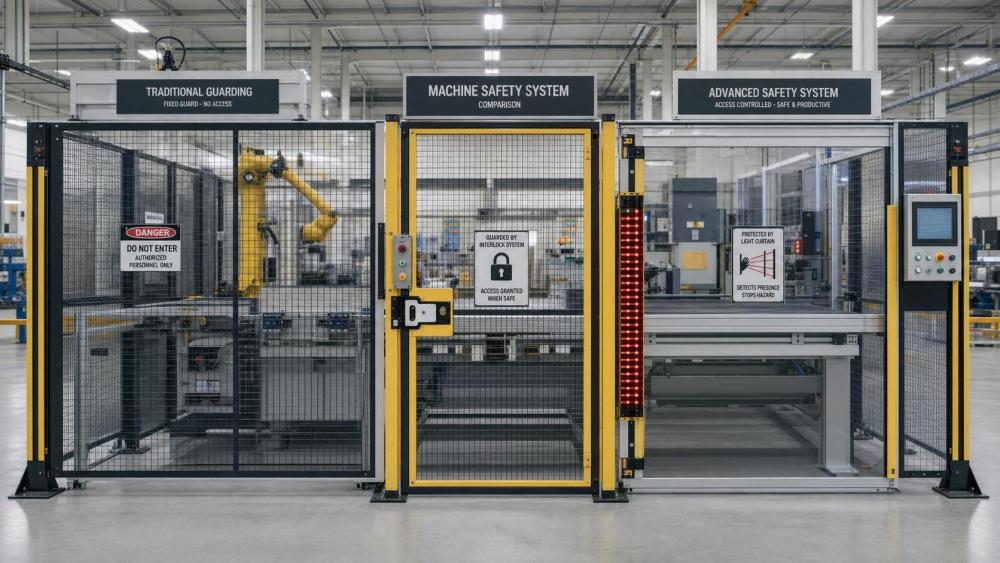
Choosing machine guarding systems UK plants can trust starts with the real operating context, not only a compliance checklist.
Many guarding projects look similar on paper, yet perform very differently once installed around production equipment.
In practice, buyers need to compare risk reduction, machine access, uptime impact, automation fit, and long-term service demands.
That matters even more in the UK, where older machinery often operates beside newer automated cells.
This mix changes how machine guarding systems UK evaluators should assess enclosure design, interlocks, light curtains, and perimeter protection.
A good comparison process should answer one commercial question clearly: which solution reduces risk without creating new production problems?
Start With Risk Profile, Not Product Type
The first mistake in machine guarding systems UK selection is choosing a product category before defining the actual hazard.
A press line, palletiser, robot cell, conveyor, and CNC machine do not need the same guarding logic.
Start by mapping pinch points, ejection risk, rotating parts, hot surfaces, unexpected restart, and access frequency.
Then separate routine access from exceptional access.
That distinction often decides whether fixed guards, interlocked doors, or presence-sensing devices make more sense.
In UK factories, retrofit work is common.
This means technical teams should also check available floor space, machine stopping time, and operator travel routes.
If a guard solves one hazard but blocks maintenance access, it will probably be bypassed later.
Questions That Should Shape Early Screening
- What hazard remains if the machine stops late?
- How often do operators need access during normal production?
- Will the guard affect loading, changeovers, cleaning, or tool adjustment?
- Does the machine already have safety PLC, relays, or legacy controls?
- How difficult will fault finding be after installation?
Compare Compliance Depth, Not Just Compliance Claims
Every supplier will say its machine guarding systems UK offer is compliant, but the quality of that compliance varies.
Buyers should look beyond a simple declaration and review how the design aligns with applicable standards.
Typical references include the UK Supply of Machinery framework, BS EN ISO 14120, BS EN ISO 13849, and relevant safeguarding distances.
The real issue is whether the proposed system matches the machine’s stopping behavior and access pattern.
For example, a light curtain may appear efficient, yet become unsafe if stopping distance is underestimated.
Likewise, interlocked doors are only effective if lock release logic reflects stored energy and run-down time.
When comparing machine guarding systems UK suppliers, ask for the underlying safety assumptions and validation method.
What Better Documentation Looks Like
- Documented risk assessment linked to each guard position
- Stopping-time calculation for presence-sensing devices
- Performance level or safety integrity explanation
- Validation test plan before handover
- Clear user guidance for operation, reset, and maintenance
Assess Mechanical Design and Daily Usability
Strong machine guarding systems UK decisions depend as much on mechanical detail as on electrical safety architecture.
A guard that vibrates, loosens, corrodes, or obstructs routine tasks will create friction from day one.
This is especially relevant in metalworking, food processing, packaging, and material handling applications.
Check frame rigidity, panel material, viewing panels, hinge quality, lock durability, and resistance to site conditions.
Then check whether operators can still load parts, inspect status, and clear small faults without awkward movement.
More expensive machine guarding systems UK packages often justify cost through better access design and lower downtime.
That value is easy to miss if evaluation focuses only on hardware count.
Practical Design Points to Compare
- Door swing and access clearance around the machine
- Visibility into process zones during setup and operation
- Ease of cleaning in dusty, oily, or wet environments
- Replacement speed for damaged panels or switches
- Tamper resistance without making legitimate access too slow
Check Integration With Controls and Automation
A growing issue in machine guarding systems UK projects is control integration, especially in semi-automated and fully automated lines.
Guarding should not be treated as a separate add-on after the machine has already been configured.
The guarding strategy must fit the control platform, safety logic, and production sequence.
This becomes critical where robots, conveyors, vision systems, or automatic tool changers are involved.
If the supplier cannot explain reset zones, muting logic, diagnostic feedback, and safe restart behavior, the design is incomplete.
From a lifecycle view, diagnostics matter almost as much as safety performance.
Machine guarding systems UK buyers should prefer solutions that make faults visible and isolation steps easy to follow.
Integration Risks Often Missed in Early Quotes
- Legacy PLC limitations that require extra safety hardware
- Long cable routes that complicate commissioning
- Poor HMI messaging during guard faults or reset conditions
- Inadequate zoning for maintenance or partial operation modes
- Unclear responsibility between machine builder and guard supplier
Measure Lifecycle Cost Instead of Purchase Price Alone
Machine guarding systems UK procurement often starts with capital cost, but that is only part of the decision.
A lower-price guard may create higher costs through slower changeovers, nuisance trips, frequent damage, or difficult spare parts sourcing.
That is why comparison should include installation time, commissioning effort, operator training, maintenance burden, and expected service life.
In UK industrial sites, maintenance resources are often stretched.
So a technically advanced guard only makes sense if local teams can support it properly.
Better machine guarding systems UK evaluations use a simple total-cost model over three to seven years.
That model makes hidden cost drivers much easier to compare.
Use a Structured Supplier Comparison Method
When two machine guarding systems UK proposals both appear acceptable, scoring structure helps separate them objectively.
A weighted comparison works well because not every factor has the same operational value.
For a high-throughput cell, uptime and diagnostics may matter more than initial hardware savings.
For a retrofit on older equipment, installation complexity and documentation quality may carry more weight.
The point is to compare machine guarding systems UK options against actual business priorities.
Suggested Evaluation Criteria
- Safety performance and validation quality
- Fit with machine layout and production method
- Ease of maintenance and fault recovery
- Integration with control architecture
- Lifecycle cost and spare parts support
- Supplier engineering depth and commissioning capability
This approach also improves internal alignment between engineering, operations, maintenance, and procurement teams.
That alignment usually prevents late design changes, which are expensive and disruptive.
Make the Final Decision Around Operational Reality
The best machine guarding systems UK selection is rarely the most basic option or the most complex one.
It is the one that fits the machine, the hazard, the workforce, and the production model with the least friction.
From a decision standpoint, the strongest proposals usually share three traits.
They explain risk clearly, integrate with operations cleanly, and remain manageable over the equipment lifecycle.
So before approving any machine guarding systems UK project, review the guard in use, not only on drawings.
Walk the operator path, test maintenance access, confirm reset logic, and verify documentation depth.
That final step often reveals whether a guarding solution will support safe productivity or quietly undermine it.
For industrial buyers, a disciplined comparison method turns machine guarding systems UK selection from a compliance task into a stronger capital decision.
Related News
 What is driving consolidation in the global equipment supplier market?IEG Heavy Machinery & Automation AnalystGlobal equipment supplier market consolidation is accelerating through technology, service, and supply-chain demands. Discover how buyers can capture value while managing risk.
 When does capital equipment investment pay back in manufacturing?IEG Heavy Machinery & Automation AnalystCapital equipment investment manufacturing: learn when equipment truly pays back by evaluating full costs, cash flow, ramp-up, operational risks, and lifecycle value.
 When does a distribution center need an automated pallet handling system?Heavy Lifting Systems AnalystPallet handling systems help distribution centers overcome labor shortages, bottlenecks, safety risks, and storage constraints. Discover the key signs it’s time to automate.
 How to build a machinery investment plan around payback periodIEG Heavy Machinery & Automation AnalystMachinery investment planning manufacturing guide: build a credible payback plan with full costs, ramp-up assumptions, lifecycle risks, and scenario-based cash benefits.
 How to Specify a Modular Packaging Line for Fast Changeovers and Scalable OutputRobotics EngineerModular packaging line specification guide: achieve faster changeovers, scalable output, reliable controls, and lower lifecycle costs with practical planning.
 How industrial IoT devices reduce unplanned downtime in factoriesRobotics EngineerIndustrial IoT devices help factories detect early equipment issues, plan maintenance, and reduce costly unplanned downtime before production is disrupted.
 What is driving industrial machinery market demand in manufacturing?IEG Heavy Machinery & Automation AnalystIndustrial machinery market manufacturing demand is rising as factories pursue automation, energy efficiency, resilient supply chains, and lifecycle productivity gains.
 316L Stainless Steel Pipe Tube Technical Factors That Shape Buyer DecisionsCNC Machining AnalystA technical analysis for 316L stainless steel pipe tube buyers, covering corrosion expectations, pipe route choice, tolerance, surface, and inspection.
 How ground conditions determine crawler piling equipment selectionConstruction Equipment SpecialistCrawler piling equipment selection starts with ground conditions. Learn how soil, rock, groundwater and site constraints shape safer, more productive piling solutions.
 3300mm CNC Beam Saw Sheet Capacity: Layout Checks Before PurchaseCNC Machining AnalystZhongding ZD330 beam saw specifications: assess 3300mm sheet capacity, layout clearances, handling flow, and acceptance checks before buying.
 How Bucket Chain Diamond Dredgers Meet ISO 12100 Safety Requirements in Alluvial Mining ProjectsMining Infrastructure ExpertBucket chain diamond dredger safety made real: how ISO 12100 compliance ensures operator protection, reliability & zero lost-time injuries in alluvial mining.
 Modular Packaging for High-Mix Automotive Assembly Lines: How Standardized Load Units Reduce Line Changeover Time by 37% — Case Study from Tier-1 Supplier in GuangdongHeavy Lifting Systems AnalystModular packaging slashes automotive line changeover time by 37%—discover how standardized load units boost OEE, cut labor costs, and enable seamless high-mix assembly.