How to Evaluate Industrial Control Architecture in Manufacturing




How to Evaluate Industrial Control Architecture in Manufacturing
Evaluating industrial control architecture manufacturing decisions starts with a correction: a control architecture is not just a PLC brand, a SCADA package, or a network diagram. It is the operating logic of the plant translated into hardware layers, software functions, communication paths, safety boundaries, and maintenance responsibilities. That is why two systems built from similar components can perform very differently in production. One remains stable through product changes, troubleshooting, and capacity expansion; the other becomes fragile as soon as a line is modified or a second vendor is introduced.
In practical terms, technical assessment teams are not only asking whether a control system can run a machine today. They are asking whether it can support the factory's future operating model: more data visibility, tighter quality control, shorter changeovers, higher safety expectations, and better coordination between production and business systems. A control architecture that looks acceptable during procurement can become expensive later if spare parts are difficult to source, if software changes require specialist intervention, or if plant data cannot move cleanly into MES, historian, or ERP environments.
This is where many evaluations go wrong. Teams often compare controller speed, I/O count, or interface design before clarifying the real question: what kind of manufacturing process is being controlled, and how much variation must the architecture absorb? A high-volume packaging line, a batch process unit, a discrete assembly cell, and a heavy continuous production plant do not place the same demands on the control layer. The architecture has to fit the production physics as much as the IT strategy.
Start with the production structure, not the product catalog
A useful evaluation usually begins by mapping the control problem into levels. Which functions must run in real time at the machine or skid level? Which decisions belong to supervisory control? What information needs to be passed to plant-wide monitoring, quality systems, maintenance tools, or business reporting? Without this separation, architecture reviews become feature comparisons detached from operations.
In manufacturing, the main architecture choices often revolve around centralization versus distribution. A centralized design can simplify governance and reduce software fragmentation, but it may also create larger fault domains and make local equipment integration more rigid. A distributed approach can improve modularity and make expansions easier, especially in plants that add lines over time, yet it can also increase network complexity and version-control problems if standards are weak.
That tradeoff is not theoretical. If a plant expects phased capacity growth, line-level replication, or equipment sourced from multiple OEMs, architecture modularity matters early. If the site is relatively stable and prioritizes tightly controlled standardization, a more centralized model may be easier to manage. Neither is inherently better. The wrong choice is the one that conflicts with the plant's change pattern.
Interoperability is where many systems become costly
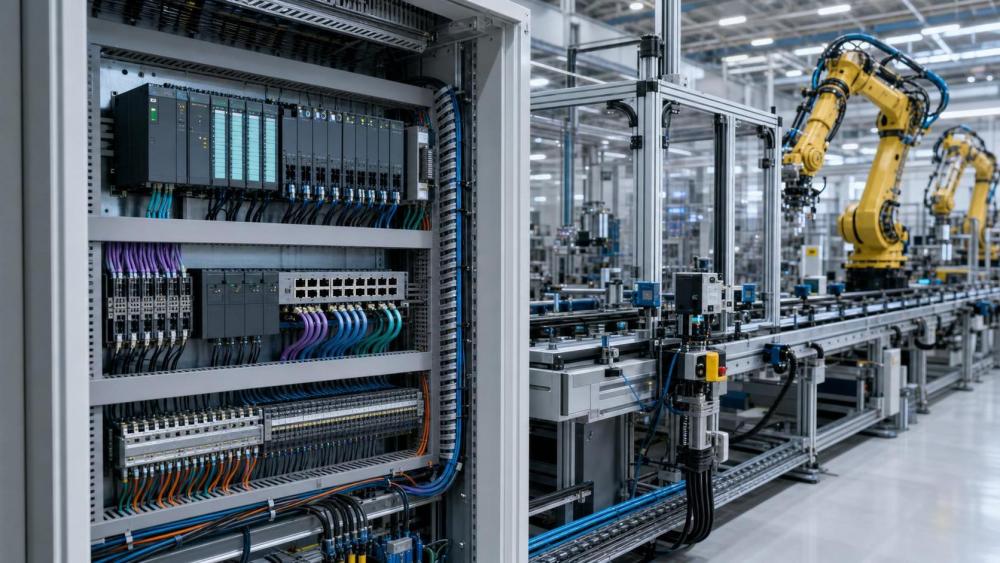
One of the most commercially important parts of industrial control architecture manufacturing reviews is interoperability. Plants rarely operate as closed technical islands. They need controllers, drives, HMIs, safety systems, vision devices, historians, condition monitoring tools, and enterprise software to exchange usable information. The issue is not whether communication is technically possible. It usually is. The real issue is how much engineering effort is required to make that exchange reliable, maintainable, and secure.
Assessment teams should look closely at protocol support, data model consistency, naming standards, and integration dependencies. Native support for widely used industrial communication standards can reduce risk, but protocol availability alone does not guarantee smooth integration. A system may technically connect while still creating long commissioning cycles because tags are inconsistent, diagnostics are opaque, or custom middleware becomes necessary.
This is also where vendor lock-in should be evaluated with precision rather than rhetoric. Total vendor standardization can simplify support, training, and lifecycle purchasing. In some factories, that is a sensible choice. But if one supplier controls the logic environment, field integration tools, software licensing, and upgrade path, the plant should be clear about the long-term cost of that dependency. Lock-in is not just about price. It affects negotiation power, spare strategy, integrator availability, and the speed of future modifications.
Cybersecurity is not a separate layer anymore
A recurring mistake in control system selection is treating cybersecurity as something that can be added after the architecture is chosen. In connected manufacturing environments, that assumption is weak. Remote support, production reporting, cloud analytics, and cross-site visibility all increase the number of pathways into operational technology. Architecture decisions therefore have direct security consequences.
The evaluation should consider user access control, network segmentation, patching practicality, remote access governance, and asset visibility. International guidance such as the IEC 62443 series is commonly referenced in industrial automation cybersecurity discussions, but the point in a procurement context is not to casually claim compliance. It is to ask whether the proposed architecture can be administered in a way that supports secure operation over years, including by maintenance teams who are balancing uptime pressures against IT discipline.
A technically advanced architecture can still be weak if it depends on uncontrolled laptops, shared passwords, undocumented ports, or unsupported legacy gateways. Good evaluation work pays attention to operational reality, not just security functions shown in a presentation.
Lifecycle value is usually hidden in supportability
The purchase price of controllers, panels, and software licenses is visible. Lifecycle cost is less obvious, but it often has more strategic weight. A plant should ask how easily technicians can diagnose faults, how software versions are managed, how backups are handled, how quickly failed modules can be replaced, and whether local service capability exists in the regions where the equipment will operate.
This matters especially in multi-year capital equipment environments. Control architecture choices influence training depth, engineering change procedures, spare parts inventory, and the availability of third-party integration skills. An architecture that requires rare expertise for routine changes can undermine responsiveness even if its original design was elegant. By contrast, a slightly less sophisticated platform may deliver better plant economics if the support ecosystem is stronger and maintenance teams can work confidently within it.
Scalability should be tied to a real expansion scenario
"Scalable" is one of the most overused words in automation procurement. Nearly every supplier claims it. The useful question is scalable in what direction. More I/O points? More production lines? More sites using the same template? More data consumers? Faster cycle requirements? Safety integration? Recipe complexity? Without a defined growth path, scalability remains a vague promise.
For technical evaluation teams, it helps to test the architecture against likely plant changes. Suppose an OEM line must later connect to a site historian and production scheduling system. Suppose an isolated machine cell may become part of a traceability program. Suppose a brownfield plant plans to standardize alarms and dashboards across mixed-vendor assets. These scenarios reveal whether the architecture can expand through configuration and standard engineering practice or whether it will require structural rework.
Brownfield conditions deserve special attention. In older facilities, the right architecture is often not the one with the most advanced brochure. It is the one that can coexist with legacy controls, uneven documentation, and staged shutdown windows. Integration tolerance becomes a selection criterion in its own right.
Safety, reliability, and production discipline cannot be evaluated separately
In manufacturing, control architecture is tightly linked to safety instrumented functions, machine safeguarding, interlocks, alarm handling, and fault response strategy. That does not mean every project requires the same formal safety design approach, but it does mean safety cannot be treated as a parallel discussion left to the end. Architecture affects how failures are isolated, how permissives are managed, and how operators understand abnormal conditions.
Reliability is equally tied to operational discipline. If alarm floods are common, if bypasses are poorly controlled, or if maintenance modes are inconsistent across assets, the architecture may be increasing human error exposure. A system should not only run; it should make the plant easier to run correctly.
That is why good assessment work often goes beyond architecture drawings and includes review of cause-and-effect logic, recovery sequences, diagnostic design, and operator interaction patterns. These details are easy to dismiss during early selection, yet they strongly influence uptime and incident response later.
A practical way to compare options
When comparing alternative control architectures, teams usually get better results by using a weighted decision framework tied to plant realities rather than generic scoring sheets. The categories often worth weighting are production fit, integration effort, maintainability, cybersecurity manageability, lifecycle availability, engineering standardization, and upgrade flexibility. Cost belongs in the model, but not only as upfront spend. Commissioning effort, future modification effort, training depth, and obsolescence exposure should also shape the decision.
It also helps to pressure-test supplier claims with practical questions:
- How are software changes tracked, approved, and restored after failure?
- What happens when a mixed-vendor subsystem must be integrated later?
- Which parts of the design depend on custom engineering rather than standard tools?
- How is remote access controlled during support events?
- What is the migration path if the selected hardware family reaches end of life?
These questions do not produce perfect certainty, but they move the evaluation from feature comparison to operational judgment. That is the real objective. Industrial control architecture manufacturing choices should be assessed as long-life production infrastructure, not as isolated automation components. When the architecture aligns with process behavior, maintenance capability, integration needs, and security discipline, it becomes easier to expand, easier to troubleshoot, and less likely to trap the plant in costly workarounds later.
For decision-makers, the most reliable approach is to judge the architecture by the kind of factory it must support over time, not just by the performance it can demonstrate during a controlled demo. In manufacturing, that distinction is where much of the real value sits.
Related News
 What is driving consolidation in the global equipment supplier market?IEG Heavy Machinery & Automation AnalystGlobal equipment supplier market consolidation is accelerating through technology, service, and supply-chain demands. Discover how buyers can capture value while managing risk.
 When does capital equipment investment pay back in manufacturing?IEG Heavy Machinery & Automation AnalystCapital equipment investment manufacturing: learn when equipment truly pays back by evaluating full costs, cash flow, ramp-up, operational risks, and lifecycle value.
 When does a distribution center need an automated pallet handling system?Heavy Lifting Systems AnalystPallet handling systems help distribution centers overcome labor shortages, bottlenecks, safety risks, and storage constraints. Discover the key signs it’s time to automate.
 How to build a machinery investment plan around payback periodIEG Heavy Machinery & Automation AnalystMachinery investment planning manufacturing guide: build a credible payback plan with full costs, ramp-up assumptions, lifecycle risks, and scenario-based cash benefits.
 How to Specify a Modular Packaging Line for Fast Changeovers and Scalable OutputRobotics EngineerModular packaging line specification guide: achieve faster changeovers, scalable output, reliable controls, and lower lifecycle costs with practical planning.
 How industrial IoT devices reduce unplanned downtime in factoriesRobotics EngineerIndustrial IoT devices help factories detect early equipment issues, plan maintenance, and reduce costly unplanned downtime before production is disrupted.
 What is driving industrial machinery market demand in manufacturing?IEG Heavy Machinery & Automation AnalystIndustrial machinery market manufacturing demand is rising as factories pursue automation, energy efficiency, resilient supply chains, and lifecycle productivity gains.
 316L Stainless Steel Pipe Tube Technical Factors That Shape Buyer DecisionsCNC Machining AnalystA technical analysis for 316L stainless steel pipe tube buyers, covering corrosion expectations, pipe route choice, tolerance, surface, and inspection.
 How ground conditions determine crawler piling equipment selectionConstruction Equipment SpecialistCrawler piling equipment selection starts with ground conditions. Learn how soil, rock, groundwater and site constraints shape safer, more productive piling solutions.
 3300mm CNC Beam Saw Sheet Capacity: Layout Checks Before PurchaseCNC Machining AnalystZhongding ZD330 beam saw specifications: assess 3300mm sheet capacity, layout clearances, handling flow, and acceptance checks before buying.
 How Bucket Chain Diamond Dredgers Meet ISO 12100 Safety Requirements in Alluvial Mining ProjectsMining Infrastructure ExpertBucket chain diamond dredger safety made real: how ISO 12100 compliance ensures operator protection, reliability & zero lost-time injuries in alluvial mining.
 Modular Packaging for High-Mix Automotive Assembly Lines: How Standardized Load Units Reduce Line Changeover Time by 37% — Case Study from Tier-1 Supplier in GuangdongHeavy Lifting Systems AnalystModular packaging slashes automotive line changeover time by 37%—discover how standardized load units boost OEE, cut labor costs, and enable seamless high-mix assembly.