When does distributed industrial motion control reduce wiring complexity?




Distributed industrial motion control reduces wiring complexity when the physical layout of a machine makes centralized control cabinets expensive to wire, difficult to service, or hard to expand. The strongest candidates are machines with many motion axes, repeated modules, moving sections, or substantial distance between motors and the main cabinet.
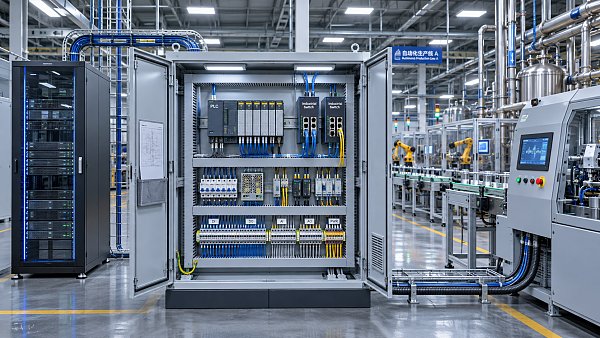
The idea is simple: instead of routing every motor power cable, encoder cable, sensor lead, and actuator connection back to one central enclosure, intelligent drives and I/O are placed closer to the equipment they control. A field network then carries coordinated control data between the central controller and distributed devices.
That does not automatically make every machine better. A distributed architecture replaces some copper, terminals, cable trays, and cabinet space with field-rated electronics, network design work, local power distribution, and different maintenance requirements. It reduces complexity when those trade-offs match the machine's layout and lifecycle needs.
Where centralized wiring becomes the real problem
Centralized motion control is often practical for a compact machine with a few axes positioned close to one electrical cabinet. A short run from a drive cabinet to each motor is straightforward, accessible, and easy to document. Moving drives into the field in this situation may add enclosure cost and create more service points without removing enough wiring to justify the change.
The calculation changes when cable routing begins to dominate the electrical design. In a centralized arrangement, each remote axis can require separate motor power, feedback, brake, sensor, and auxiliary connections. A production line with stations spread over a long frame may therefore accumulate large bundles of cables, multiple junction boxes, extensive tray space, and time-consuming point-to-point termination.
Distributed industrial motion control is most useful when the system can replace many of those individual runs with shorter local connections and a smaller number of shared backbone cables. The reduction is especially meaningful when the machine design is repeated, reconfigured often, transported in sections, or assembled on site.
Machine layouts that usually benefit
A useful first test is to map every controlled device against the cabinet that would otherwise serve it. Do not only count axes. Look at cable distance, routing obstacles, moving cable carriers, access restrictions, and the number of field devices that sit near each axis.
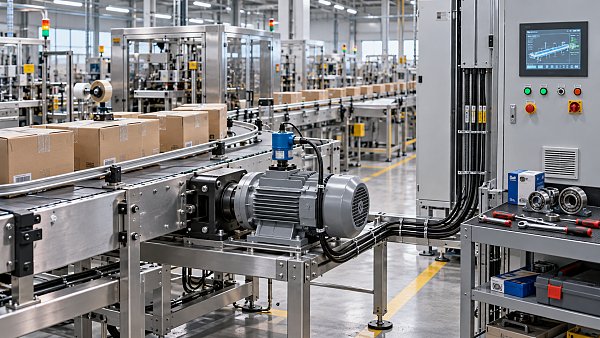
Examples include conveyor zones with independent motors, filling and packaging machines with repeated stations, assembly systems with remote servo axes, material-handling equipment, and process skids that are built and tested as separate modules. In each case, the benefit comes from physical distribution, not from the word “distributed” itself.
The wiring reduction is broader than motor cables
Teams sometimes evaluate the concept only by comparing motor cable lengths. That is incomplete. The more important comparison is between complete electrical architectures.
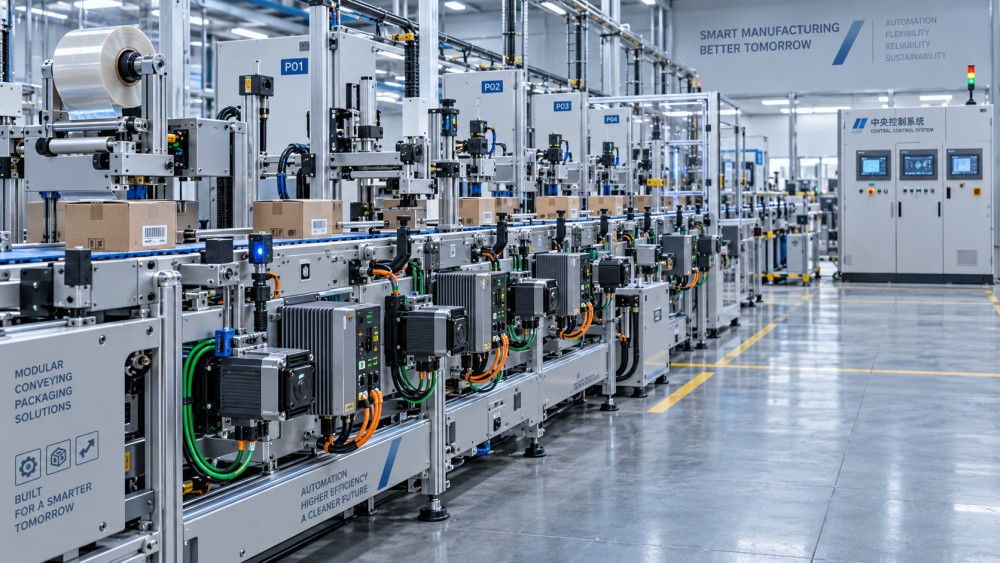
In a centralized panel, a remote station may send discrete sensors, valves, safety devices, motor feedback, brakes, and power circuits back to the cabinet. In a distributed station, short local leads can connect those devices to nearby drive and I/O units, while a network connection carries control, diagnostics, and status information upstream.
This can reduce cabinet congestion in several ways:
- Fewer long point-to-point signal cables require terminal blocks, labeling, and continuity checks.
- Smaller cable bundles may simplify tray routing, conduit sizing, and machine installation.
- Local I/O can remove the need to bring every sensor and valve signal to a distant marshalling area.
- Modular station wiring can be completed and tested before final line integration.
- Future changes can often remain within one machine section rather than disturbing a central cabinet.
The savings are often most visible during assembly and commissioning, when technicians spend less time tracing long conductors and resolving terminal errors. They can also matter later, particularly when a failed station can be diagnosed locally from drive, I/O, and network status rather than only from a fault at the central controller.
Do not confuse fewer cables with a simpler system
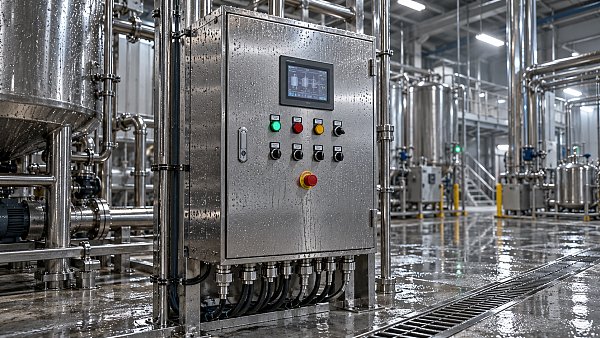
A distributed system has fewer long individual conductors, but it needs disciplined architecture. A field-mounted drive introduces requirements that a drive inside a conditioned cabinet may not face: washdown exposure, dust, ambient temperature, vibration, electromagnetic noise, and physical impact. Enclosures, connectors, cable glands, cooling paths, and mounting locations must suit the operating environment.
Power distribution also deserves early attention. Local drives need appropriately planned supply feeds, protective devices, grounding, isolation methods, and a clear response to loss of power in one section. Replacing many motor cables with a shared distributed power arrangement can simplify installation, but it also changes fault containment and troubleshooting behavior.
Network design is equally important. Motion applications may require deterministic communication and coordinated timing. A machine with independent conveyor zones can tolerate a different architecture from one that coordinates multiple servo axes for electronic gearing, registration, camming, or robotic handling. The proposed network and controller must support the required update behavior, axis count, diagnostic visibility, and recovery process.
Safety should be designed as part of the architecture rather than added after the drives are selected. Emergency stops, safe torque removal, guarded-zone behavior, and restart rules may all cross local modules. A clean distributed layout is of little value if technicians cannot quickly understand what remains energized, which zone is inhibited, or how a faulted module is returned to service.
When distribution is the wrong answer
A compact, fixed machine with a small number of axes and short cable runs often remains better served by a central cabinet. The wiring is contained, heat management is easier, field exposure is limited, and service personnel have one obvious location for electrical work.
Distribution may also be a poor fit where the environment is unusually severe and practical protection is difficult, where local mounting space is unavailable, or where plant maintenance relies on a highly centralized service model. The cost of ruggedized components and field enclosures can outweigh the value of shorter cables.
Another weak use case is a machine with high-performance coordinated motion but no well-defined approach to timing, network resilience, and fault recovery. Distributed drives can support demanding motion tasks, but they should not be selected merely to reduce wire length if the control design has not proven that synchronization requirements will be met.
Evaluate the architecture as a lifecycle decision
The purchase comparison should not stop at the price of drives and cables. A distributed solution may shift spending from a large panel and long cable runs toward field-capable drives, network components, connectors, local protection, and mechanical mounting. The relevant question is whether the complete system is easier to build, commission, operate, modify, and restore after a fault.
A practical review can proceed in this order:
- Map axis locations, remote I/O, safety devices, and the actual cable paths to the proposed cabinet location.
- Identify repeated stations or machine modules that could use a common local control package.
- Separate motion classes: independent axes, coordinated servo groups, and non-motion field devices should not be assumed to have identical requirements.
- Define environmental conditions at each possible field mounting point, including cleaning methods, vibration, heat, contamination, and access.
- Review how technicians will isolate, replace, address, and recommission one local device without creating confusion elsewhere in the machine.
- Compare installation labor, cabinet construction, cable management, commissioning effort, expansion work, and expected maintenance access as one lifecycle model.
This sequence prevents a common mistake: calculating only the eliminated cable length while ignoring the practical effort required to make distributed devices maintainable. A field device that is electrically correct but hidden behind guarding, exposed to damage, or difficult to identify can increase downtime rather than reduce it.
Modularity is often the deciding factor
The case for distributed control becomes stronger when machine builders sell the same platform in different lengths, capacities, or station counts. If each module has a repeatable local drive and I/O arrangement, engineering can define standardized mechanical, power, network, and safety interfaces. Adding a station then becomes more predictable than extending a central cabinet and pulling a new collection of home-run cables across the machine.
That benefit is not limited to new equipment. A production line that changes configuration over time may gain a cleaner path for upgrades. Additional zones, inspection devices, feeders, or handling modules can be integrated nearer to their point of use, provided the original controller, network capacity, and safety concept were planned for expansion.
For capital equipment evaluations, this is where wiring reduction connects to commercial value. Less installation work may shorten deployment, while a clearer modular structure can reduce disruption when capacity changes later. Industrial Edge Global examines these kinds of equipment decisions through lifecycle factors rather than treating electrical architecture as an isolated component choice.
Questions that expose weak proposals
Before approving a distributed industrial motion control design, ask the supplier or internal engineering team to show the physical architecture, not only the network diagram. The following questions usually reveal whether the proposal is mature:
- Which cables are eliminated, which cables are merely relocated, and which new network or power cables are introduced?
- Where will each drive and I/O block be mounted, and can it be safely reached for inspection or replacement?
- How are field devices protected from the actual production environment?
- Which axes need tightly coordinated motion, and how is timing maintained across the system?
- How is a single section isolated and restored after a fault?
- Can a replacement device be identified and commissioned without manually rebuilding the machine configuration?
- What changes if one module is added, removed, or moved in a future machine variant?
Clear answers indicate that the wiring simplification is supported by a workable service model. Vague answers usually mean that the design has stopped at a conceptual layout.
The practical threshold
Distributed motion control reduces wiring complexity when distance, repetition, modularity, or machine movement causes centralized home-run wiring to multiply faster than the added complexity of field devices and networks. It is especially effective when local control packages can be repeated across stations and when technicians can access, isolate, and diagnose those packages without difficulty.
For a small, compact machine, centralization may remain the cleaner design. For a long production line, modular packaging system, multi-axis handling machine, or expandable automated cell, placing intelligence near the motion can turn wiring from a custom installation burden into a repeatable part of the machine architecture.
Related News
 MSHA Issues Mine Truck Safety Alert After One Death and 121 InjuriesMining Infrastructure ExpertMSHA mine truck safety alert reports one death and 121 lost-time injuries. Discover why mine operators should review safety practices.
 How to size a crushing plant for ore processingMining Infrastructure ExpertSize your ore processing equipment crushing plant with confidence. Learn how to calculate throughput, assess ore characteristics, and prevent bottlenecks.
 Trump Administration Rewrites Mining Policy to Spur Critical Minerals DevelopmentMining Infrastructure ExpertU.S. critical minerals mining policy is changing. Explore what faster approvals could mean for investment, equipment demand and supply chains.
 How IEC 62443 defines security zones for industrial communication systemsRobotics EngineerExplore industrial communication systems and IEC 62443: learn how security zones, conduits, and risk-based controls help protect plant operations.
 China-Peru Trade Agreement Upgrade Takes Effect, Easing Machinery CertificationConstruction Equipment SpecialistThe China-Peru trade agreement upgrade simplifies machinery certification. Discover what mutual recognition could mean for exporters entering Peru.
 How do industrial control systems regulate water treatment?Robotics EngineerDiscover how industrial control systems in water treatment use sensors, PLCs, and SCADA to regulate processes and help operators respond to changing conditions.
 Exotec Report: 25% of Supply Chain Leaders Regret Warehouse Automation DecisionsRobotics EngineerWarehouse automation regret affects 25% of surveyed supply chain leaders, according to Exotec. Explore the cost, contract and readiness risks before investing.
 How to set maintenance intervals for mining equipment in AustraliaMining Infrastructure ExpertMining equipment maintenance Australia: Learn how to set service intervals using operating hours, site conditions and equipment data to reduce downtime.
 EY Survey Ranks Complexity as Mining's Top Risk for 2027Mining Infrastructure ExpertMining risk in 2027 is led by complexity, EY's survey finds. Discover how aging mines, declining ore grades and supply chain pressures are reshaping the industry.
 Can asset lifecycle management automation reduce equipment downtime?IEG Heavy Machinery & Automation AnalystDiscover how asset lifecycle management automation can reduce equipment downtime through timely maintenance, faster repairs, and smarter service workflows.
 Caterpillar Q3 2026 Revenue Rises 17% to $20.7 Billion as Both Equipment Segments GrowConstruction Equipment SpecialistCaterpillar Q3 2026 revenue reportedly rose 17% to $20.7 billion. Explore equipment segment growth and what it could mean for procurement planning.
 How to choose a rugged industrial control panel for wet environmentsRobotics EngineerChoose a rugged industrial control panel for wet environments. Compare IP ratings, materials, seals, and condensation control to improve reliability.