What lifting capacity should compact jib crane systems provide?




A compact jib crane should be rated for the maximum complete load that will be lifted at the most demanding point of travel, with sufficient allowance for the lifting attachment, load-control needs, and foreseeable changes in the handling task. The correct rating is therefore rarely the bare mass of a workpiece. A part that weighs 400 kg may require a materially higher crane rating once the hook block, hoist, spreader beam, vacuum lifter, clamps, fixtures, and any suspended packaging are included.
The starting point is to define a “gross lifted load” rather than a product weight. This is the combined suspended mass from the crane hook downward. The rating shown on the crane and hoist must cover that total under the intended duty conditions. A capacity selected only against the heaviest nominal component can leave no practical reserve for tooling changes, replacement parts, or an attachment that was excluded from the original request.
Begin with the actual suspended load
List every item carried by the hook during the heaviest normal lift. This normally includes the part, pallet or stillage where applicable, slings or lifting chains, shackles, below-the-hook fixture, spreader beam, gripper, and hook block. For vacuum systems, magnetic lifters, pneumatic grippers, or powered manipulators, the dead weight of the device and its connecting hardware belongs in the calculation even when the device itself has its own marked lifting limit.
Load mass is only one part of the question. The load’s dimensions and centre of gravity affect how it behaves below the boom. A compact, centrally balanced component can be moved with relatively little correction. A long fabricated frame, uneven casting, or bundle with an offset lifting point can swing, rotate, or demand a wider exclusion area despite having the same mass. The crane capacity does not cure poor load balance; it establishes the allowable vertical load while the lifting arrangement still needs to maintain stable control.
Where the same station handles several products, capacity should be based on the heaviest credible combination rather than an average load. The credible combination is important. It includes loads expected under normal production, set-up, maintenance, and material replenishment, but not an exceptional lift that belongs on another item of lifting equipment. Designing a small workstation crane around a rare oversized load can raise structural, installation, and operating costs without improving the primary handling process.
Outreach changes the structural question
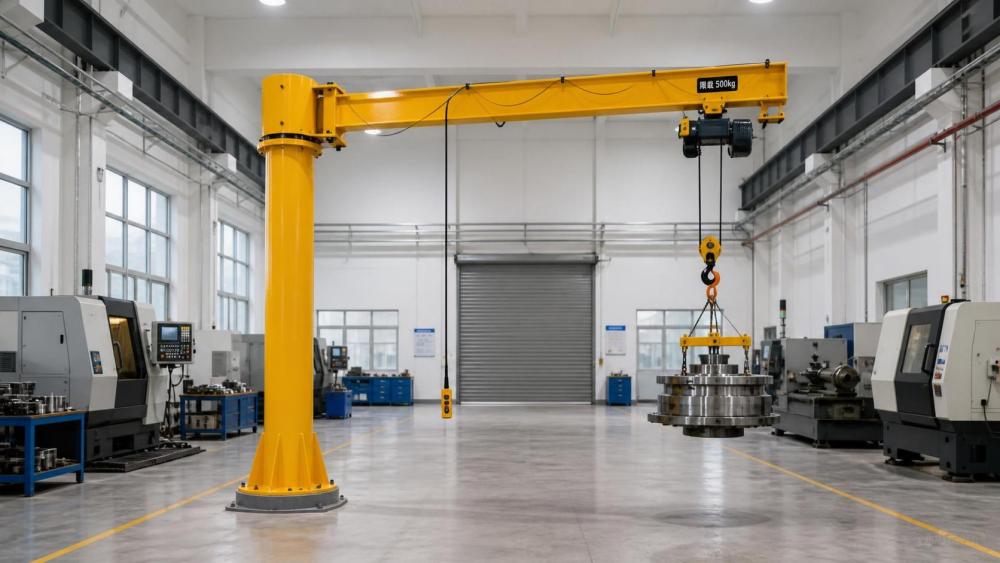
The hoist rating and the jib structure must be assessed together. On a jib crane, the load creates a moment that increases as the hook moves farther from the support. A 500 kg load close to the mast does not impose the same demand on the mounting structure as the same load at the outer end of a long boom. The crane manufacturer’s rated capacity is normally tied to a stated boom length and configuration. It should never be assumed that a longer replacement boom, an extended trolley travel range, or a field alteration preserves the original rating.
For wall-mounted, column-mounted, ceiling-supported, and freestanding arrangements, the supporting structure deserves equal attention. The relevant question is not merely whether a floor slab, steel column, wall, or roof member appears substantial. It must be evaluated for the vertical reaction, overturning moment, anchor forces, local reinforcement requirements, fatigue exposure, and deflection generated by the selected crane. A foundation that is adequate for a lighter short-reach jib may not be adequate after either capacity or outreach is increased.
Deflection can create an operational problem before it becomes a strength problem. Excessive boom or support movement may affect positioning over a fixture, reduce clearance beneath nearby services, encourage pendulum motion, or make a load feel less controllable. This matters in assembly, machining, welding, test cells, and maintenance areas where placement is close to guards, tooling, or machines.
Capacity must match duty, not just a single lift
A crane used occasionally to remove a gearbox has a different service profile from one that transfers components between machining stations throughout a shift. Repeated lifting, traversing, slewing, lowering, and positioning place cumulative demand on the hoist, trolley, bearings, electrical controls, and support connections. Capacity alone cannot describe that demand.
Duty assessment should establish how often lifts occur, how long loads remain suspended, whether travel is largely full stroke or short positioning movement, and whether the crane regularly works near its rated load. Fast cycle times can also introduce unintended dynamic loading when acceleration, braking, or abrupt stopping causes the suspended item to swing. Controls that allow smooth variable motion are useful where precise placement is required, but they do not justify exceeding the marked rated capacity.
A higher nominal rating is not automatically the best response to a demanding duty cycle. Oversizing the crane without considering the hoist’s duty classification, control arrangement, and mounting structure can produce a system that is strong on paper but poorly matched to repeated use. Conversely, a lower-capacity crane with properly selected duty components may be more suitable for frequent handling of lighter parts. The rating, duty classification, and intended operating pattern need to be specified as a package.
Allowance is necessary, but arbitrary oversizing creates problems
A reasonable capacity allowance accommodates known variation: different fixtures, a future revision to a component, lifting accessories that are likely to change, or a weight tolerance in fabricated assemblies. It should be traceable to an identified condition. Selecting a greatly oversized crane simply “to be safe” can increase mast size, boom weight, foundation demand, installation complexity, and the force needed to move the boom manually. It can also make fine positioning less comfortable when a small load is handled with a large hoist and hook block.
The better approach is to distinguish between planned variation and unknown contingency. Planned variation belongs in the capacity basis. Unknown future processes should be assessed separately. If a future part is substantially heavier, longer, hotter, more awkward, or fitted with a different lifting device, it may change more than the crane rating. It may alter headroom, boom reach, clearances, support reactions, and the suitability of the selected hoist.
Do not confuse capacity limits with load-control limits
Several constraints can prevent a lift even when the calculated load is below the marked rating. Available headroom may be insufficient once the hook block, lifting beam, and load height are assembled. A low building service, machine enclosure, or door track can make a physically possible lift unusable. The crane may have enough capacity but lack the travel needed to place the load fully onto a fixture or conveyor.
Clearance at the boom end also matters. A hoist trolley requires physical end stops, so the hook cannot normally reach the extreme geometric tip of the jib. Similarly, a wall-mounted boom has a restricted inner zone near the support. A layout based solely on the nominal boom length can leave an inaccessible area at the exact location where the load needs to be placed. Draw the hook path, not only the boom sweep, when checking coverage.
Manual rotation and trolley movement add another practical boundary. A load close to the limit may be within structural capacity yet difficult to position by hand because of inertia, boom slope under load, friction, or confined space. Powered travel or slewing may be appropriate where loads are heavy relative to the required positioning precision, where the travel path is long, or where repeated movement would otherwise lead to inconsistent handling. The selected control method should be compatible with the task rather than treated as an optional add-on after the crane rating has been chosen.
Installation information often exposes an unsuitable rating
Before releasing a crane specification, confirm the location of the support, the available height beneath structures, the boom orientation, the required slewing angle, and access for installation. A freestanding mast may require a foundation layout that conflicts with underground services, floor joints, drainage, or nearby machine bases. A wall-mounted crane may transfer load into a member that was designed for building enclosure rather than cyclic lifting forces. Ceiling support introduces its own questions around load paths, roof framing, and interference with utilities.
Electrical supply, pendant reach, festoon routing, compressed-air connections for a balancer, and maintenance access should be settled early. These matters do not change the rated load, but unresolved details can force a different boom length, hoist arrangement, or mounting position. Such changes can then affect the structural calculation that supported the original selection.
Use a defined capacity basis in the specification
A purchase specification is stronger when it states the operating condition behind the requested rating. Record the maximum gross lifted load, attachment mass, load dimensions, centre-of-gravity condition, lift points, required hook height, working radius, boom length, slewing range, travel coverage, expected cycle pattern, and support arrangement. Identify whether the stated load occurs at full outreach and whether it is a routine production lift or an infrequent service lift.
The following questions are particularly useful before a rating is finalized:
- Does the stated mass include every item below the hook, including a fixture that may remain attached between lifts?
- Will the heaviest lift occur at the greatest radius, or is the part only handled close to the mast?
- Is there enough vertical room to clear the load, attachment, and hook block without passing close to obstructions?
- Will a change in product design alter the centre of gravity, lifting-point spacing, or required reach even if the component mass remains similar?
- Can the proposed slab, steelwork, wall, or ceiling arrangement accept the documented crane reactions for the full intended duty?
Capacity markings, hoist settings, overload protection, and lifting accessories must remain consistent with the approved configuration. Replacing a sling, hook attachment, hoist, or boom component with an apparently similar item can introduce a different dead weight, geometry, travel limit, or rating. Maintenance records should preserve the approved load basis so that later changes are evaluated against the complete system rather than against a remembered part weight.
For most applications, the right capacity is the lowest rated configuration that safely covers the documented gross load, full required outreach, intended duty, and known near-term variation while remaining compatible with the support structure and workspace. That basis keeps the selection tied to the real handling task, where lifting capacity is only meaningful when the crane can reach, clear, control, and repeatedly place the load as required.
Related News
 What is driving consolidation in the global equipment supplier market?IEG Heavy Machinery & Automation AnalystGlobal equipment supplier market consolidation is accelerating through technology, service, and supply-chain demands. Discover how buyers can capture value while managing risk.
 When does capital equipment investment pay back in manufacturing?IEG Heavy Machinery & Automation AnalystCapital equipment investment manufacturing: learn when equipment truly pays back by evaluating full costs, cash flow, ramp-up, operational risks, and lifecycle value.
 When does a distribution center need an automated pallet handling system?Heavy Lifting Systems AnalystPallet handling systems help distribution centers overcome labor shortages, bottlenecks, safety risks, and storage constraints. Discover the key signs it’s time to automate.
 How to build a machinery investment plan around payback periodIEG Heavy Machinery & Automation AnalystMachinery investment planning manufacturing guide: build a credible payback plan with full costs, ramp-up assumptions, lifecycle risks, and scenario-based cash benefits.
 How to Specify a Modular Packaging Line for Fast Changeovers and Scalable OutputRobotics EngineerModular packaging line specification guide: achieve faster changeovers, scalable output, reliable controls, and lower lifecycle costs with practical planning.
 How industrial IoT devices reduce unplanned downtime in factoriesRobotics EngineerIndustrial IoT devices help factories detect early equipment issues, plan maintenance, and reduce costly unplanned downtime before production is disrupted.
 What is driving industrial machinery market demand in manufacturing?IEG Heavy Machinery & Automation AnalystIndustrial machinery market manufacturing demand is rising as factories pursue automation, energy efficiency, resilient supply chains, and lifecycle productivity gains.
 316L Stainless Steel Pipe Tube Technical Factors That Shape Buyer DecisionsCNC Machining AnalystA technical analysis for 316L stainless steel pipe tube buyers, covering corrosion expectations, pipe route choice, tolerance, surface, and inspection.
 How ground conditions determine crawler piling equipment selectionConstruction Equipment SpecialistCrawler piling equipment selection starts with ground conditions. Learn how soil, rock, groundwater and site constraints shape safer, more productive piling solutions.
 3300mm CNC Beam Saw Sheet Capacity: Layout Checks Before PurchaseCNC Machining AnalystZhongding ZD330 beam saw specifications: assess 3300mm sheet capacity, layout clearances, handling flow, and acceptance checks before buying.
 How Bucket Chain Diamond Dredgers Meet ISO 12100 Safety Requirements in Alluvial Mining ProjectsMining Infrastructure ExpertBucket chain diamond dredger safety made real: how ISO 12100 compliance ensures operator protection, reliability & zero lost-time injuries in alluvial mining.
 Modular Packaging for High-Mix Automotive Assembly Lines: How Standardized Load Units Reduce Line Changeover Time by 37% — Case Study from Tier-1 Supplier in GuangdongHeavy Lifting Systems AnalystModular packaging slashes automotive line changeover time by 37%—discover how standardized load units boost OEE, cut labor costs, and enable seamless high-mix assembly.