Bucket Chain Diamond Dredger Quotes: Technical Details to Verify




A dredger quotation can look complete while leaving the most expensive questions unanswered. Bucket capacity, digging depth and installed power are useful starting points, but they do not establish how much diamond-bearing gravel the system can excavate, process and account for under actual site conditions. Procurement teams need to verify the assumptions behind each figure, the boundaries of the supplied equipment and the evidence supporting acceptance.
The central distinction is between excavation capacity and recoverable mineral production. A mechanically capable dredger may still feed an unsuitable processing circuit, exceed available power or struggle with oversize material. Quotes should therefore be compared against the same deposit description and operating duty, rather than ranked by headline throughput or purchase price.
Set a common operating basis before comparing prices
Issue a site-duty specification with the request for quotation. It should describe water-level variation, working depth, overburden, gravel characteristics, expected oversize and the proposed mining sequence. Where information is incomplete, identify the uncertainty explicitly and ask each bidder to state its design assumptions.
A bucket chain diamond dredger should be assessed as an excavation-and-processing system, even when different contractors supply those functions. The specification must define whether the dredger handles overburden separately, excavates mineral-bearing material directly or performs both duties. Otherwise, suppliers may quote substantially different arrangements against what appears to be the same requirement.
The U.S. Army Corps of Engineers manual EM 1110-2-5025, Dredging and Dredged Material Management (2015) describes dredging equipment selection in relation to material characteristics, site conditions and operational requirements. Although it is not a diamond-recovery design guide, it provides a useful foundation for evaluating the excavation side of a proposal.
- Deposit information: particle-size distribution, clay content, compactness, oversize frequency and representative sampling results.
- Working envelope: minimum and maximum water levels, required excavation profile, positioning constraints and available operating area.
- Production basis: whether capacity means in-situ excavation, loose material delivered to the plant or dry solids processed.
- Utilities and logistics: available fuel or electricity, transport restrictions, assembly facilities and maintenance access.
Check what the quoted throughput actually measures
A bucket-volume figure multiplied by bucket discharge frequency gives a theoretical volumetric delivery rate. It is not automatically a sustained production guarantee. Fill, spillage, material swell, digging resistance and interruptions must be addressed before that figure can be used in a commercial comparison.
Ask for the calculation basis rather than accepting a single capacity value. The supplier should distinguish bucket geometric volume from expected working fill and explain whether its stated output refers to loose or in-situ material. Any conversion to tonnes requires a declared bulk-density basis; wet feed mass and dry solids mass should not be treated as interchangeable.
The processing plant introduces another capacity boundary. A feed rate described in cubic metres per hour cannot be compared directly with a plant rating in tonnes per hour without consistent density and moisture assumptions. Clay-rich feed, for example, may require a different preparation duty from clean gravel. The quotation should explain how variable feed conditions affect its proposed operating range.
Separate instantaneous capacity, expected operating output and any contractually guaranteed performance. If bidders use different definitions, request revised schedules on a common basis. This prevents a nominally cheaper quote from appearing more productive simply because it excludes downtime or measures a different material stream.
Inspect the bucket chain, ladder and drive as one assembly
The bucket ladder, chain, drive and supporting structure should be reviewed together. Ask for the ladder arrangement, working angles, discharge geometry and the conditions defining maximum digging depth. A depth rating without a water-level reference or excavation profile leaves too much room for interpretation.
For the chain assembly, request bucket drawings, pin and bushing details, material specifications, replaceable wear components and chain-tensioning arrangements. “Wear-resistant steel” is not an adequate procurement description. The quotation should identify material grades, applicable heat treatment and the inspection records available for the supplied components.
Drive power also needs context. Ask how the supplier has allowed for digging resistance, loaded starts and abnormal loads, and which mechanism protects the drivetrain during a blockage. The response should identify the actual proposed controls or protective devices, rather than promise that the machine can handle every ground condition.
A listing described as a bucket chain diamond dredger can help identify a proposed equipment configuration, but its category label is not evidence of diamond-recovery performance. Where a platform is also offered for gold-bearing deposits, buyers should request a diamond-specific process flowsheet and verify which downstream equipment is included. Similar excavation hardware does not establish equivalent mineral-processing suitability.
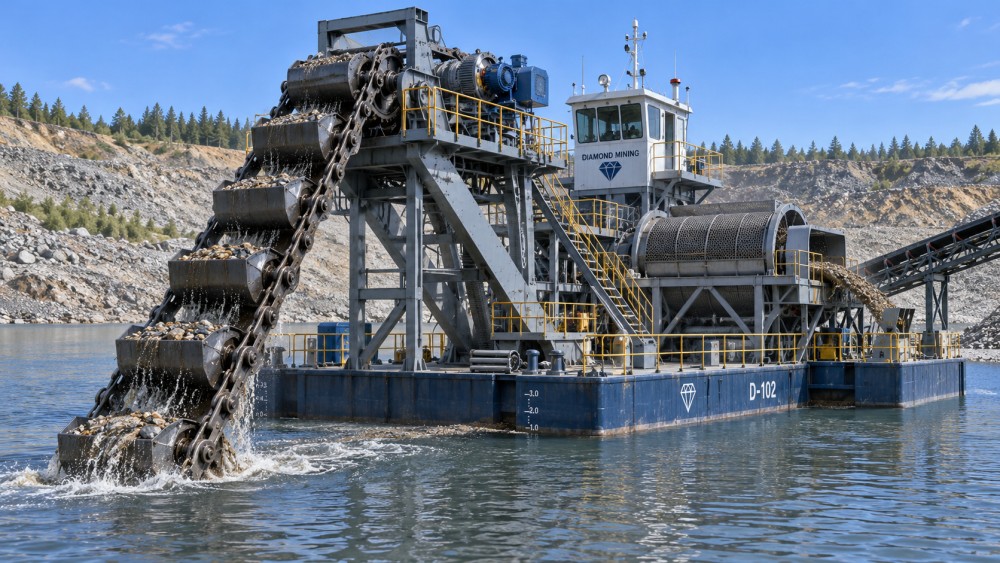
Maintenance drawings are especially valuable here. Check whether chain components can be replaced using the proposed onboard handling equipment and whether inspection points remain accessible after guards and walkways are installed. A service task that requires unplanned external lifting equipment can materially change the operating budget.
Verify the route from excavated gravel to recoverable product
The recovery circuit should be reviewed independently of the dredger’s mechanical specification. Request a flowsheet showing feed preparation, sizing, concentration, final recovery and reject streams. Every transfer point should have a defined duty and a stated equipment supplier.
Scrubbing and screening deserve close attention when the deposit contains clay or variable particle sizes. Ask how the proposed equipment liberates material, controls feed presentation and manages oversize. Screen apertures and discard routes must be reconciled with the project’s target recovery size range; they should not be accepted as routine catalogue selections.
Wills’ Mineral Processing Technology, 8th edition, by Barry A. Wills and James A. Finch (2016), explains the principles of sizing, gravity concentration and dense-medium separation. These principles support a key procurement distinction: selecting a recognized separation method does not establish recovery performance for a particular deposit. Representative material testing and circuit-specific evidence are still needed.
Request the basis for every recovery claim. Was it derived from testing the project’s material, a different deposit or an equipment assumption? The answer should state the feed characteristics, size fractions assessed, sampling method and recovery boundary. A percentage without those details is not a dependable contractual guarantee.
Product handling belongs in the technical scope as well. Define controlled access, concentrate storage, sampling points and material-accounting responsibilities. These measures should fit the owner’s security procedures without making routine inspection and maintenance impractical.
Reconcile power, flotation and positioning requirements
Installed motor power is not the same as the electrical demand used to select a generator. Ask for a load list identifying operating combinations, starting requirements and essential auxiliary loads. The quotation should state whether plant preparation equipment, pumps, lighting and handling equipment are included in the power balance.
For generator-based packages, request the declared rating category and site-related derating assumptions. ISO 8528-1:2018, Reciprocating internal combustion engine driven alternating current generating sets—Part 1: Application, ratings and performance, provides the relevant terminology for generator applications and ratings. A generator recommendation should match the intended operating duty, not merely the sum of motor nameplates.
The floating platform requires a defined engineering basis covering equipment weights, operating loads and relevant working configurations. Request the hull arrangement, compartmentation, weight schedule and stability documentation appropriate to the installation. Buyers should not infer that a platform remains suitable after adding processing equipment, lifting devices or stored spares.
Positioning equipment needs an equally clear scope. Specify who provides anchors, winches, cables, spuds where applicable and shore interfaces. Ask which environmental and operating limits govern excavation and repositioning. Applicable vessel, mining and environmental requirements depend on jurisdiction and deployment; the supplier should identify its design basis, while the purchaser confirms local obligations.
Turn safety statements into verifiable deliverables
“Safe operation” and “international standard” are not sufficient acceptance criteria. Require a machine-specific risk assessment, guarding drawings, access arrangements and a documented isolation procedure. The review should address the bucket chain, rotating drives, lifting activities, hydraulic stored energy and maintenance work near water.
ISO 12100:2010, Safety of machinery—General principles for design—Risk assessment and risk reduction, provides a framework for machinery risk assessment and risk reduction. It does not, by itself, certify a complete dredger or resolve every jurisdictional requirement. Ask which hazards the supplier has evaluated and how the resulting measures appear in drawings, controls and operating instructions.
For hydraulic systems, ISO 4413:2010, Hydraulic fluid power—General rules and safety requirements for systems and their components, is a relevant reference when incorporated into the project specification. Procurement documents should identify the required evidence and review process, rather than assume that mentioning a standard proves compliance.
Establish who owns the design and the warranty
A wholesaler may coordinate several manufacturers rather than design and build the complete package. That arrangement can be workable, but buyers need a responsibility matrix identifying who controls drawings, approves substitutions, performs inspections and resolves interface problems.
Ask whether the seller can obtain engineering revisions directly from the original equipment manufacturers. Replacement-part availability should be demonstrated through part numbers, controlled drawings or another agreed identification system—not only a promise that components can be supplied later.
Shipping and assembly exclusions should also be explicit. Check packing, transport dimensions, site lifting requirements, commissioning attendance and operator training. Factory completion and readiness to operate at the mine are different delivery milestones.
Make acceptance testing and lifecycle cost part of the comparison
Factory testing can verify assembly, controls and specified functions, but a no-load run cannot demonstrate digging performance or mineral recovery. Distinguish factory inspections from site acceptance, and define which tests are possible before shipment.
The site protocol should specify feed conditions, measurement boundaries, test duration, permitted interruptions and the method for recording results. Recovery testing needs an agreed sampling and accounting procedure. If representative material is unavailable before purchase, document the unresolved risk rather than replace it with an unsupported guarantee.
Compare ownership costs using the same operating assumptions across bidders. Include wear parts, energy, maintenance labour, planned inspections and realistic access to replacement components. Avoid treating an unverified service-life estimate as a fixed saving.
A purchase-ready quotation should connect each consequential claim to a drawing, calculation, specification, test or clearly stated assumption. Where evidence remains incomplete, the contract should assign responsibility and define how the uncertainty will be resolved. That is a stronger basis for selection than either the lowest initial price or the largest advertised capacity.
Related News
 MSHA Issues Mine Truck Safety Alert After One Death and 121 InjuriesMining Infrastructure ExpertMSHA mine truck safety alert reports one death and 121 lost-time injuries. Discover why mine operators should review safety practices.
 How to size a crushing plant for ore processingMining Infrastructure ExpertSize your ore processing equipment crushing plant with confidence. Learn how to calculate throughput, assess ore characteristics, and prevent bottlenecks.
 Trump Administration Rewrites Mining Policy to Spur Critical Minerals DevelopmentMining Infrastructure ExpertU.S. critical minerals mining policy is changing. Explore what faster approvals could mean for investment, equipment demand and supply chains.
 How IEC 62443 defines security zones for industrial communication systemsRobotics EngineerExplore industrial communication systems and IEC 62443: learn how security zones, conduits, and risk-based controls help protect plant operations.
 China-Peru Trade Agreement Upgrade Takes Effect, Easing Machinery CertificationConstruction Equipment SpecialistThe China-Peru trade agreement upgrade simplifies machinery certification. Discover what mutual recognition could mean for exporters entering Peru.
 How do industrial control systems regulate water treatment?Robotics EngineerDiscover how industrial control systems in water treatment use sensors, PLCs, and SCADA to regulate processes and help operators respond to changing conditions.
 Exotec Report: 25% of Supply Chain Leaders Regret Warehouse Automation DecisionsRobotics EngineerWarehouse automation regret affects 25% of surveyed supply chain leaders, according to Exotec. Explore the cost, contract and readiness risks before investing.
 How to set maintenance intervals for mining equipment in AustraliaMining Infrastructure ExpertMining equipment maintenance Australia: Learn how to set service intervals using operating hours, site conditions and equipment data to reduce downtime.
 EY Survey Ranks Complexity as Mining's Top Risk for 2027Mining Infrastructure ExpertMining risk in 2027 is led by complexity, EY's survey finds. Discover how aging mines, declining ore grades and supply chain pressures are reshaping the industry.
 Can asset lifecycle management automation reduce equipment downtime?IEG Heavy Machinery & Automation AnalystDiscover how asset lifecycle management automation can reduce equipment downtime through timely maintenance, faster repairs, and smarter service workflows.
 Caterpillar Q3 2026 Revenue Rises 17% to $20.7 Billion as Both Equipment Segments GrowConstruction Equipment SpecialistCaterpillar Q3 2026 revenue reportedly rose 17% to $20.7 billion. Explore equipment segment growth and what it could mean for procurement planning.
 How to choose a rugged industrial control panel for wet environmentsRobotics EngineerChoose a rugged industrial control panel for wet environments. Compare IP ratings, materials, seals, and condensation control to improve reliability.