How many decks should conventional aggregate screens have?




How Many Decks Should Conventional Aggregate Screens Have?
How many decks should conventional aggregate screens have? For technical evaluators, the answer depends on required product gradations, feed characteristics, capacity targets, moisture levels, and available plant space. Selecting the right conventional aggregate screens number of decks is critical to achieving efficient material separation, stable throughput, lower recirculation, and practical maintenance performance.
There is no universal “correct” deck count. A two-deck inclined screen may be the most sensible choice for a straightforward crushed-stone operation producing one coarse product and one finer product. A three- or four-deck screen may be justified where a plant must produce several tightly controlled commercial sizes from the same feed stream. More decks do not automatically mean better screening. They add separation opportunities, but they also introduce more screen media, more possible plugging points, greater installation height, and more maintenance work.
The practical question is not simply how many layers of screening media can fit in one machine. It is whether each deck has a clear job within the plant flowsheet. In quarrying, mining, recycled aggregate, and construction-material production, the deck configuration should follow the material balance and product specification rather than a preference for a larger machine.
Start With the Number of Required Separation Cuts
A screen deck creates a separation point, often called a cut. Material smaller than the aperture passes through the deck, while larger material remains on top and is discharged as oversize. In a conventional multi-deck vibrating screen, the largest opening is generally placed on the upper deck and progressively smaller openings are used below it.
The first engineering step is therefore to map the desired products. If a plant receives a single crushed feed and only needs to remove oversize before sending the remaining material to another process, one deck can be sufficient. If it must create two saleable fractions plus an oversize return stream, two decks may be appropriate. If it must simultaneously make several separate aggregate sizes, a three-deck arrangement often becomes easier to justify.
A useful distinction is that the number of decks is not always the same as the number of final products. A screen may discharge material to a crusher, stockpile, wash plant, blending conveyor, or another screen. Conversely, some plants create multiple finished products by combining screen fractions downstream. The evaluator should review the complete circuit before deciding that each product requires its own deck.
Why Two and Three Decks Are Common Choices
In many conventional aggregate plants, two- and three-deck screens represent a workable balance between classification flexibility and operating simplicity. They can support common production patterns without forcing too much material through a long stack of progressively finer media. This is especially relevant for dry crushed aggregate, where the feed is reasonably consistent and the target sizes are not extremely fine.
A two-deck screen can separate an upper oversize fraction, an intermediate fraction, and a lower undersize fraction. Depending on the circuit, one or more of those streams may be re-crushed, stockpiled, washed, or directed to another screen. It is often a practical configuration where product requirements change periodically and the operator wants relatively simple media replacement and conveyor routing.
A three-deck screen is more appropriate when three usable size fractions must be separated consistently, in addition to top-deck oversize. It can reduce the need for a second screening machine, but that benefit should be tested against lower-deck loading. The bottom deck typically handles material that has already passed through the upper decks. Its effective screening area, aperture selection, and risk of blinding deserve particular scrutiny.
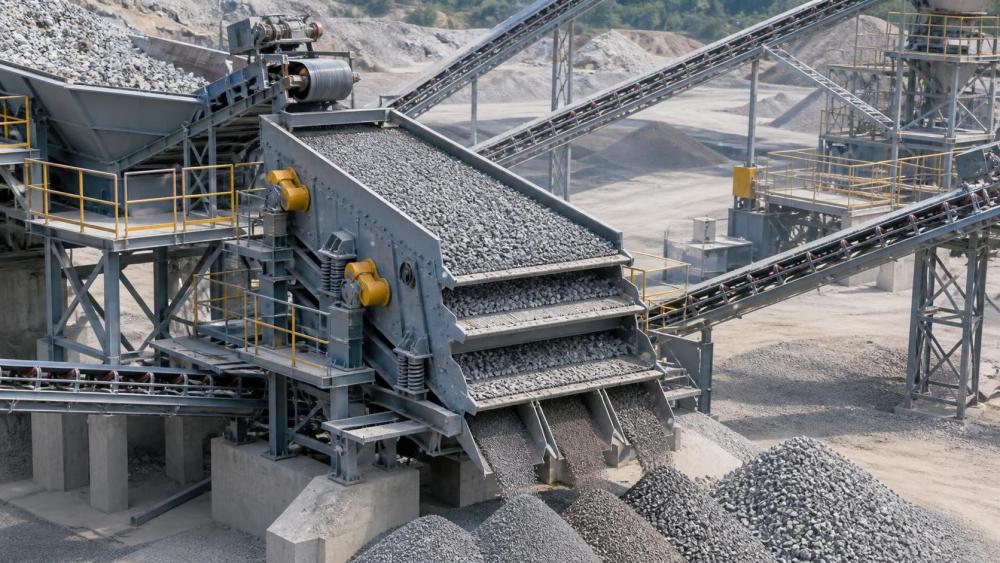
Four-deck machines can be technically valid, particularly where several narrow size bands are required. Yet they should not be treated as a default upgrade. In some duties, splitting the work across two screens can provide better access, simpler chute design, greater operational flexibility, and less disruption when one deck requires media replacement. The better arrangement depends on the site layout, process redundancy requirements, and the consequences of unplanned downtime.
Feed Material Can Change the Answer
Deck count cannot be selected from product sizes alone. Feed condition has a direct effect on screening efficiency. Moist, sticky, clay-bearing, flaky, or highly variable feed can reduce the open area available for separation. Fine particles may adhere to larger particles rather than passing through the intended aperture. Flat or elongated particles may orient themselves unpredictably. In those conditions, adding another deck may make the machine look more versatile on paper while making it harder to operate in practice.
High moisture content is a common reason to reconsider a dry multi-deck configuration. Blinding and pegging can become more significant as aperture size decreases. Depending on the material and required cut size, the project may need different screen media, higher-energy motion, wash water, a separate dewatering stage, or a revised process arrangement. These choices should be evaluated together; the number of decks is only one variable.
Feed top size and gradation matter as well. A screen receiving a broad, heavily loaded crusher discharge has a different duty from a finishing screen fed by a controlled intermediate fraction. Large top-size material on the upper deck can shield smaller particles from the openings below. If the top deck is overloaded, lower decks may never receive material in a condition that allows accurate separation. This is why the first deck is often designed not only for classification, but also for protecting the lower decks from excessive burden.
Capacity Is Governed by Usable Area, Not Deck Count Alone
A frequent evaluation mistake is to assume that a screen with more decks has greater capacity. Capacity is affected by the available screening area on each deck, the proportion of near-size material, the opening size and shape, screen-media open area, feed distribution, vibration characteristics, deck slope, and the time particles remain on the deck. A fourth deck does not increase the usable area of the deck that has become the bottleneck.
Near-size material deserves special attention. These are particles close to the opening size, and they generally require more opportunities to present themselves to an aperture. A product specification with a strict separation around a difficult cut point may demand more area, a longer screen, different media, or a different screening stage rather than simply another deck. A supplier’s capacity estimate should identify the assumed feed gradation, bulk density, moisture, and required screening efficiency. Without those assumptions, a nominal tons-per-hour figure has limited value.
Technical teams should also look beyond average throughput. The relevant duty may include peak feed rate, seasonal moisture variation, crusher operating changes, and the effect of recirculating load. A screen that performs adequately under average conditions but loses separation during short high-feed events can destabilize the whole crushing circuit.
Screen Media and Deck Arrangement Must Be Evaluated Together
The opening on a drawing does not tell the full story. Woven wire, polyurethane panels, rubber modules, perforated plate, self-cleaning wire, and hybrid media can offer different wear life, open area, flexibility, and anti-blinding behavior. An upper deck handling abrasive rock may require a robust media choice that differs from the fine finishing deck below. Media weight also affects changeout handling and the screen’s maintenance routine.
Deck sequence should be checked for practical compatibility. The upper deck needs enough strength to absorb impact and support the expected burden. Lower decks need sufficient effective open area to perform the finer separations. If a specification requires very fine cuts from difficult material, placing that task at the bottom of an overloaded conventional screen can be a poor decision. A separate finishing screen, a wash system, or another classification technology may be more appropriate.
Plant Layout and Maintenance Often Decide the Final Configuration
Every added deck increases the vertical stack of discharge streams. This affects chute angles, conveyor elevations, access platforms, guarding, steelwork, and the height of the supporting structure. In a fixed quarry plant, a taller screen may be manageable if it replaces several separate units. In a mobile or modular installation, transport limits, axle loads, folding conveyors, and setup time may narrow the options considerably.
Maintenance access should be examined before purchase, not after commissioning. Can technicians safely replace screen panels on every deck? Is there enough clearance around side plates, drive assemblies, springs, and discharge chutes? Can media be removed without dismantling unrelated equipment? If an operation expects frequent material changes or abrasive wear, these questions have a direct bearing on lifecycle cost.
Safety requirements also vary by region and site. Guarding, access arrangements, lockout procedures, dust control, noise exposure, and lifting provisions should be reviewed against local requirements and the owner’s engineering standards. Deck count influences these details because a more complex screen installation usually creates more elevated maintenance points and more discharge interfaces.
A Practical Basis for Specifying the Number of Decks
Before requesting quotations, prepare a screening duty sheet rather than asking only for a machine size or deck count. At minimum, it should define the feed source, maximum particle size, expected gradation, moisture condition, bulk density, contamination or clay content, design feed rate, peak feed rate, required product cuts, allowable oversize and undersize, and downstream destination for every discharge stream. If the aggregate must meet a project specification, attach the applicable gradation requirements rather than describing the products only by informal names.
It is also wise to distinguish current requirements from likely future requirements. A plant that will soon need an extra commercial fraction may benefit from space and conveyors reserved for a future screen, even if the initial installation uses fewer decks. That can be more economical and operationally sound than installing a four-deck machine today for a separation duty that does not yet exist.
Industrial Edge Global approaches equipment selection as a lifecycle and process decision rather than a catalogue comparison. For aggregate-screen evaluations, that means connecting deck arrangement with material behavior, crusher recirculation, power demand, maintenance access, spare-media availability, plant controls, and the value of consistent finished gradation. The same perspective helps engineering and procurement teams compare proposals that may appear similar but rely on different operating assumptions.
The Most Defensible Answer
For many conventional aggregate duties, two or three decks are often enough. A single deck suits simple scalping or oversize removal. Four or more decks should be selected only when the process genuinely requires the additional separation cuts and the screening area, feed condition, layout, and maintenance plan can support them.
The best conventional aggregate screens number of decks is the lowest number that reliably produces the required material streams at the required capacity and quality. Confirm that conclusion with representative feed data, a clear material balance, and supplier calculations that state their assumptions. That discipline is usually more valuable than choosing the screen with the longest list of decks.
Related News
 What is driving consolidation in the global equipment supplier market?IEG Heavy Machinery & Automation AnalystGlobal equipment supplier market consolidation is accelerating through technology, service, and supply-chain demands. Discover how buyers can capture value while managing risk.
 When does capital equipment investment pay back in manufacturing?IEG Heavy Machinery & Automation AnalystCapital equipment investment manufacturing: learn when equipment truly pays back by evaluating full costs, cash flow, ramp-up, operational risks, and lifecycle value.
 When does a distribution center need an automated pallet handling system?Heavy Lifting Systems AnalystPallet handling systems help distribution centers overcome labor shortages, bottlenecks, safety risks, and storage constraints. Discover the key signs it’s time to automate.
 How to build a machinery investment plan around payback periodIEG Heavy Machinery & Automation AnalystMachinery investment planning manufacturing guide: build a credible payback plan with full costs, ramp-up assumptions, lifecycle risks, and scenario-based cash benefits.
 How to Specify a Modular Packaging Line for Fast Changeovers and Scalable OutputRobotics EngineerModular packaging line specification guide: achieve faster changeovers, scalable output, reliable controls, and lower lifecycle costs with practical planning.
 How industrial IoT devices reduce unplanned downtime in factoriesRobotics EngineerIndustrial IoT devices help factories detect early equipment issues, plan maintenance, and reduce costly unplanned downtime before production is disrupted.
 What is driving industrial machinery market demand in manufacturing?IEG Heavy Machinery & Automation AnalystIndustrial machinery market manufacturing demand is rising as factories pursue automation, energy efficiency, resilient supply chains, and lifecycle productivity gains.
 316L Stainless Steel Pipe Tube Technical Factors That Shape Buyer DecisionsCNC Machining AnalystA technical analysis for 316L stainless steel pipe tube buyers, covering corrosion expectations, pipe route choice, tolerance, surface, and inspection.
 How ground conditions determine crawler piling equipment selectionConstruction Equipment SpecialistCrawler piling equipment selection starts with ground conditions. Learn how soil, rock, groundwater and site constraints shape safer, more productive piling solutions.
 3300mm CNC Beam Saw Sheet Capacity: Layout Checks Before PurchaseCNC Machining AnalystZhongding ZD330 beam saw specifications: assess 3300mm sheet capacity, layout clearances, handling flow, and acceptance checks before buying.
 How Bucket Chain Diamond Dredgers Meet ISO 12100 Safety Requirements in Alluvial Mining ProjectsMining Infrastructure ExpertBucket chain diamond dredger safety made real: how ISO 12100 compliance ensures operator protection, reliability & zero lost-time injuries in alluvial mining.
 Modular Packaging for High-Mix Automotive Assembly Lines: How Standardized Load Units Reduce Line Changeover Time by 37% — Case Study from Tier-1 Supplier in GuangdongHeavy Lifting Systems AnalystModular packaging slashes automotive line changeover time by 37%—discover how standardized load units boost OEE, cut labor costs, and enable seamless high-mix assembly.