When do secondary crushers need closed-circuit screening?




Secondary crushers need closed-circuit screening when a single crushing pass cannot reliably meet the required size limit, and oversize material must be returned for further reduction rather than accepted, stockpiled, or sent to another crushing stage. The strongest justification is a defined product or downstream feed requirement—not simply a desire for a finer crusher discharge.
Closing the circuit can improve size control, but it also increases the tonnes handled by the crusher, screen, and conveyors. The decision therefore depends on two linked questions: whether oversize removal is necessary, and whether the complete circuit can process the resulting return load at the required fresh-feed rate. A screen added without this capacity check can turn a quality improvement into a production bottleneck.
Start with the required discharge, not the crusher setting
A crusher’s closed-side setting is not a guaranteed maximum product size. Discharge contains a distribution of particle sizes influenced by feed grading, rock characteristics, chamber geometry, operating conditions, and wear. Elongated particles can also pass through crushing and screening equipment differently from more equidimensional material.
This distinction matters when a specification limits the amount retained on a particular sieve. Tightening the crusher setting may reduce oversize, but it can also reduce throughput, increase fines, or push operation toward power and mechanical limits. Where compliance depends on separating acceptable material from material needing another pass, screening provides a control function that crusher adjustment alone cannot replace.
Before specifying a closed circuit, define:
- The required product grading, including allowable oversize and fines.
- Whether the secondary discharge is a saleable product or feed to another process.
- The fresh-feed production rate that must be sustained.
- The range of feed sizes, moisture conditions, and material characteristics the circuit must accommodate.
A product with a strict upper-size tolerance creates a different requirement from a tertiary crusher feed that can accept some coarse material. Similarly, achieving an average grading during a short test is not equivalent to maintaining compliance across changing feed and liner condition.
Where closed-circuit screening adds a necessary function
Oversize cannot remain in the finished product
When secondary crushing is the final reduction stage, a screen can separate material meeting the size requirement and return the coarse fraction. This arrangement is useful when open-circuit discharge contains an unacceptable oversize fraction even at a practical crusher setting.
The screen aperture must be selected against the actual grading specification. Nominal aperture alone does not guarantee compliance: media type, opening shape, wear, loading, and particle shape affect separation. A specification expressed using laboratory square-mesh sieves should not be translated directly into an operating screen aperture without checking the resulting product.
Downstream equipment requires a controlled feed size
A tertiary crusher, roll crusher, mill, or other process may impose a feed-size limit. Returning secondary oversize can protect that interface and reduce coarse-feed excursions. However, the return destination matters. If the secondary crusher cannot efficiently reduce the difficult fraction at the required rate, routing that material to a separate reduction stage may be more suitable than repeatedly circulating it.
Closing the secondary circuit is therefore not automatically preferable to adding or retaining tertiary crushing. The choice depends on the required reduction ratio, available capacity, and whether repeated secondary crushing produces excessive fines before the coarse fraction reaches the target size.
Feed variability makes open-circuit control unreliable
Changes in primary crusher discharge, rock strength, or feed grading can change the secondary product distribution. A closed circuit removes part of that variability from the outgoing product by retaining oversize within the loop. It does not eliminate the variability: it converts some of it into fluctuating internal load.
This is valuable only if the plant can absorb those load changes. A circuit sized around favorable feed conditions may lose fresh-feed capacity when a coarser or harder feed increases the proportion returning to the crusher.
Screening is not always the same as closing the circuit
An open-circuit secondary stage can still include screening. A screen ahead of the crusher may bypass material already small enough, while a screen after it may classify products and send oversize elsewhere. The stage becomes closed circuit when a separated coarse stream returns to that same crushing stage.
Two arrangements deserve separate evaluation:
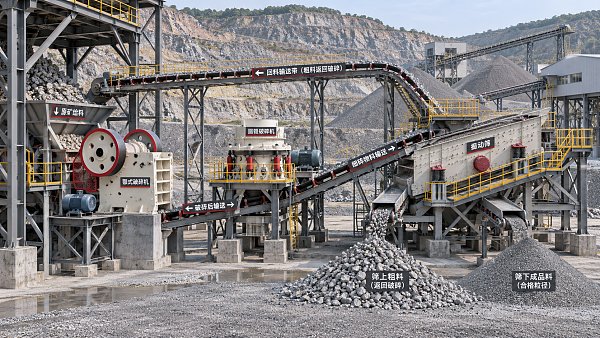
- Crusher followed by a screen: all crusher discharge reaches the screen; accepted material leaves, and oversize returns to the crusher feed.
- Screen ahead of the crusher, receiving fresh and returned material: acceptable fines bypass the crusher, while screen oversize enters it. Crusher discharge returns to the screen.
The second arrangement can avoid crushing material that already meets the size requirement. Its screen, however, must accommodate both fresh feed and crusher discharge. That duty can be substantially larger than the fresh-feed tonnage suggests.
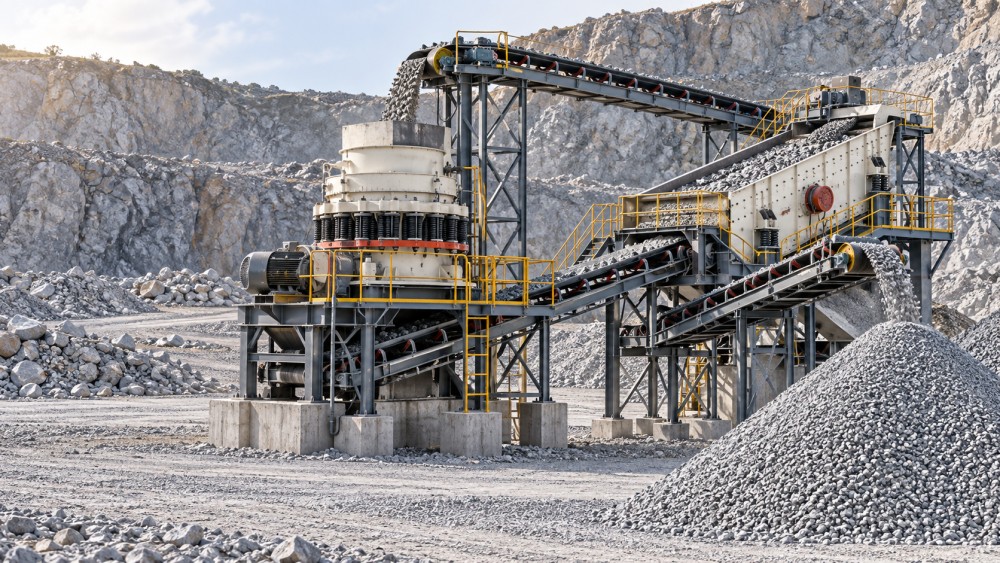
The flowsheet should identify every stream and its design duty. Terms such as “screen capacity” or “plant throughput” are insufficient unless they state whether they refer to fresh feed, crusher feed, total screen feed, or finished product.
Calculate circulating load before selecting equipment
Consider an illustrative steady-state circuit in which all fresh feed enters the secondary crusher, crusher discharge goes to a screen, and screen oversize returns. Assume no material losses or other outlets.
If fresh feed is F, crusher throughput is C, and the fraction of screen feed returned is r, then:
C = F ÷ (1 − r)
Return load = C − F
At 200 tonnes per hour of fresh feed and a 35% return fraction, the crusher and screen each handle approximately 308 tonnes per hour, with about 108 tonnes per hour circulating back. The circulating-load ratio, defined here as return load divided by fresh feed, is approximately 54%.
If the return fraction rises to 50%, internal throughput reaches 400 tonnes per hour to sustain the same 200 tonnes per hour of fresh feed. These figures are arithmetic examples, not recommended design values. They show why a crusher selected only against the fresh-feed target can be undersized.
The distinction between return fraction and circulating-load ratio should be explicit in equipment proposals. A percentage without its denominator can lead to materially different capacity assumptions.
This simplified balance also does not predict the return fraction. That requires a crusher product-size distribution and screen separation performance for the intended operating conditions. Where fresh feed first enters a prescreen, the individual equipment loads must be calculated from that particular flowsheet rather than copied from the example.
The screen can determine the circuit’s practical capacity
A screen is not an ideal size separator. Some undersize material can report to the oversize stream, unnecessarily returning to the crusher. Some oversize can report to the product because of media damage, unsuitable openings, particle orientation, or other separation limitations. These errors have different consequences: one consumes capacity and promotes overcrushing; the other threatens product compliance.
Material close to the cut size is especially important. A feed containing a large near-size fraction presents a different screening duty from one dominated by particles well above or below the aperture, even at the same tonnage.
Screen selection should therefore account for more than nominal throughput:
- Feed size distribution and near-size content: these influence the difficulty of separation.
- Moisture and clay: adhesion, blinding, and agglomeration can prevent effective sizing.
- Bulk density and bed depth: volumetric loading and material presentation affect usable capacity.
- Deck arrangement and media: each deck has its own separation duty, loading, and open area.
- Feed distribution: uneven loading can overload part of the deck while leaving other areas underused.
Where wet screening is needed, water supply, drainage, product moisture, and water treatment become part of the circuit scope. Returning damp fines to a crushing chamber can also change material flow behavior. These interfaces should be resolved before treating wet screening as a straightforward remedy for poor dry-screen performance.
Do not use recirculation to compensate for the wrong crushing duty
Closed-circuit screening is a poor substitute for an unsuitable crusher chamber, an unrealistic reduction ratio, or inadequate installed power. If a large proportion of discharge remains above the cut size on every pass, the circuit may consume its available capacity circulating material rather than accepting new feed.
Conversely, pushing a very tight setting to suppress the return stream may create more fines than the product allows. The operating target is not the lowest possible circulating load; it is the required net production and grading within equipment limits.
For cone crushers designed to operate with a stable, choke-fed chamber, the return stream must be blended with fresh feed without causing erratic loading or segregation. A surge bin and controlled feeder can help decouple short-term conveyor fluctuations from crusher operation. Their sizing and layout need to reflect the combined feed, not just incoming plant tonnage.
Closed-circuit screening also does not directly solve particle-shape requirements. Additional crushing may change shape, but grading compliance and shape compliance remain separate checks. Nor can screening remove excess fines already generated unless the flowsheet includes a separate fines-removal route.
Check the installation against peak internal duty
In a retrofit, the most restrictive component may be a return conveyor, transfer chute, or screen support structure rather than the crusher. Conveyors need assessment for both mass flow and volumetric loading; chutes require sufficient space and geometry to handle the intended material without buildup or spillage.
Access is another design constraint. Screen media replacement, crusher maintenance, belt cleaning, and blocked-chute intervention all need safe working space and appropriate isolation provisions. A compact layout that fits the equipment footprint can still be impractical to maintain.
Control logic should prevent the loop from feeding into a failed discharge path. Screen or return-conveyor stoppages need coordinated upstream shutdowns, while bin-level monitoring and crusher-load control should limit accumulating material. Startup and shutdown sequences must account for material already circulating in the system.
The installed-cost comparison should include these interfaces, together with structural steel, electrical distribution, dust control, lifting access, and commissioning downtime. Comparing only the purchase price of a screen against expected product improvement understates the project scope.
Approve the circuit on net output and verified grading
A closed circuit is justified when it delivers a necessary size-control function at an acceptable net production rate and lifecycle cost. Open-circuit operation remains appropriate when its discharge consistently meets the requirement, downstream equipment can accept the size range, or oversize already has a suitable destination.
Before committing to closure, obtain a representative feed analysis and evaluate credible variations in grading, material strength, moisture, and wear condition. Request a balanced flowsheet showing fresh feed, each internal stream, expected product grading, and equipment loading. Capacity margins should respond to those operating scenarios rather than an unexplained allowance.
Performance acceptance should measure fresh-feed throughput, product compliance, circulating load, and energy per tonne of acceptable output over a stable operating period. A high crusher throughput alone can be misleading because the same material may pass through several times.
The decisive test is whether screening allows the plant to meet its size requirement reliably without exceeding the capacity of the loop. If meeting that requirement demands persistent high recirculation, excessive fines production, or reduced fresh-feed output, the better solution may be a revised crushing stage—not simply a larger return conveyor.
Related News
 MSHA Issues Mine Truck Safety Alert After One Death and 121 InjuriesMining Infrastructure ExpertMSHA mine truck safety alert reports one death and 121 lost-time injuries. Discover why mine operators should review safety practices.
 How to size a crushing plant for ore processingMining Infrastructure ExpertSize your ore processing equipment crushing plant with confidence. Learn how to calculate throughput, assess ore characteristics, and prevent bottlenecks.
 Trump Administration Rewrites Mining Policy to Spur Critical Minerals DevelopmentMining Infrastructure ExpertU.S. critical minerals mining policy is changing. Explore what faster approvals could mean for investment, equipment demand and supply chains.
 How IEC 62443 defines security zones for industrial communication systemsRobotics EngineerExplore industrial communication systems and IEC 62443: learn how security zones, conduits, and risk-based controls help protect plant operations.
 China-Peru Trade Agreement Upgrade Takes Effect, Easing Machinery CertificationConstruction Equipment SpecialistThe China-Peru trade agreement upgrade simplifies machinery certification. Discover what mutual recognition could mean for exporters entering Peru.
 How do industrial control systems regulate water treatment?Robotics EngineerDiscover how industrial control systems in water treatment use sensors, PLCs, and SCADA to regulate processes and help operators respond to changing conditions.
 Exotec Report: 25% of Supply Chain Leaders Regret Warehouse Automation DecisionsRobotics EngineerWarehouse automation regret affects 25% of surveyed supply chain leaders, according to Exotec. Explore the cost, contract and readiness risks before investing.
 How to set maintenance intervals for mining equipment in AustraliaMining Infrastructure ExpertMining equipment maintenance Australia: Learn how to set service intervals using operating hours, site conditions and equipment data to reduce downtime.
 EY Survey Ranks Complexity as Mining's Top Risk for 2027Mining Infrastructure ExpertMining risk in 2027 is led by complexity, EY's survey finds. Discover how aging mines, declining ore grades and supply chain pressures are reshaping the industry.
 Can asset lifecycle management automation reduce equipment downtime?IEG Heavy Machinery & Automation AnalystDiscover how asset lifecycle management automation can reduce equipment downtime through timely maintenance, faster repairs, and smarter service workflows.
 Caterpillar Q3 2026 Revenue Rises 17% to $20.7 Billion as Both Equipment Segments GrowConstruction Equipment SpecialistCaterpillar Q3 2026 revenue reportedly rose 17% to $20.7 billion. Explore equipment segment growth and what it could mean for procurement planning.
 How to choose a rugged industrial control panel for wet environmentsRobotics EngineerChoose a rugged industrial control panel for wet environments. Compare IP ratings, materials, seals, and condensation control to improve reliability.