How foundation requirements affect secondary crusher machine costs




How foundation requirements affect secondary crusher machine costs
The quoted price of a secondary crusher machine is only part of its installed cost. Excavation, reinforced concrete, anchor bolts, vibration control, and engineering can add substantial expenditure, particularly where ground conditions or existing structures create constraints. These items also affect when the machine can start producing. A competitive equipment quotation can become an expensive project if foundation requirements are discovered after the purchase order is signed.
For procurement teams, the task is not simply to obtain a concrete price. It is to establish what the crusher needs, what the site can support, and who is responsible for the interface between them. Comparing suppliers on that basis produces a more useful installed-cost estimate than comparing machine prices alone.
Why machine weight does not tell you the foundation cost
Shipping weight is an inadequate basis for pricing a crusher foundation. The supporting system must resist operating loads, maintain alignment, and limit movement under the conditions defined by the equipment manufacturer and project engineer. Depending on the arrangement, it may also carry a drive assembly, feed chute, access platform, or supporting steelwork.
Dynamic behavior matters as much as static weight. Rotating or reciprocating components generate time-varying forces; feed fluctuations and abnormal operating events can introduce additional load cases. Foundation design therefore needs more than a general arrangement drawing showing bolt positions.
The supplier should provide operating mass, center of gravity, support reactions, dynamic forces and moments, relevant frequencies, and applicable startup, shutdown, or upset loads. A qualified engineer then evaluates the combined machine, foundation, and ground response. Adding concrete without that assessment does not automatically solve a vibration problem.
Crusher design changes the supporting arrangement
Cone crushers, impact crushers, and jaw crushers used in secondary duties do not impose identical support requirements. Their motion, mounting systems, drive arrangements, and maintenance needs differ. Even machines with similar throughput can require different civil works.
Some packages use manufacturer-specified resilient mounts; others use rigidly anchored frames or engineered steel structures. A compact machine may save footprint but still need adequate discharge clearance and maintenance lifting space. There is no dependable rule that one crusher type always has the cheapest foundation. Compare actual supplier designs at the required duty, not broad equipment categories.
Site conditions can outweigh differences in equipment price
Ground conditions determine how loads reach a reliable supporting layer. Competent material close to the surface may permit a relatively straightforward shallow foundation. Uncontrolled fill, compressible soils, groundwater, or variable strata can introduce ground improvement, deeper excavation, piles, or other engineered measures. None should be assumed necessary—or unnecessary—without site investigation.
Bearing capacity is only part of the question. Settlement and differential movement can disturb machine alignment, chute connections, and conveyor interfaces even where the ground can carry the nominal load. Where warranted, the geotechnical investigation should also provide information relevant to dynamic analysis, rather than only a static allowable bearing pressure.
Physical access creates another cost layer. Excavation beside an operating plant may require temporary support, utility relocation, restricted work windows, and controlled demolition. High groundwater can add dewatering and construction difficulties. These are site costs, not evidence that the crusher itself is overpriced.
Existing concrete deserves particular caution. A floor slab that supports vehicles is not automatically suitable for a secondary crusher machine. Reuse requires verification of geometry, reinforcement, concrete condition, underlying ground, and anchorage capacity. Where records are incomplete, investigation and testing belong in the budget before reuse is treated as a saving.
Look beyond the concrete block
A foundation quotation based only on concrete volume leaves several expensive interfaces unresolved. Reinforcement congestion, anchor installation tolerances, grout placement, structural steel, and access for construction all influence the final price. The cheapest rate per cubic meter may have little relevance to the finished installation.
A useful arrangement drawing shows the complete load path: crusher supports, base frame or mounts, anchors, concrete or steel support, and ground. It should also show nearby structures and the discharge route. That view helps reveal clashes before they become field modifications.
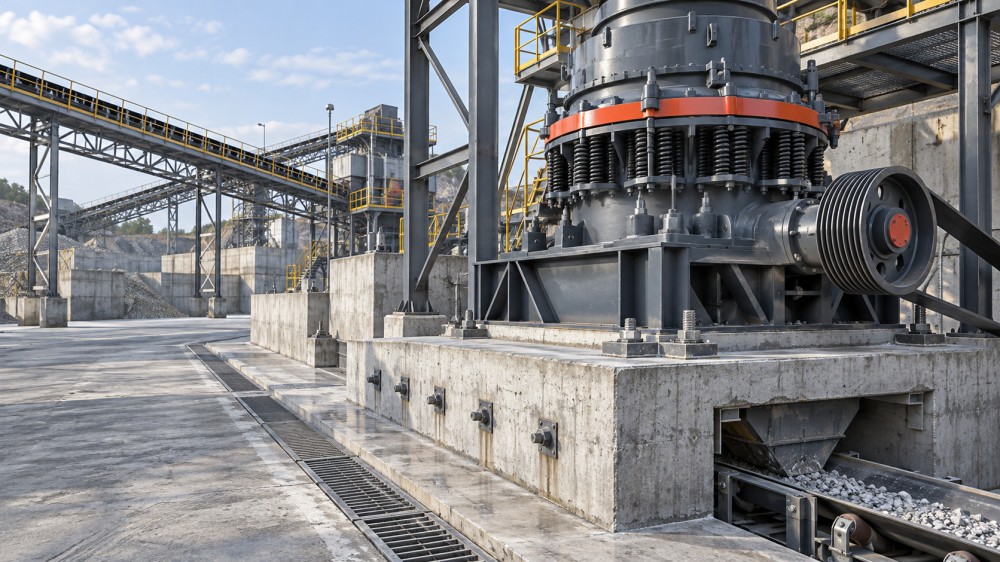
Anchor bolts are a frequent interface risk. Their grade, embedment, spacing, projection, and installation method must match the engineered design and machine base. Cast-in anchors require accurate setting; post-installed anchors require a suitable design and verified installation conditions. Substituting one approach for another is not merely a purchasing decision.
Vibration isolation also needs system-level thinking. Resilient mounts may reduce transmitted vibration when correctly selected, but they introduce movement that connected chutes, ducts, cables, and services must accommodate. They do not eliminate foundation engineering. Similarly, separating a machine foundation from surrounding floors may help in some arrangements, but the decision depends on the structural and dynamic assessment.
Compare installation options without assuming one is cheaper
A ground-supported concrete installation, an elevated steel arrangement, and a skid-mounted package distribute costs differently. Procurement comparisons should include all supporting work rather than treating the supplier’s package boundary as the project boundary.
“Skid-mounted” does not mean “place anywhere.” Nor does a steel frame remove the need for foundations. Ask each supplier to state the support conditions assumed in its proposal. Otherwise, a seemingly complete package may depend on civil works that nobody has priced.
Build a cost comparison around defined responsibilities
For budget purposes, separate the equipment purchase from investigation, engineering, site preparation, foundation construction, mounting components, erection, and commissioning. Keep modifications to adjoining conveyors, chutes, platforms, and services visible rather than burying them in a general installation allowance.
There is no reliable universal percentage for foundation cost relative to crusher price. Local labor rates, ground conditions, support height, access restrictions, and project scope can change that relationship substantially. Early allowances should state their assumptions and uncertainty, then be replaced by quantity-based estimates as the design develops.
Before comparing final offers, resolve these commercial and technical boundaries:
- Who supplies the machine loading data, and when will it be released?
- Who designs and approves the foundation and supporting structure under applicable local requirements?
- Are anchors, templates, mounts, grout, and installation supervision included or excluded?
- Which dimensions and loads are preliminary, and what happens commercially if they change?
- Who checks installed tolerances and accepts the completed support before machine erection?
- What operating conditions and measurement methods govern vibration acceptance?
These answers matter more than a generic statement that “foundation drawings are included.” A supplier’s outline drawing may communicate equipment requirements without constituting a site-specific civil design. The contract should make that distinction explicit.
Foundation decisions affect delivery and lifetime cost
Equipment delivery is not the same as installation readiness. Geotechnical investigation, design review, excavation, reinforcement, anchor setting, concrete placement, strength verification, and grouting each need space in the schedule. Loading and commissioning must follow the specified readiness criteria, not simply the date the crusher arrives.
Late revisions can be especially disruptive. A changed bolt pattern or support reaction may force redesign after reinforcement has been fabricated or anchors positioned. Agreeing drawing-release dates and design hold points before award can reduce this exposure. Where early construction is necessary, the remaining change risk should be explicit.
The operating consequences also belong in the decision. Excessive movement, loose anchorage, or deteriorating grout can contribute to alignment problems and repeated maintenance. Conversely, spending more on concrete does not guarantee reliability if the load model, installation, or connected equipment is wrong. Good design and installation control are more valuable than an arbitrary foundation mass allowance.
Maintenance access is another legitimate trade-off. Providing space for wear-part changes, lifting operations, and anchor inspection may increase the initial footprint, yet avoid difficult shutdown work later. Evaluate that layout against the actual maintenance procedure, not just the machine’s external dimensions.
What to establish before placing the order
Industrial Edge Global (IEG) approaches capital equipment decisions through installed cost, operating requirements, and investment risk—not purchase price alone. For a secondary crusher machine, that perspective means treating the support system as part of the productive asset rather than an incidental construction expense.
Before award, bring the preferred supplier, site engineer, and civil estimator together around the same layout and loading assumptions. Confirm ground information, foundation responsibility, package exclusions, maintenance clearances, and drawing dates. If those inputs remain unresolved, retain a clearly identified allowance and risk provision instead of presenting the budget as firm. The useful comparison is the cost of a crusher ready to operate reliably at your site—not the lowest machine quotation.
Related News
 MSHA Issues Mine Truck Safety Alert After One Death and 121 InjuriesMining Infrastructure ExpertMSHA mine truck safety alert reports one death and 121 lost-time injuries. Discover why mine operators should review safety practices.
 How to size a crushing plant for ore processingMining Infrastructure ExpertSize your ore processing equipment crushing plant with confidence. Learn how to calculate throughput, assess ore characteristics, and prevent bottlenecks.
 Trump Administration Rewrites Mining Policy to Spur Critical Minerals DevelopmentMining Infrastructure ExpertU.S. critical minerals mining policy is changing. Explore what faster approvals could mean for investment, equipment demand and supply chains.
 How IEC 62443 defines security zones for industrial communication systemsRobotics EngineerExplore industrial communication systems and IEC 62443: learn how security zones, conduits, and risk-based controls help protect plant operations.
 China-Peru Trade Agreement Upgrade Takes Effect, Easing Machinery CertificationConstruction Equipment SpecialistThe China-Peru trade agreement upgrade simplifies machinery certification. Discover what mutual recognition could mean for exporters entering Peru.
 How do industrial control systems regulate water treatment?Robotics EngineerDiscover how industrial control systems in water treatment use sensors, PLCs, and SCADA to regulate processes and help operators respond to changing conditions.
 Exotec Report: 25% of Supply Chain Leaders Regret Warehouse Automation DecisionsRobotics EngineerWarehouse automation regret affects 25% of surveyed supply chain leaders, according to Exotec. Explore the cost, contract and readiness risks before investing.
 How to set maintenance intervals for mining equipment in AustraliaMining Infrastructure ExpertMining equipment maintenance Australia: Learn how to set service intervals using operating hours, site conditions and equipment data to reduce downtime.
 EY Survey Ranks Complexity as Mining's Top Risk for 2027Mining Infrastructure ExpertMining risk in 2027 is led by complexity, EY's survey finds. Discover how aging mines, declining ore grades and supply chain pressures are reshaping the industry.
 Can asset lifecycle management automation reduce equipment downtime?IEG Heavy Machinery & Automation AnalystDiscover how asset lifecycle management automation can reduce equipment downtime through timely maintenance, faster repairs, and smarter service workflows.
 Caterpillar Q3 2026 Revenue Rises 17% to $20.7 Billion as Both Equipment Segments GrowConstruction Equipment SpecialistCaterpillar Q3 2026 revenue reportedly rose 17% to $20.7 billion. Explore equipment segment growth and what it could mean for procurement planning.
 How to choose a rugged industrial control panel for wet environmentsRobotics EngineerChoose a rugged industrial control panel for wet environments. Compare IP ratings, materials, seals, and condensation control to improve reliability.