EU Updates Machinery Rules for Connected Industrial Equipment




On June 26, 2026, the European Commission formally issued the revised Machinery Regulation (EU) 2026/1325, with mandatory application starting on January 1, 2027. The change matters because it places industrial robots, CNC machine tools, and automated assembly systems within a clearly defined compliance category for high-risk connected machinery, adding cybersecurity certification and dual marking requirements that can affect export access, conformity assessment timing, and technical file preparation for manufacturers supplying the EU market.
What the regulation change formally introduces
The revised Machinery Regulation (EU) 2026/1325 was formally issued by the European Commission on June 26, 2026. According to the provided information, the regulation will become mandatory on January 1, 2027.
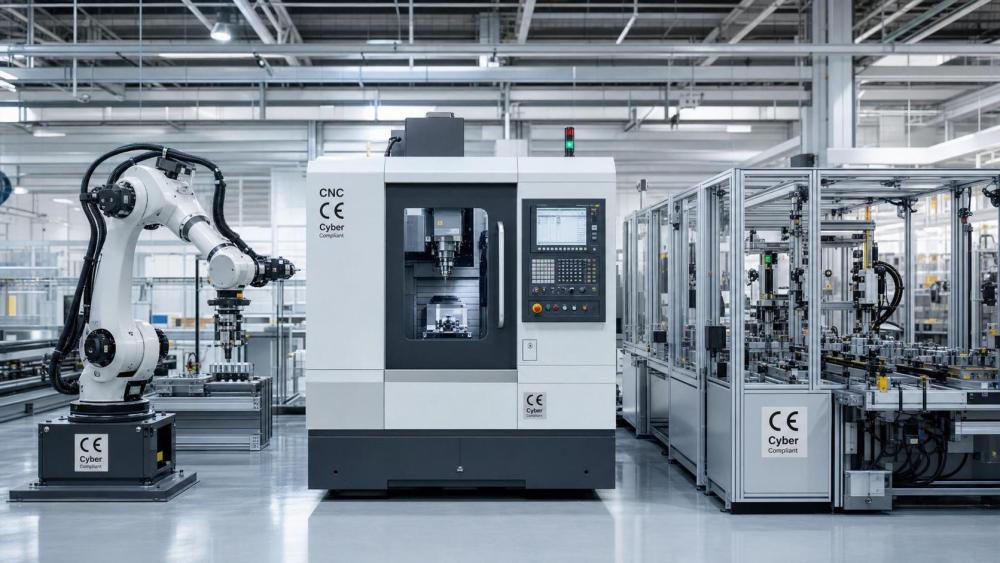
The new rule explicitly classifies industrial robots, CNC equipment, and automated assembly systems as high-risk connected machinery. For these products, compliance now includes EN IEC 62443-4-2 security development lifecycle certification together with dual conformity under CE and Cyber marking requirements.
The provided summary also indicates that this change directly affects export access procedures for Chinese manufacturers shipping to Europe, as well as type-testing timelines and the preparation of technical documentation.
Where the practical pressure is likely to appear first
For manufacturers shipping connected machinery to Europe
Analysis shows that the most immediate effect is likely to fall on equipment manufacturers whose products now sit inside the explicitly named high-risk connected machinery scope. The reason is straightforward: market access is no longer only about conventional machinery compliance, but also about whether cybersecurity-related certification and marking requirements can be demonstrated in a form acceptable for EU entry.
From a business-process perspective, the areas to watch most closely are export readiness reviews, product conformity planning, and document preparation. Companies involved in industrial robots, CNC machine tools, and automated assembly systems will need to pay closer attention to whether existing compliance packages are sufficient once the new rule becomes mandatory.
For certification and testing-related service providers
Observably, certification bodies, testing support firms, and technical compliance advisers may see pressure shift toward the sequencing of assessments and the completeness of supporting files. Because the summary specifically mentions type-testing cycles and technical documentation, the operational issue is not only whether certification is required, but also how review steps are organized before shipment or market placement.
What deserves closer attention is whether clients begin requesting earlier compliance screening, additional documentation review, or revised certification scheduling in response to the 2027 effective date.
For buyers and sourcing teams
From an industry perspective, procurement teams buying connected industrial equipment for EU-facing projects may also be affected. Where a machine now falls within the high-risk connected category, supplier qualification may increasingly depend on whether the vendor can demonstrate readiness for EN IEC 62443-4-2 certification and CE plus Cyber compliance marking.
In practical terms, sourcing and delivery planning may need to account for longer pre-delivery verification, requests for updated compliance documents, and closer checks on whether a supplier's technical package aligns with the revised regulatory requirement.
What companies should review before the mandatory date
Recheck whether the product scope now captures existing export models
Analysis shows that companies should first review whether their current industrial robot, CNC, or automated assembly product lines are now clearly captured by the high-risk connected machinery definition referenced in the summary. This is a product-scope question before it becomes a certification question.
Prepare for certification and marking as a linked compliance task
What deserves closer attention is that the rule change is framed as a dual requirement: EN IEC 62443-4-2 security development lifecycle certification and CE plus Cyber marking compliance. Companies should therefore treat certification planning, marking readiness, and internal compliance review as connected workstreams rather than separate downstream tasks.
Strengthen the technical file and supporting documentation process
The provided information specifically points to technical document preparation. That makes documentation control a near-term priority for exporters, especially where product files, conformity materials, and supporting records may need to be updated or reorganized to match the revised EU entry expectation.
Watch for execution details rather than assume a settled market practice
Observably, the regulation itself is identified as formally issued and time-bound, but the input does not provide detailed enforcement language, review procedures, or implementation guidance. Companies should therefore monitor how certification interpretation, documentation expectations, and procurement-side requirements are expressed in actual compliance workflows.
Why this should be read as an execution signal
From an industry perspective, this development is more than a general policy direction. The regulation has a defined issue date, a defined mandatory date, named product categories, and named certification and marking requirements. That makes it more appropriate to understand this as a rule implementation signal rather than a tentative regulatory discussion.
At the same time, analysis shows that the market still needs to observe how the requirement is applied in practice. The input confirms the direction of compliance change, but not every operational detail around execution. For that reason, companies should pay continued attention to certification interpretation, technical documentation expectations, tender language, and buyer-side compliance checks.
How the market is likely to frame this update
A balanced reading of this development is that the EU has moved cybersecurity compliance further into the market-entry path for certain connected industrial machinery. For exporters, certification-related service providers, and procurement teams, the main implication is not abstract regulatory change but a more demanding compliance sequence tied to access, documentation, and delivery timing.
Current observation suggests this should be treated as an already defined rule change with practical implementation consequences, while some execution details still require continued monitoring through actual certification practice and market feedback.
Basis of this article and points that still need verification
This article is based on the user-provided news title, event date, and event summary. For developments of this kind, relevant source categories typically include official regulatory announcements, notices from supervisory authorities, trade or customs-related updates, industry association communications, standards organization documents, and reporting from established professional media.
A specific official source link was not provided in the input, so the original publication pathway and any supporting implementation materials still need to be verified on an ongoing basis. Further observation is also needed on detailed enforcement language, certification interpretation, tender document changes, market feedback, and how companies execute the new requirements in practice.
Related News
 What is driving consolidation in the global equipment supplier market?IEG Heavy Machinery & Automation AnalystGlobal equipment supplier market consolidation is accelerating through technology, service, and supply-chain demands. Discover how buyers can capture value while managing risk.
 When does capital equipment investment pay back in manufacturing?IEG Heavy Machinery & Automation AnalystCapital equipment investment manufacturing: learn when equipment truly pays back by evaluating full costs, cash flow, ramp-up, operational risks, and lifecycle value.
 When does a distribution center need an automated pallet handling system?Heavy Lifting Systems AnalystPallet handling systems help distribution centers overcome labor shortages, bottlenecks, safety risks, and storage constraints. Discover the key signs it’s time to automate.
 How to build a machinery investment plan around payback periodIEG Heavy Machinery & Automation AnalystMachinery investment planning manufacturing guide: build a credible payback plan with full costs, ramp-up assumptions, lifecycle risks, and scenario-based cash benefits.
 How to Specify a Modular Packaging Line for Fast Changeovers and Scalable OutputRobotics EngineerModular packaging line specification guide: achieve faster changeovers, scalable output, reliable controls, and lower lifecycle costs with practical planning.
 How industrial IoT devices reduce unplanned downtime in factoriesRobotics EngineerIndustrial IoT devices help factories detect early equipment issues, plan maintenance, and reduce costly unplanned downtime before production is disrupted.
 What is driving industrial machinery market demand in manufacturing?IEG Heavy Machinery & Automation AnalystIndustrial machinery market manufacturing demand is rising as factories pursue automation, energy efficiency, resilient supply chains, and lifecycle productivity gains.
 316L Stainless Steel Pipe Tube Technical Factors That Shape Buyer DecisionsCNC Machining AnalystA technical analysis for 316L stainless steel pipe tube buyers, covering corrosion expectations, pipe route choice, tolerance, surface, and inspection.
 How ground conditions determine crawler piling equipment selectionConstruction Equipment SpecialistCrawler piling equipment selection starts with ground conditions. Learn how soil, rock, groundwater and site constraints shape safer, more productive piling solutions.
 3300mm CNC Beam Saw Sheet Capacity: Layout Checks Before PurchaseCNC Machining AnalystZhongding ZD330 beam saw specifications: assess 3300mm sheet capacity, layout clearances, handling flow, and acceptance checks before buying.
 How Bucket Chain Diamond Dredgers Meet ISO 12100 Safety Requirements in Alluvial Mining ProjectsMining Infrastructure ExpertBucket chain diamond dredger safety made real: how ISO 12100 compliance ensures operator protection, reliability & zero lost-time injuries in alluvial mining.
 Modular Packaging for High-Mix Automotive Assembly Lines: How Standardized Load Units Reduce Line Changeover Time by 37% — Case Study from Tier-1 Supplier in GuangdongHeavy Lifting Systems AnalystModular packaging slashes automotive line changeover time by 37%—discover how standardized load units boost OEE, cut labor costs, and enable seamless high-mix assembly.