



How Do You Troubleshoot an AGV That Stops Mid-Route?
When an automated guided vehicle stops mid-route, treat it first as a controlled safety event, then as an operational problem requiring evidence-based diagnosis.
The immediate goal is not simply to restart the vehicle. Teams must identify why it stopped, prevent recurrence, and restore material flow safely.
For plant managers, the central question is whether the stop is isolated, route-specific, fleet-wide, or evidence of a growing reliability risk.
For technicians, the practical challenge is narrowing the fault quickly among navigation, battery condition, safety sensing, communications, traffic control, and mechanical systems.
A vehicle that repeatedly pauses in the same location usually points toward an environmental, mapping, traffic, or communication issue rather than random equipment failure.
An AGV that stops at different locations may instead indicate weak battery performance, unstable wireless coverage, intermittent safety trips, wheel traction problems, or software faults.
The most effective troubleshooting process begins with fault history, alarm codes, location data, battery readings, and nearby system events rather than visual inspection alone.
Production teams should avoid repeatedly clearing alarms without recording conditions. That may recover one task, but it removes clues needed to eliminate recurring downtime.
Before moving the vehicle manually, confirm its load condition, stopping position, surrounding pedestrian risk, emergency-stop state, and whether other AGVs are blocked behind it.
A structured response helps maintenance teams restore availability while giving operations leaders clearer information about spare parts needs, infrastructure weaknesses, and automation investment priorities.
Start With the Stop Event, Not the Assumed Cause
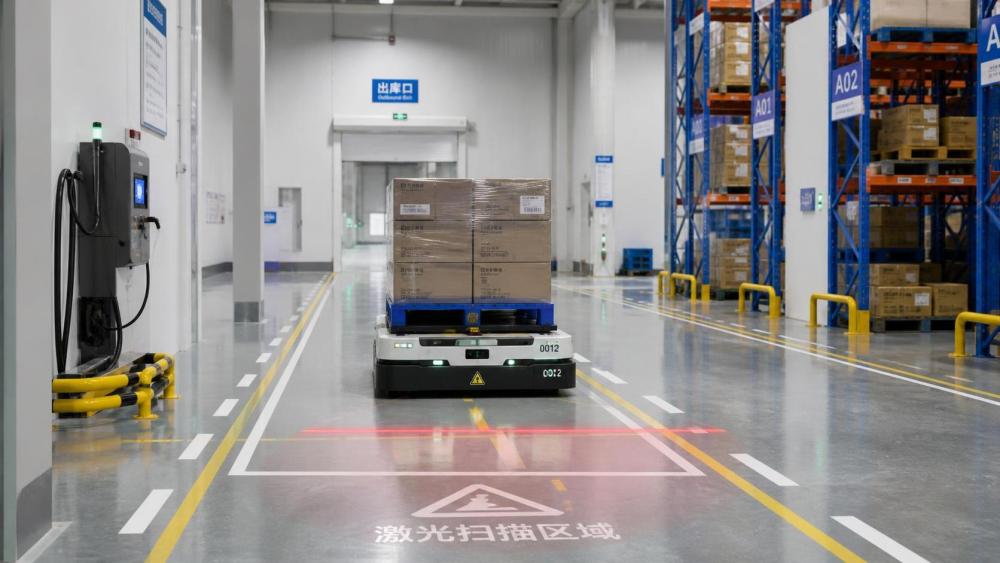
The first diagnostic step is to capture the exact stop event. Record the AGV identification number, timestamp, mission number, route segment, payload, and active alarm.
Many systems classify stops differently, including obstacle detection, localization loss, low battery, blocked path, communication timeout, safety circuit activation, or traffic-control waiting.
Read the vehicle controller log and fleet-management dashboard before resetting anything. The first error often identifies the initiating event more reliably than later alarms.
Compare the stopped vehicle with nearby AGVs operating on the same route. A shared failure pattern usually indicates infrastructure or supervisory-system conditions.
If only one AGV stops repeatedly, compare its firmware version, maintenance status, wheel condition, battery cycle count, sensor calibration, and configuration parameters.
Check whether the stop occurred during acceleration, docking, turning, lifting, charging, zone entry, or route handoff. Each operating state narrows the probable cause.
A stop while turning may relate to navigation markers, lidar visibility, steering alignment, speed limits, or load stability. A dock stop may involve positioning tolerances.
Document any recent changes around the route, including racks, pallets, floor repairs, reflective packaging, new machinery, wireless equipment, temporary barriers, or altered traffic rules.
Even minor layout changes can affect laser navigation, camera-based guidance, QR-code recognition, magnetic guidance, or virtual-route boundaries used by the AGV control platform.
For recurring incidents, create a short event record that includes cause category, response time, reset action, downtime minutes, corrective action, and verification result.
Check Safety Sensors and Physical Route Obstructions
Safety protection is the most common reason an AGV stops mid-route, and technicians should never bypass a safety device simply to recover production speed.
Inspect the safety laser scanner, bumper switches, ultrasonic sensors, emergency-stop buttons, safety relays, and protective-field configuration associated with the active travel direction.
Look for pallets extending into aisles, loose stretch wrap, floor debris, low-hanging materials, damaged guardrails, or pedestrian activity within the AGV safety field.
Some objects are difficult for sensors to interpret. Highly reflective film, transparent barriers, narrow metal legs, dark surfaces, and moving forklift tines can cause unexpected stops.
Clean scanner lenses and camera housings using the manufacturer-approved method. Dust, oil mist, condensation, and scratched covers can reduce detection quality or localization confidence.
Verify that the vehicle did not stop because its load exceeded the approved profile. An oversized pallet can enter the safety envelope during turns or narrow-aisle travel.
Inspect wheel assemblies, drive motors, casters, brakes, and suspension components. A mechanical restriction may trigger fault protection when the vehicle cannot maintain commanded movement.
Floor condition also matters. Uneven joints, damaged epoxy, wet areas, ramps, and loose debris can reduce traction, increase wheel slip, or cause unstable load sensing.
If obstacle alarms occur at the same point without a visible obstruction, review the safety-field map and observe the route under actual operating lighting and traffic conditions.
After correcting a physical issue, run several unloaded and loaded verification cycles. A single successful restart does not demonstrate that the route is reliably available.
Verify Battery Health, Charging Behavior, and Power Connections
Low battery warnings are straightforward, but power-related stopping can also result from voltage drop, poor charging contact, battery aging, thermal limits, or connector resistance.
Review the battery state of charge when the stop occurred, then compare it with the vehicle’s configured return-to-charge threshold and its actual mission distance.
An AGV may have enough displayed charge to move, yet lack sufficient voltage under acceleration, lifting, incline travel, or heavy payload conditions.
Check charging station availability and queuing logic. A fleet with limited chargers may dispatch vehicles too aggressively and create repeated low-energy interruptions during peak demand.
Inspect charging contacts for dirt, corrosion, misalignment, mechanical wear, or low contact pressure. Incomplete charging can appear as a vehicle problem rather than charger failure.
Battery management logs should show cell imbalance, overtemperature events, charging interruptions, abnormal discharge rates, and differences between estimated and usable battery capacity.
Compare battery performance across similar vehicles. One AGV with significantly shorter runtime may require battery testing, connector inspection, charger validation, or replacement planning.
For lithium battery fleets, follow supplier procedures for isolation, inspection, and replacement. Improvised repair work can create serious safety, warranty, and compliance consequences.
Operations leaders should track energy-related stops as a capacity metric. Frequent charging interruptions can reveal that fleet size, charger count, or duty-cycle assumptions are inadequate.
Corrective actions may include revised charging windows, opportunity charging, additional charging capacity, battery replacement, lower peak dispatch density, or route optimization for energy demand.
Investigate Navigation, Localization, and Route Map Problems
Navigation faults are especially likely when an AGV stops at a specific location, loses position after a turn, or reports low confidence in its calculated position.
The diagnostic method depends on guidance technology. Laser-guided, vision-guided, magnetic, wire-guided, QR-code, natural-feature, and inertial systems fail in different ways.
For laser navigation, inspect whether mapped reflectors, walls, racks, or fixed landmarks have moved, become blocked, or changed enough to affect localization.
For camera or natural-feature guidance, assess lighting variation, shadows, glare, dust, floor markings, seasonal sunlight, and new visual objects near the travel corridor.
Magnetic tape and wire-guided AGVs require inspection for tape damage, contamination, joint separation, sensor-height changes, and route modifications that exceed design tolerances.
QR-code or barcode-guided vehicles may stop when labels are damaged, obscured, poorly positioned, or contaminated by dust, forklift marks, or floor-cleaning chemicals.
Review map revisions and software deployment records. A stop introduced after a layout update may result from missing waypoints, incorrect speed zones, or invalid route permissions.
Check route coordinates against the physical floor. Equipment relocation can create clearance conflicts that the virtual map does not fully represent.
Do not change localization parameters based only on one incident. First reproduce the condition, confirm the cause, and preserve a recoverable baseline configuration.
When route changes are frequent, establish formal acceptance testing. Mapping, safety validation, mission testing, and change approval should occur before modified routes enter production.
Test Wireless Communication and Fleet-Control Dependencies
An AGV can stop safely when it loses communication with fleet control, receives delayed commands, cannot reserve a route zone, or detects inconsistent mission data.
Review wireless signal strength, roaming events, packet loss, access-point logs, latency, channel utilization, and controller connectivity at the exact stop location.
Weak coverage is not always obvious during a walk-through. A moving AGV may encounter roaming delays, antenna shadowing, radio interference, or network congestion.
Common interference sources include new access points, handheld radios, wireless cameras, poorly configured industrial devices, metal storage structures, and changes to facility layout.
Check whether the vehicle stopped while entering a known network transition area. Repeated failures near one access point often justify a focused wireless survey.
Fleet-control systems also depend on servers, databases, industrial switches, time synchronization, and cybersecurity controls. A central fault can affect multiple vehicles simultaneously.
Confirm whether traffic-control logic placed the AGV in a wait state. A blocked intersection, unreleased zone, stale vehicle status, or deadlocked mission can halt movement.
Examine route reservation rules where AGVs, forklifts, conveyors, elevators, doors, or robotic cells share access. Integration handshakes often create hidden stop conditions.
If a network modification is necessary, involve IT and automation engineering together. Wireless performance, security segmentation, and real-time control requirements must be balanced.
After resolving communication faults, validate operation during normal production traffic. Test results from an empty facility rarely represent actual peak-load network behavior.
Separate One-Off Failures From Systemic Reliability Problems
A single stop after encountering an unexpected pallet may need only local correction. Repeated stops require trend analysis and a clearly assigned corrective-action owner.
Track stop frequency by AGV, location, alarm type, shift, payload, battery level, software version, and operating condition to identify meaningful patterns.
Maintenance teams should distinguish between mean time between failures, mean time to repair, recurring route interruptions, and planned service events.
For managers, the cost of AGV stopping mid-route includes delayed production, labor recovery, blocked equipment, expedited maintenance, safety exposure, and lower confidence in automation.
Prioritize improvements based on operational impact, not only alarm count. A rare stop at a critical production handoff may matter more than several low-impact pauses.
Use root-cause analysis when failures recur. Define the event, gather evidence, test likely causes, apply correction, and verify performance over an agreed operating period.
Escalate to the AGV supplier when logs suggest controller defects, repeated safety-system faults, unexplained localization loss, firmware instability, or component failures under warranty.
Supplier support is more effective when teams provide diagnostic logs, route maps, photographs, maintenance history, software versions, and a precise sequence of events.
For older fleets, compare repair costs against expected availability gains. Replacing batteries, sensors, radios, or controllers may be more economical than recurring emergency intervention.
The best AGV reliability programs combine preventive maintenance, route governance, wireless monitoring, operator reporting, spare-parts planning, and regular performance review.
Build a Practical Response Standard for Future Stops
A consistent response standard reduces recovery time and prevents unsafe actions. It should define who secures the area, who reviews logs, and who authorizes restart.
Operators need a simple escalation path that captures the vehicle number, alarm, location, load, route condition, and any visible obstruction without requiring technical diagnosis.
Technicians need access to current manuals, alarm references, controller software, diagnostic tools, approved spare parts, and safe isolation procedures for each AGV model.
Engineering teams should review recurring stops weekly or monthly, especially after layout changes, fleet expansion, new product introductions, or warehouse process redesign.
Clear performance targets help organizations judge whether improvements work. Useful measures include fleet availability, stop rate, recovery time, route completion rate, and manual interventions.
When troubleshooting an automated guided vehicle that keeps stopping mid-route, the strongest approach is systematic: secure, record, diagnose, correct, verify, and trend the result.
AGV downtime is rarely solved by repeated resets alone. Reliable recovery depends on connecting individual alarms with the physical route, power system, control network, and operating process.
Organizations that treat stops as operational data can improve safety, protect throughput, reduce maintenance cost, and make better decisions about fleet upgrades and automation expansion.