Industrial automation Middle East projects: what drives integration costs




In industrial automation Middle East projects, the invoice line that draws attention first is rarely the one that creates the real cost pressure. Procurement teams usually see the headline price of PLCs, drives, SCADA, robots, or instrumentation, but integration cost is shaped by a wider set of choices: how the plant is structured, how much legacy equipment must be retained, how much site work is needed, and how much local engineering support is actually available during commissioning.
That is why “automation cost” is a weak starting point. The better question is whether the project is a clean replacement, a brownfield upgrade, or a multi-system integration across operations, utilities, safety, and data layers. In the Middle East, where many industrial projects combine imported equipment, mixed vendor bases, fast-track schedules, and harsh operating conditions, that distinction matters more than in a standard catalog purchase.
For buyers, the point is not to chase the lowest integration quote. It is to understand what drives cost variance, where suppliers tend to understate effort, and which scope items will later turn into change orders, delay claims, or avoidable downtime.
Why integration costs vary so much
Integration cost is the work required to make separate automation components operate as one dependable system. In practice, that includes hardware wiring, software configuration, networking, cybersecurity, testing, operator training, documentation, and site commissioning. The more interfaces and exceptions a project has, the more expensive integration becomes.
In the Middle East, several factors amplify that spread. Some plants are new-build projects with a relatively clean architecture. Others are retrofit environments where new automation must coexist with old switchgear, aging PLCs, imported OEM machines, or incomplete documentation. The second case almost always costs more, even when the device count looks similar on paper.
Environmental conditions also matter. High ambient temperatures, dust, humidity, corrosive atmospheres, and remote site logistics can force higher-spec enclosures, cooling, sealing, cabling, and maintenance access. Those requirements do not always show up in the first vendor quotation, but they usually show up in the final budget.
The hidden cost drivers procurement should watch
Procurement teams often compare system architecture and unit pricing, but the real cost drivers sit behind the line items.
Brownfield projects are usually the most expensive
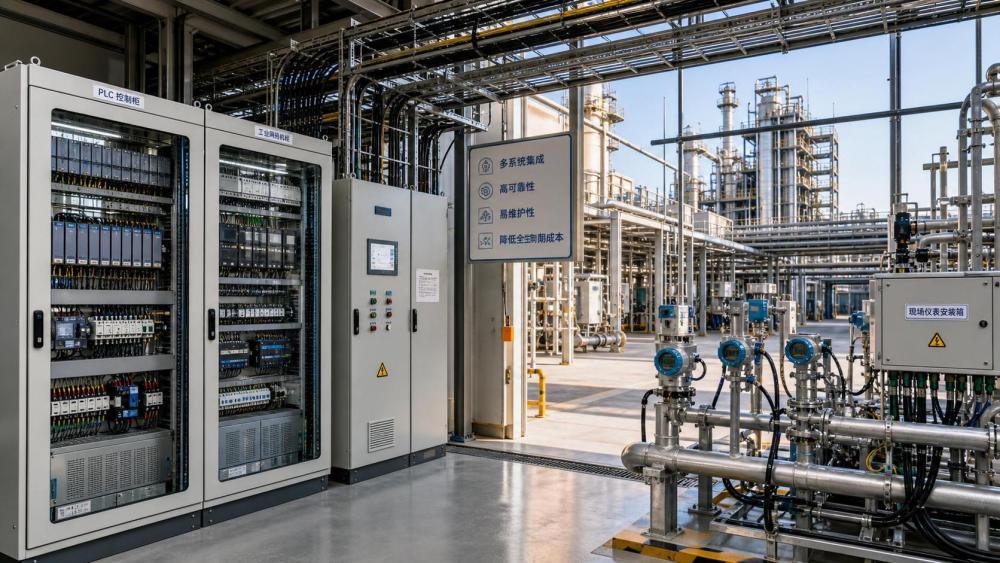
In industrial automation Middle East projects, brownfield work is where budgets most often drift. Plants in refining, petrochemicals, food processing, packaging, building materials, and utilities may need modernization without shutting down production for long periods. That creates a difficult procurement problem: the system must be integrated around existing operations, not simply installed into an empty site.
Brownfield projects often require detailed surveys, reverse engineering, shutdown windows, temporary bypasses, and staged commissioning. Even when the automation hardware itself is not complex, the coordination burden is high. Procurement should expect more engineering hours, more site visits, and more schedule risk than in a greenfield build.
There is also a commercial trap here. Suppliers may quote an attractive automation package and leave out the cost of adapting it to the plant’s real condition. Once现场 work starts, undocumented panels, obsolete protocol converters, and inconsistent tag naming can all trigger revisions. If the tender package does not define ownership of these issues clearly, the buyer ends up paying for discovery later.
Standardization reduces cost, but only when it is real
Many suppliers argue that using one brand across PLCs, drives, HMIs, and networking products lowers integration cost. That can be true, but only when the plant is genuinely standardized. If the project still needs multiple machines, imported subsystems, and third-party process equipment, the brand advantage is limited.
The real savings come from reducing complexity at the architecture level: fewer protocol translations, fewer custom scripts, fewer engineering exceptions, and fewer training paths for operators and maintenance teams. A tightly defined standard is more valuable than a broad brand preference.
Procurement should ask whether the proposed standard is being used to simplify support or simply to lock the buyer into one ecosystem. Those are not the same thing. A proprietary stack may reduce initial integration effort, but it can raise lifecycle cost if spare parts, software licensing, or future expansion become vendor-dependent.
Regional conditions change the math
The Middle East is not one procurement environment. Integration cost differs by country, sector, site type, and ownership model. A new logistics-linked factory in a free zone will not face the same constraints as a remote mining operation, a municipal utility, or an oil and gas brownfield site.
Two regional factors matter particularly often. First, many projects depend on imported equipment and international engineering teams, which adds shipping, travel, and coordination cost. Second, local content expectations and in-country service capability can affect both bid evaluation and long-term support structure. Buyers should verify whether the integrator has real local resources or only a sales presence.
Schedule pressure is another cost multiplier. Fast-track projects often compress design review, FAT, and commissioning windows. That increases the chance that issues will be solved on site rather than in engineering, which is always more expensive. In procurement terms, an aggressive delivery date should be treated as a cost item, not a free benefit.
What should be included in a serious bid comparison
A useful bid comparison for industrial automation should go beyond hardware price and include scope clarity, commissioning assumptions, and support structure. At minimum, procurement teams should compare the following:
- Hardware scope, including panels, I/O, drives, sensors, and network equipment
- Software scope, including licenses, engineering tools, SCADA screens, and data integration
- Interface scope, especially connections to MES, ERP, safety systems, and utilities
- Testing scope, including FAT, SAT, simulation, and acceptance criteria
- Commissioning scope, including number of engineers, duration, and travel assumptions
- Training scope, including operator, maintenance, and administrator training
- Documentation scope, including as-builts, manuals, and source code handover
- Warranty and support scope, including response time and local service coverage
A bid that looks cheaper may simply be narrower. That is not savings; it is unpriced risk.
Cost control starts before tendering
The strongest cost control happens before the RFQ is issued. If the plant owner cannot clearly define the operating logic, the interface boundaries, the shutdown windows, and the acceptance criteria, then suppliers will quote defensively or leave gaps. Both outcomes hurt the buyer.
For procurement teams, the practical move is to force early clarity on four points: what must be automated, what must stay untouched, what data must be shared, and who owns commissioning failures. Once these are agreed, the buyer can compare integrators on the basis of execution quality rather than guesswork.
This is especially important in projects that involve mixed vendor environments. If the site already contains different generations of equipment and control platforms, integration cost should be budgeted as an engineering program, not as a simple equipment purchase. Treating it as a procurement-only exercise usually produces incomplete scope and later escalation.
What buyers should expect from suppliers
Suppliers that understand industrial automation Middle East projects should be able to explain not only what they will deliver, but how they will reduce integration risk under local conditions. That means showing their assumptions about ambient conditions, local support, protocol compatibility, commissioning resources, and spare parts strategy.
They should also be specific about exclusions. If the proposal is silent on panel modifications, network security hardening, or third-party equipment integration, those omissions should be assumed to cost more later. Buyers should not reward vague offers simply because the initial number is low.
In mature procurement processes, the best automation supplier is not the one with the broadest product portfolio. It is the one that can make the project predictable: clear scope, credible schedule, realistic support, and a clean handover. In this region, that discipline is often what separates a manageable integration budget from a project that keeps revisiting the same line items long after start-up.
For procurement teams, that is the real decision point. Integration cost is not just the price of making systems talk to each other. It is the price of making them work reliably under the conditions the plant will actually face.
Related News
 What is driving consolidation in the global equipment supplier market?IEG Heavy Machinery & Automation AnalystGlobal equipment supplier market consolidation is accelerating through technology, service, and supply-chain demands. Discover how buyers can capture value while managing risk.
 When does capital equipment investment pay back in manufacturing?IEG Heavy Machinery & Automation AnalystCapital equipment investment manufacturing: learn when equipment truly pays back by evaluating full costs, cash flow, ramp-up, operational risks, and lifecycle value.
 When does a distribution center need an automated pallet handling system?Heavy Lifting Systems AnalystPallet handling systems help distribution centers overcome labor shortages, bottlenecks, safety risks, and storage constraints. Discover the key signs it’s time to automate.
 How to build a machinery investment plan around payback periodIEG Heavy Machinery & Automation AnalystMachinery investment planning manufacturing guide: build a credible payback plan with full costs, ramp-up assumptions, lifecycle risks, and scenario-based cash benefits.
 How to Specify a Modular Packaging Line for Fast Changeovers and Scalable OutputRobotics EngineerModular packaging line specification guide: achieve faster changeovers, scalable output, reliable controls, and lower lifecycle costs with practical planning.
 How industrial IoT devices reduce unplanned downtime in factoriesRobotics EngineerIndustrial IoT devices help factories detect early equipment issues, plan maintenance, and reduce costly unplanned downtime before production is disrupted.
 What is driving industrial machinery market demand in manufacturing?IEG Heavy Machinery & Automation AnalystIndustrial machinery market manufacturing demand is rising as factories pursue automation, energy efficiency, resilient supply chains, and lifecycle productivity gains.
 316L Stainless Steel Pipe Tube Technical Factors That Shape Buyer DecisionsCNC Machining AnalystA technical analysis for 316L stainless steel pipe tube buyers, covering corrosion expectations, pipe route choice, tolerance, surface, and inspection.
 How ground conditions determine crawler piling equipment selectionConstruction Equipment SpecialistCrawler piling equipment selection starts with ground conditions. Learn how soil, rock, groundwater and site constraints shape safer, more productive piling solutions.
 3300mm CNC Beam Saw Sheet Capacity: Layout Checks Before PurchaseCNC Machining AnalystZhongding ZD330 beam saw specifications: assess 3300mm sheet capacity, layout clearances, handling flow, and acceptance checks before buying.
 How Bucket Chain Diamond Dredgers Meet ISO 12100 Safety Requirements in Alluvial Mining ProjectsMining Infrastructure ExpertBucket chain diamond dredger safety made real: how ISO 12100 compliance ensures operator protection, reliability & zero lost-time injuries in alluvial mining.
 Modular Packaging for High-Mix Automotive Assembly Lines: How Standardized Load Units Reduce Line Changeover Time by 37% — Case Study from Tier-1 Supplier in GuangdongHeavy Lifting Systems AnalystModular packaging slashes automotive line changeover time by 37%—discover how standardized load units boost OEE, cut labor costs, and enable seamless high-mix assembly.