Pneumatic Automation Cost Breakdown: What Drives Total System Spend?




Why does pneumatic automation cost often exceed the quoted component price?
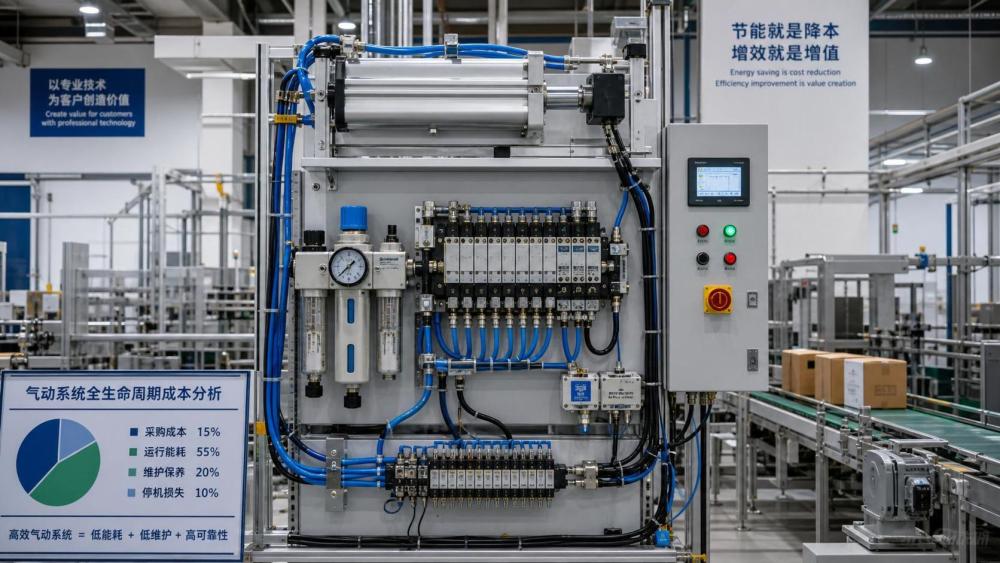
Pneumatic automation cost rarely begins and ends with cylinders, valves, and air treatment units.
The quoted hardware price is only one layer of total system spend.
In real projects, cost expands through air supply design, controls integration, installation labor, commissioning, maintenance planning, and production risk.
That is why two systems with similar actuator counts can produce very different investment outcomes.
A packaging line, a metalworking cell, and a material handling station may all use pneumatics, yet their cost structures differ sharply.
The biggest reason is that pneumatic automation cost is tied to system architecture, not just parts count.
Industrial decision support platforms such as IEG increasingly frame automation equipment this way.
The useful question is not, “How much do these components cost?”
The better question is, “What will this automation asset cost to install, run, service, and protect over its working life?”
Once that shift is made, budget approval becomes more disciplined and easier to defend.
Which cost drivers matter most when reviewing a pneumatic automation project?
A practical review starts by separating direct equipment cost from system-level obligations.
The following areas usually drive the largest share of pneumatic automation cost:
- Actuators and valves: specification, cycle rate, force requirement, and duty class change pricing quickly.
- Air preparation and distribution: filters, regulators, dryers, piping length, fittings, and pressure stability all add cost.
- Controls integration: PLC interfaces, sensors, solenoid wiring, I/O expansion, and safety logic often surprise first-time buyers.
- Mechanical design: custom brackets, guarding, manifolds, and space constraints push engineering hours upward.
- Installation and commissioning: shutdown windows, contractor rates, leak testing, and tuning affect spend and schedule.
- Operating energy: compressed air is convenient, but it is not free, especially in high-cycle systems.
- Maintenance exposure: seal wear, contamination, spare stock, and troubleshooting time matter over several years.
More complex systems usually do not become expensive because of one premium component.
They become expensive because many small technical decisions accumulate across the full installation.
A quick review table for total system spend
This table helps translate a supplier quote into a broader cost conversation.
Is compressed air operating cost really a major part of pneumatic automation cost?
In many facilities, yes.
Compressed air is one of the most overlooked contributors to pneumatic automation cost.
It feels inexpensive because the air network already exists.
The hidden issue is that every fast cycle, pressure drop, leak, and oversized actuator raises energy demand.
In actual use, poor air efficiency can outgrow the initial hardware savings that made pneumatics attractive.
This matters even more where lines run continuously or across multiple shifts.
A low-entry-cost design may become a high-utility-cost asset.
A sensible approval review asks for a basic air consumption estimate, compressor impact statement, and leak management plan.
Without those numbers, total pneumatic automation cost is incomplete.
More mature industrial evaluations now treat compressed air like any other operating utility.
That approach aligns with how capital equipment is increasingly assessed across global manufacturing and production systems.
When does design complexity push costs higher than expected?
The price curve usually rises when a simple motion task becomes an integrated production function.
For example, clamping or pushing parts sounds straightforward.
But once the application needs synchronized motion, position sensing, safety guarding, contamination protection, and traceable performance, engineering hours increase fast.
That is where pneumatic automation cost often shifts from catalog pricing to project pricing.
The same pattern appears in heavy machinery support systems, packaging lines, assembly cells, and process equipment auxiliaries.
Applications with vibration, dust, washdown, or high ambient temperature also require better sealing and more careful component placement.
Needle adjustments, special manifolds, and service access points may look minor on drawings.
They are not minor once fabrication and commissioning begin.
A reliable way to control this is to ask for design assumptions in writing.
- What cycle rate is the system sized for?
- What air quality level is required?
- Which parts are standard, and which are custom fabricated?
- What performance guarantee applies at production speed?
If these points remain vague, the final installed cost can drift well beyond the original estimate.
How should pneumatic automation cost be compared with electric or hybrid alternatives?
The right comparison is not based on component price alone.
Pneumatics often win on simplicity, speed, and clean force generation for repetitive motion.
Electric motion may win where precision, programmability, and energy control are more valuable.
Hybrid layouts are increasingly common because many production systems need both.
The useful comparison should include five questions:
- How many cycles per shift are expected?
- Is repeatable positioning important, or is end-stop motion enough?
- Does the site already have efficient compressed air capacity?
- What is the cost of downtime if a motion device fails?
- Will future line changes require flexible reprogramming?
Sometimes a pneumatic solution remains the lowest-risk option even if energy cost is higher.
In other cases, a cheaper pneumatic starting point creates long-term expense because the application actually needs electric precision.
That is why lifecycle comparison matters more than entry price comparison.
What hidden risks usually distort the budget after approval?
Budget overruns usually come from omissions, not from dramatic technical failures.
Several blind spots appear repeatedly in pneumatic automation projects.
- Existing compressors are assumed to have spare capacity, but pressure stability drops after startup.
- Leak detection is ignored, so operating cost rises quietly over time.
- Installation routing is harder than expected because of crowded equipment layouts.
- Spare parts strategy is postponed, causing long stops when a valve island or seal kit fails.
- Operator and maintenance training are excluded from the original budget.
- Acceptance criteria are unclear, so commissioning drags into production time.
These issues are common across automation, factory equipment, and broader capital asset investments.
They are especially relevant where uptime, throughput, and service response affect commercial performance.
A stronger approval process asks suppliers to separate base scope from exclusions.
That single step often reveals the real pneumatic automation cost more clearly than a lower headline quote.
What is a practical way to judge value before making the final decision?
The most useful method is a simple lifecycle screen.
Start with the installed price, then add expected energy use, maintenance exposure, spare stock, and estimated downtime impact.
After that, compare the result against output improvement, labor reduction, defect reduction, or safety gains.
This is how pneumatic automation cost becomes a business decision instead of a component purchase.
It also reflects the way structured industrial intelligence platforms evaluate equipment markets and long-term asset value.
Before approval, it helps to confirm these points in one internal review note:
- Expected annual air and power cost
- Required shutdown time for installation
- Critical spare parts and lead times
- Planned maintenance intervals
- Performance assumptions behind return estimates
If any of those items are missing, the financial picture is still incomplete.
In simple terms, pneumatic automation cost is driven by design choices, utility demand, installation realities, and reliability over time.
The next step is to compare proposals using the same cost structure, not just the same equipment list.
That makes it easier to judge risk, defend the investment, and avoid expensive surprises after the system goes live.
Related News
 What is driving consolidation in the global equipment supplier market?IEG Heavy Machinery & Automation AnalystGlobal equipment supplier market consolidation is accelerating through technology, service, and supply-chain demands. Discover how buyers can capture value while managing risk.
 When does capital equipment investment pay back in manufacturing?IEG Heavy Machinery & Automation AnalystCapital equipment investment manufacturing: learn when equipment truly pays back by evaluating full costs, cash flow, ramp-up, operational risks, and lifecycle value.
 When does a distribution center need an automated pallet handling system?Heavy Lifting Systems AnalystPallet handling systems help distribution centers overcome labor shortages, bottlenecks, safety risks, and storage constraints. Discover the key signs it’s time to automate.
 How to build a machinery investment plan around payback periodIEG Heavy Machinery & Automation AnalystMachinery investment planning manufacturing guide: build a credible payback plan with full costs, ramp-up assumptions, lifecycle risks, and scenario-based cash benefits.
 How to Specify a Modular Packaging Line for Fast Changeovers and Scalable OutputRobotics EngineerModular packaging line specification guide: achieve faster changeovers, scalable output, reliable controls, and lower lifecycle costs with practical planning.
 How industrial IoT devices reduce unplanned downtime in factoriesRobotics EngineerIndustrial IoT devices help factories detect early equipment issues, plan maintenance, and reduce costly unplanned downtime before production is disrupted.
 What is driving industrial machinery market demand in manufacturing?IEG Heavy Machinery & Automation AnalystIndustrial machinery market manufacturing demand is rising as factories pursue automation, energy efficiency, resilient supply chains, and lifecycle productivity gains.
 316L Stainless Steel Pipe Tube Technical Factors That Shape Buyer DecisionsCNC Machining AnalystA technical analysis for 316L stainless steel pipe tube buyers, covering corrosion expectations, pipe route choice, tolerance, surface, and inspection.
 How ground conditions determine crawler piling equipment selectionConstruction Equipment SpecialistCrawler piling equipment selection starts with ground conditions. Learn how soil, rock, groundwater and site constraints shape safer, more productive piling solutions.
 3300mm CNC Beam Saw Sheet Capacity: Layout Checks Before PurchaseCNC Machining AnalystZhongding ZD330 beam saw specifications: assess 3300mm sheet capacity, layout clearances, handling flow, and acceptance checks before buying.
 How Bucket Chain Diamond Dredgers Meet ISO 12100 Safety Requirements in Alluvial Mining ProjectsMining Infrastructure ExpertBucket chain diamond dredger safety made real: how ISO 12100 compliance ensures operator protection, reliability & zero lost-time injuries in alluvial mining.
 Modular Packaging for High-Mix Automotive Assembly Lines: How Standardized Load Units Reduce Line Changeover Time by 37% — Case Study from Tier-1 Supplier in GuangdongHeavy Lifting Systems AnalystModular packaging slashes automotive line changeover time by 37%—discover how standardized load units boost OEE, cut labor costs, and enable seamless high-mix assembly.