When does intralogistics systems integration reduce warehouse bottlenecks




Warehouse bottlenecks rarely start with a dramatic failure. More often, they show up as small delays that keep repeating: pallets wait at inbound even though receiving is staffed, replenishment arrives late to pick faces, fork trucks cross paths with automated zones, and order release happens faster than the floor can actually move product. A site can look busy and still feel strangely uncoordinated. If you are responsible for delivery schedules, ramp-up timing, or warehouse performance during expansion, that kind of friction is difficult because no single machine appears to be “the problem.”
In many operations, the real issue is that the warehouse has grown in layers. A conveyor was added for one flow, scanners for another, a warehouse management system was configured around old slotting logic, and later an automated storage, sortation, or shuttle area was introduced without fully rethinking upstream and downstream timing. This is usually the point where intralogistics systems integration starts to matter. Not because integration sounds advanced, but because disconnected decisions eventually create physical bottlenecks, data lag, and avoidable waiting time.
A common mistake is to treat congestion as a capacity problem only. Teams often assume they need more labor, another conveyor section, extra buffer lanes, or faster equipment. Sometimes that is true. But in many warehouses, throughput is being limited by poor handoffs between systems rather than raw equipment speed. Material handling assets may be able to move faster, yet the release logic, task priority rules, exception handling, and inventory visibility are out of sync. Adding more hardware on top of that can simply move the bottleneck to another location.
When the bottleneck is really an integration issue
There are a few patterns that usually point away from a simple equipment shortfall and toward a coordination problem.
The first is when queues move around. One week the receiving dock is blocked, the next week the issue appears at pallet putaway, and later order staging becomes the pressure point. If the bottleneck shifts depending on order mix, labor allocation, or time of day, the operation may not have a stable control layer connecting flow decisions across zones.
The second is when local teams optimize their own area and the overall result still gets worse. Pickers ask for faster replenishment. Replenishment teams respond by sending more pallets. Then aisles become crowded, travel paths slow down, and outbound sorting loses rhythm because picks arrive in waves instead of in a controlled sequence. That is not just a labor issue; it is often a sign that subsystems are reacting independently.
The third is when operators rely on phone calls, spreadsheets, whiteboards, or manual status checks to keep the day moving. Temporary workarounds are normal during start-up or disruption, but if they become part of daily control, the warehouse is compensating for missing integration. People are acting as the message bus between systems.
Another warning sign is exception overload. A warehouse can process standard flow reasonably well, but anything unusual—partial pallets, damaged goods, urgent orders, slotting conflicts, blocked lanes, mixed-SKU handling—causes delays out of proportion to the event itself. That usually means the interfaces between software, equipment controls, and floor procedures were designed only for the happy path.
When these conditions appear together, intralogistics systems integration tends to reduce bottlenecks not by making one asset dramatically faster, but by making movement decisions more coherent across the whole warehouse.
Why isolated fixes often disappoint
It is tempting to solve each visible symptom separately. If picking waits for inventory, teams focus on replenishment. If conveyors back up, they tune the conveyor. If truck loading runs late, they add staging rules. The difficulty is that warehouses behave like connected flow systems. A change in release timing can affect reserve storage, aisle traffic, sorter loading, packing rhythm, and dock utilization several steps later.
That is why some improvement efforts feel successful for a short period and then fade. The local metric improves, but the warehouse loses balance elsewhere. A project can even produce more alarms and manual interventions because systems are now operating at different speeds without shared logic.
Integration reduces this mismatch when it connects not just data, but operational intent. It aligns what the warehouse management layer wants to happen, what equipment controls can physically execute, and what floor teams need to see in real time. If those three parts stay disconnected, bottlenecks return in a new form.
Where integration usually makes the biggest difference
It helps to think in handoff points rather than in equipment categories. Bottlenecks are often strongest where responsibility changes: receiving to storage, storage to replenishment, replenishment to picking, picking to packing, packing to sortation, and sortation to shipping. These transition zones are where timing errors become visible.
Inbound is one of the clearest examples. Goods arrive, but disposition rules, quality checks, labeling, location assignment, and putaway task creation are not synchronized. Pallets wait because the physical receipt has happened, while the system state is still incomplete. In that situation, more forklifts do not solve the root cause. Integration helps when dock activity, identification, storage rules, and transport task creation are coordinated as one process instead of separate steps.
Another common area is replenishment into forward picking. If reserve inventory, demand signals, and travel task priorities are loosely connected, replenishment either happens too late or in disruptive surges. A well-integrated setup does not just trigger more replenishment; it places replenishment in the right sequence relative to order release, aisle congestion, and downstream packing capacity.
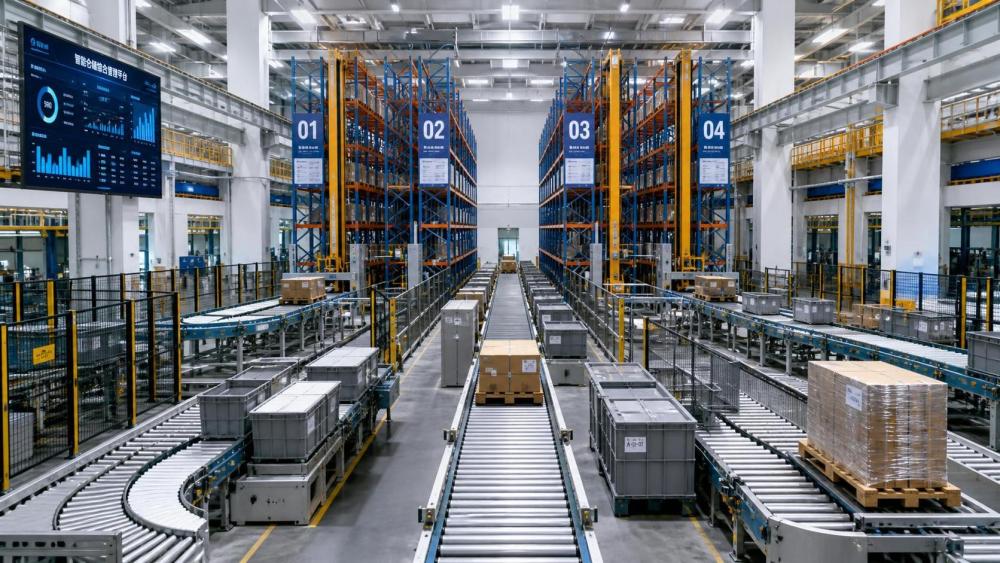
Automated and manual zones are another frequent source of trouble. A warehouse may have conveyors, AS/RS, mobile robots, shuttle systems, or sorters operating beside manual pallet movement and case picking. Each piece may work correctly on its own. The bottleneck appears when task release, route decisions, or exception recovery are not shared across those environments. Integration becomes valuable here because it reduces the dead space between systems: waiting, re-handling, duplicate scans, blocked drop points, and unclear ownership of exceptions.
Returns handling and rework areas are also easy to underestimate. These flows often sit outside the main automation path, yet they compete for labor, storage slots, and transaction accuracy. If they are not integrated into the broader intralogistics logic, they create hidden congestion that spills back into standard operations.
A more reliable way to judge timing
Not every warehouse needs a major integration project. The key question is not whether the site has multiple systems, but whether the current disconnects are already constraining execution. A practical way to judge this is to look for repeated timing loss in normal operating conditions, not only during peak events.
If queue formation is predictable at certain handoffs, if operators routinely wait for confirmations from another system before proceeding, if inventory status is technically available but not trusted on the floor, or if planners cannot see the real effect of release decisions until congestion has already formed, integration is likely to reduce bottlenecks.
Another useful test is to ask whether the site can absorb change without becoming unstable. Changes might include a new SKU profile, a packaging update, altered dispatch priorities, partial automation, dock rescheduling, or a second shift. If even moderate changes trigger cascading delays, the warehouse may be too dependent on manual coordination. In that case, integration is less about optimization and more about resilience.
Project teams should also separate peak-volume pain from structural design flaws. A warehouse that runs smoothly most of the time but struggles during very short surges may need capacity balancing or operational rules first. But if the same frictions happen in ordinary weeks, the issue is more likely embedded in system interactions.
What to review before changing anything
Before selecting software changes, controls work, or equipment interfaces, it helps to map the warehouse around events instead of departments. Follow a unit load or order through the exact moments when its status changes, who owns that change, where it is confirmed, and which system becomes the source of truth. The goal is to uncover places where physical movement and digital movement are out of step.
This review should include simple questions that are often skipped. When a pallet is scanned at inbound, what immediately becomes possible in downstream tasks? If an aisle is blocked, which system adjusts routing or priority? When an order is released, does that release account for packing, sortation, and dock readiness, or only picking availability? When an automated cell faults, who sees the impact first: controls, warehouse management, or the floor supervisor?
It is also worth reviewing exception logic early, not at the end. Warehouses rarely fail because the normal path was misunderstood. They struggle because damaged loads, unreadable labels, mixed cartons, inventory discrepancies, and urgent changes were never properly connected across systems. Any intralogistics systems integration effort that ignores exceptions tends to recreate manual workarounds under a new interface.
What a sensible integration path usually looks like
The most useful projects do not begin by trying to connect everything at once. They begin where delays are both frequent and expensive in operational terms. For one site, that may be receiving-to-putaway. For another, it is order release into mixed manual and automated picking. The point is to choose a flow boundary where better synchronization will be visible in daily work.
After that, define operating rules before technical interfaces. Teams often jump straight into system mapping, but unresolved process ownership creates confusion later. Someone needs to decide which platform triggers tasks, which one confirms completion, how priorities are assigned, what happens during exceptions, and how operators should work when one layer is temporarily unavailable.
Then the technical side can be framed more realistically: warehouse management logic, equipment control communication, sensor and scan event handling, transport task orchestration, visibility dashboards, and alarm routing. In industrial settings, especially where automation systems, industrial controls, and material handling assets have been added over time, clarity in these boundaries is more important than chasing feature lists.
For engineering and project leaders, it is often helpful to treat the integration effort as a flow-control project rather than an IT-only activity. Physical constraints, equipment behavior, maintenance access, operator actions, and software state all matter together. That mindset reduces the risk of building a clean interface that still performs poorly on the floor.
What improvement should actually look like
When integration is doing its job, the warehouse does not necessarily become dramatic or visibly “faster.” Instead, it becomes less hesitant. Tasks are released with better timing. Inventory becomes easier to trust. Automated and manual zones interfere with each other less. Exceptions are handled with fewer side conversations. Supervisors spend less time guessing where the true blockage is.
That is often the right benchmark. If a proposed change mainly promises speed but does not improve handoff quality, exception visibility, or sequence control, it may not remove the bottleneck you are seeing. Warehouses that run better usually run with fewer contradictory signals, not just more activity.
For teams evaluating next steps, the practical question is simple: is the current bottleneck caused by insufficient movement capacity, or by weak coordination between systems that already exist? When the second answer appears repeatedly, intralogistics systems integration is usually the point where effort starts to produce durable operational relief rather than another temporary workaround.
That does not mean every site needs a large transformation. It means the warehouse needs a clearer connection between physical flow, control logic, and execution priorities. Once those are aligned, bottlenecks become easier to locate, easier to contain, and much less likely to keep reappearing under a different name.
Related News
 What is driving consolidation in the global equipment supplier market?IEG Heavy Machinery & Automation AnalystGlobal equipment supplier market consolidation is accelerating through technology, service, and supply-chain demands. Discover how buyers can capture value while managing risk.
 When does capital equipment investment pay back in manufacturing?IEG Heavy Machinery & Automation AnalystCapital equipment investment manufacturing: learn when equipment truly pays back by evaluating full costs, cash flow, ramp-up, operational risks, and lifecycle value.
 When does a distribution center need an automated pallet handling system?Heavy Lifting Systems AnalystPallet handling systems help distribution centers overcome labor shortages, bottlenecks, safety risks, and storage constraints. Discover the key signs it’s time to automate.
 How to build a machinery investment plan around payback periodIEG Heavy Machinery & Automation AnalystMachinery investment planning manufacturing guide: build a credible payback plan with full costs, ramp-up assumptions, lifecycle risks, and scenario-based cash benefits.
 How to Specify a Modular Packaging Line for Fast Changeovers and Scalable OutputRobotics EngineerModular packaging line specification guide: achieve faster changeovers, scalable output, reliable controls, and lower lifecycle costs with practical planning.
 How industrial IoT devices reduce unplanned downtime in factoriesRobotics EngineerIndustrial IoT devices help factories detect early equipment issues, plan maintenance, and reduce costly unplanned downtime before production is disrupted.
 What is driving industrial machinery market demand in manufacturing?IEG Heavy Machinery & Automation AnalystIndustrial machinery market manufacturing demand is rising as factories pursue automation, energy efficiency, resilient supply chains, and lifecycle productivity gains.
 316L Stainless Steel Pipe Tube Technical Factors That Shape Buyer DecisionsCNC Machining AnalystA technical analysis for 316L stainless steel pipe tube buyers, covering corrosion expectations, pipe route choice, tolerance, surface, and inspection.
 How ground conditions determine crawler piling equipment selectionConstruction Equipment SpecialistCrawler piling equipment selection starts with ground conditions. Learn how soil, rock, groundwater and site constraints shape safer, more productive piling solutions.
 3300mm CNC Beam Saw Sheet Capacity: Layout Checks Before PurchaseCNC Machining AnalystZhongding ZD330 beam saw specifications: assess 3300mm sheet capacity, layout clearances, handling flow, and acceptance checks before buying.
 How Bucket Chain Diamond Dredgers Meet ISO 12100 Safety Requirements in Alluvial Mining ProjectsMining Infrastructure ExpertBucket chain diamond dredger safety made real: how ISO 12100 compliance ensures operator protection, reliability & zero lost-time injuries in alluvial mining.
 Modular Packaging for High-Mix Automotive Assembly Lines: How Standardized Load Units Reduce Line Changeover Time by 37% — Case Study from Tier-1 Supplier in GuangdongHeavy Lifting Systems AnalystModular packaging slashes automotive line changeover time by 37%—discover how standardized load units boost OEE, cut labor costs, and enable seamless high-mix assembly.